RBI MPC October 2026: What the Repo Rate Decision Means for Your EMI
The repo rate has sat at 5.25% since the MPC's unanimous August decision. The October meeting is the next test. Here is what actually moves when the rate does, and what a hold changes for your EMI.
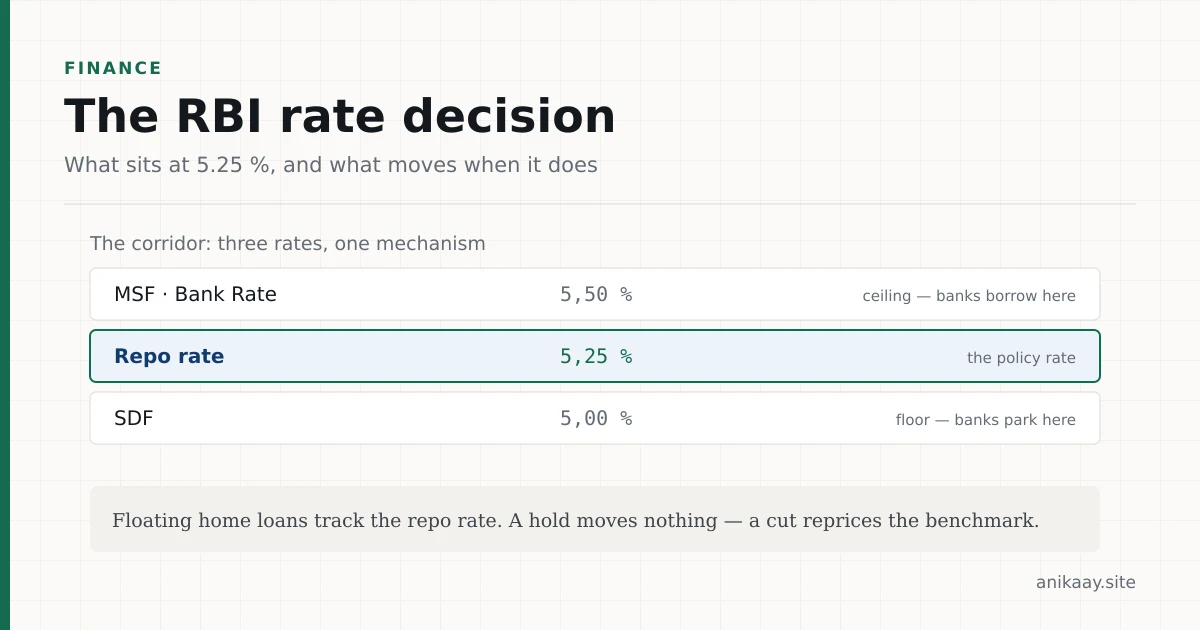
Where the rate stands today
The policy repo rate is 5.25 per cent. The Monetary Policy Committee left it there at its 62nd meeting, held 3 to 5 August 2026, and the vote to hold was unanimous.
The rates that sit alongside it:
| Rate | Level |
|---|---|
| Policy repo rate | 5.25% |
| Standing deposit facility (SDF) | 5.00% |
| Marginal standing facility (MSF) | 5.50% |
| Bank Rate | 5.50% |
The committee also chose to continue with a neutral stance, which means it is not signalling that rates need to rise, nor that they need to fall.
The next meeting runs 5 to 7 October 2026, with the decision announced on the 7th.
What the repo rate actually is
The repo rate is the rate at which the Reserve Bank lends short-term funds to banks against government securities. It is the price of the most marginal money in the banking system, and almost every other rate in the economy — home loans, auto loans, corporate credit, and eventually deposit rates — is set with reference to it.
It is not a rate you are ever offered directly. No bank will give you a “repo rate loan”. It sets the floor, and the bank adds a spread.
What moves if the rate moves
Home loans on a floating rate. Most floating home loans in India today are linked to an external benchmark, and the repo rate is the most common choice. If the repo rate falls, the benchmark falls, and the loan is repriced — usually within the following quarter, under the reset period stated in your loan agreement. This is the one place a repo change reaches a household directly and quickly.
Fixed deposits. These move much more loosely. Banks price deposits against their own funding requirements, credit growth and liquidity conditions, so FD rates can rise or fall while the repo rate is unchanged. A common misunderstanding runs in the wrong direction: a rate cut tends to push new deposit rates down, because banks need to pay less to attract funds. A cut is not good news for a depositor looking to lock in.
Existing fixed-rate loans. Nothing at all. A fixed rate is fixed. The repo rate is not a term of that contract.
The part most people get wrong
A hold does not mean your EMI is unchanged. If your loan is already on a repo-linked floating rate, a hold means the benchmark has not moved, so the bank has no benchmark reason to change your rate. That is the extent of the guarantee.
Two things sit outside that:
- The spread. Your rate is the benchmark plus a spread, and the spread is set by the bank under its own board-approved policy. It did not become part of the benchmark, and it does not change when the benchmark does.
- What your loan is linked to. If your loan predates the external benchmark regime and is still on an older internal benchmark, a repo hold changes nothing for you regardless. You can ask your lender to switch you to an external-benchmark rate, but that is an active request with its own terms, not something that happens on its own.
So the useful question is not “what did the MPC do” but “what is my loan actually linked to, and what is the spread on top of it”. Both are on your sanction letter and in your loan agreement.
Why a rate cut is not automatically good news
For a borrower with a floating loan, a cut lowers the benchmark and eventually the EMI or the tenor. For the same household’s deposit, a cut lowers what savings earn. Most Indian households hold both a loan and a deposit, so the two effects partly cancel, and which one dominates depends on the relative size and the reset timing.
There is a second effect that gets less attention: a cut can signal that growth needs support, and growth matters to whether the household’s income is secure. The rate is not only a price. It is also a statement about what the central bank thinks is happening.
What the October meeting will actually decide
Only three things can happen: a cut, a hold, or a hike. The stance can also change, and a change in stance often matters more than the decision itself, because it tells you what the committee expects to do next.
Two background facts from the August statement are worth holding onto, because they are the committee’s own framing of the risks:
- Energy prices and supply chain pressures remained elevated and uncertain.
- A deficient and uneven south-west monsoon amid El Niño conditions poses some risk to the agriculture outlook and rural demand.
Neither has a settled answer, and both bear on the inflation path the committee is judging. This article does not predict the outcome.
How to check the decision yourself
The primary source is the Reserve Bank of India’s own press release, published under Monetary Policy on the day of the decision. It states the repo rate, the SDF and MSF rates, the Bank Rate, the vote split and the stance, in a document short enough to read in full.
Three things to read in it, in this order: the rate decision, then the stance, then the vote split. A unanimous vote and a divided vote carry different information about how settled the committee’s view is, even when the rate outcome is identical.
Your bank must communicate any change to your loan terms. If you have a floating-rate loan, check the reset date in your agreement so you know when a benchmark change would reach you.
This article is general information about a published policy framework as at 2 October 2026, not financial advice for your situation. Rates and terms vary by lender, and the October decision has not yet been announced.
Topics
Frequently asked questions
What is the repo rate right now?
The policy repo rate stands at 5.25%, where the Monetary Policy Committee left it at its August 2026 meeting. The standing deposit facility rate is 5.00% and both the marginal standing facility rate and the Bank Rate are 5.50%.
When is the next RBI monetary policy decision?
The Monetary Policy Committee meets on 5, 6 and 7 October 2026. The policy decision is announced at the close of the meeting on 7 October 2026, followed by the Governor's statement.
Does a repo rate hold mean my home loan EMI stays the same?
Not automatically. If your loan is on a floating rate linked to an external benchmark such as the repo rate, a hold means your bank has no benchmark reason to change your rate. But the spread over the benchmark is set by the bank under its own policy, and switching to a repo-linked rate is an option you have to ask for, not one applied automatically.
Are fixed deposit rates likely to change?
A repo hold does not by itself move fixed deposit rates. Banks price deposits against their own funding needs, credit growth and liquidity, so deposit rates can move in either direction while the repo rate is unchanged. A cut would generally push new deposit rates down, not up.
What does a neutral stance mean?
It means the committee is neither signalling that rates need to rise to cool inflation, nor that they need to fall to support growth. It keeps both options open and is the stance the MPC adopted at its August 2026 meeting.
Is the October decision already known?
No. Nothing in this article should be read as a forecast of the decision. The outcome is announced on 7 October 2026, and the verified position as of 2 October 2026 is that the repo rate is 5.25% with a neutral stance.
Sources and references
- Monetary Policy Statement, 2026-27 — Resolution of the Monetary Policy Committee, August 3 to 5, 2026 — Reserve Bank of India, accessed 2026-10-02
- Monetary Policy — minutes, statements and press conference transcripts — Reserve Bank of India, accessed 2026-10-02