Depo-Provera MDL 3140 Settlement Program: What the Court Orders Say
Judge Rodgers has entered orders appointing a settlement administrator and setting the terms of a private Depo-Provera settlement program. Eligible claimants must register by November 30, 2026. Terms and per-claim amounts are confidential.
The short version
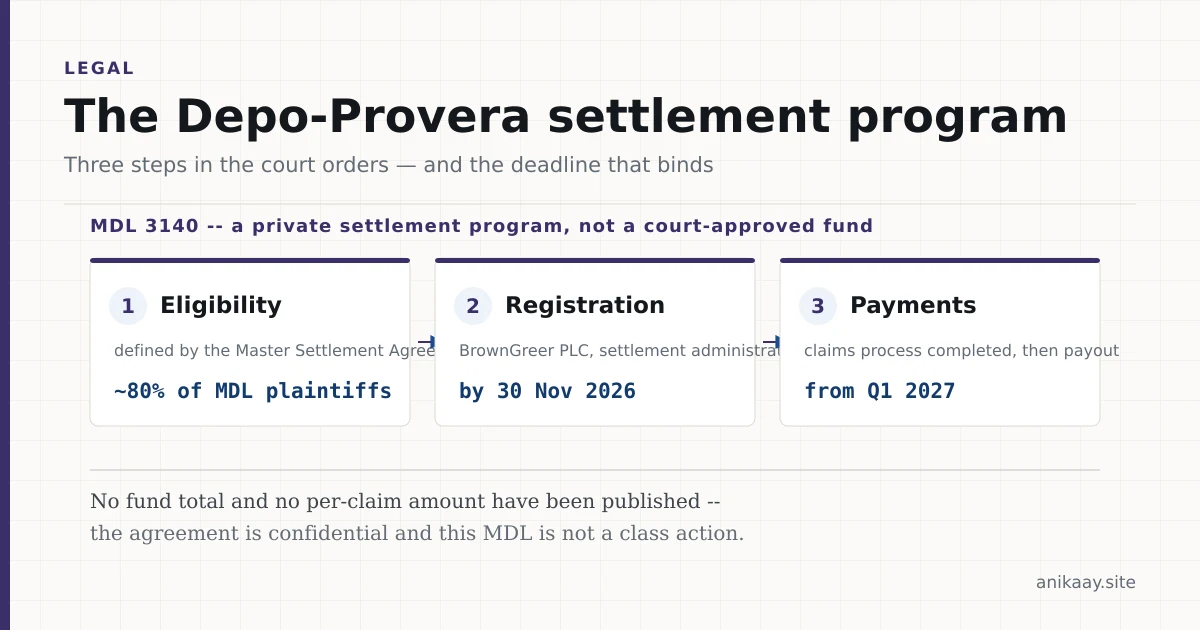
A settlement covering a majority of the Depo-Provera claims in the federal multidistrict litigation is real, and the court record now shows how it is meant to work. Plaintiffs’ leadership counsel announced the settlement at a hearing on June 15, 2026. The parties signed a Master Settlement Agreement on July 21, 2026, and Judge M. Casey Rodgers has since entered orders appointing a settlement administrator and setting the machinery of a claims process in motion. The registration deadline for eligible claimants is November 30, 2026, and the parties have represented that payments would begin rolling out by the first quarter of 2027.
What the record does not show matters just as much. The agreement is private and confidential. No aggregate settlement fund figure has been disclosed, and no per-claim payout grid has been published. Roughly 80% of MDL plaintiffs are expected to be eligible, which means the settlement does not end the litigation — it removes most claims from it and leaves the rest to proceed.
This article is built from the court’s own orders in MDL No. 3140, which is why it can be precise about the things the record covers and explicit about the things it does not.
What the court actually entered
The docket gives a clean sequence, and it is worth reading in order rather than as headlines:
- June 15, 2026 — Pretrial Order No. 30A (ECF No. 661). The court supplemented its earlier PTO 30 because of “the agreement entered into by Plaintiffs’ Lead Counsel and Defendants Pfizer Inc., Pharmacia LLC, and Pharmacia & Upjohn Co. LLC,” under which, the court wrote, all plaintiffs who meet eligibility criteria agreed by the parties “will have an opportunity to resolve their claims.” Critically, the order explains that the agreement “once finalized, will not resolve all cases in the MDL.” The court postponed ruling on the defendants’ federal preemption motion and continued the Rule 702 expert-admissibility hearing.
- July 27, 2026 — the twelfth case management conference, memorialised in Case Management Order No. 12 (ECF No. 701). The court recorded that leadership counsel had announced a settlement of a majority of the claims in the MDL and New York state court, and that a Master Settlement Agreement had been signed on July 21, 2026. The court vacated the scheduling order for the pilot cases and cancelled the December trial, because those plaintiffs were eligible to participate.
- August 5, 2026 — Case Management Order No. 13 (ECF No. 711). The court appointed BrownGreer PLC as settlement administrator, with responsibility for eligibility determinations, document review, coordination with a qualified settlement fund administrator, and fraud protection.
- August 10, 2026 — Case Management Order No. 14 (ECF No. 738). The court set the registration deadline of November 30, 2026, stayed all MDL proceedings except the settlement work and defined exceptions, and defined who counts as a Litigating Plaintiff going forward.
- September 4, 2026 — Case Management Orders Nos. 15, 16 and 17. Three more appointments: an allocation master for a Supplemental Compensation Fund, a qualified settlement fund administrator, and a lien resolution administrator.
That is the whole of it, and it is more than enough to explain where this litigation stands. Read as a set, the orders describe a settlement being administered, not a trial being won.
Why the stage matters
This is a mass tort settlement in a non-class MDL, and that distinction changes what “settled” means. Because MDL 3140 is not a class action, the court recorded in Case Management Order No. 12 that the settlement is “not subject to a fairness determination by the Court.” There is no preliminary-approval hearing, no notice-and-objection cycle, and no final-approval order of the kind that would precede a class settlement. The court’s orders here are administrative: they appoint the people who will run the process.
Two consequences follow, and both are routinely blurred in coverage of this case:
- A settlement program is not a court-approved settlement fund. The agreement is between plaintiffs’ leadership counsel and the defendants. The court has overseen its implementation but has not, in the orders reviewed for this article, ruled on its terms.
- Confidentiality is a feature of the agreement, not an oversight by the court. Case Management Order No. 12 records that the settlement is “a private agreement governed by a confidentiality agreement,” and the court stated it would enforce that agreement. That is the reason no fund total or payout grid appears in the public record.
Anyone describing this case as a court-approved payout of a specific sum is describing something the orders do not contain.
Eligibility, and who is left out
Case Management Order No. 12 records the parties’ estimate that “roughly 80% of all MDL Plaintiffs will be eligible.” Eligibility is defined by the Master Settlement Agreement, not by the court, and the court recorded the parties’ position that eligibility “will not be impacted by any future Court ruling on the legal issues that remain outstanding.”
Case Management Order No. 14 defines the categories of plaintiffs who are not in the program, and the definitions matter to anyone trying to understand whether the litigation is over:
- Non-Settling Plaintiffs — those eligible to participate who choose not to.
- Ineligible Plaintiffs — those not eligible and permitted to participate, other than the two categories below.
- Limitations Plaintiffs — those not eligible “because of the date on which they commenced their action against Defendants.”
- Latency Plaintiffs — those not eligible “because of the timing of the individual’s meningioma diagnosis relative to their last use of an MPA Product.”
- Future Filed Plaintiffs — those whose cases are filed in, removed to, or transferred into the court after the order.
The same order created a narrow administrative docket, limited to plaintiffs who signed engagement letters with counsel on or before June 11, 2026 and who are eligible to participate in the program. That is a gate, not an open register.
What is still being litigated
The settlement does not extinguish the science question. The court itself made that point: in PTO 30A it said it anticipated proceeding with the Rule 702 hearing and ruling on the expert-admissibility motions “in the ordinary course” precisely because the agreement would not resolve every case.
Two issues remain live for claims outside the program:
- General causation — whether the plaintiffs’ experts may testify that Depo-Provera causes meningioma. Case Management Order No. 12 records that the parties had fully briefed their general causation summary judgment and Rule 702 motions, and PTO 30A continued the evidentiary hearing.
- Federal preemption — the defendants’ motion for summary judgment on the ground that federal law barred the plaintiffs’ failure-to-warn claims. The court postponed its ruling in PTO 30A in light of the agreement.
Case Management Order No. 12 explains the logic: those rulings “will not impact those Plaintiffs who are eligible for and elect to participate in the Settlement,” but they will govern cases that are ineligible or opt out. State court proceedings continue in parallel in New York, Delaware, California and elsewhere.
The case count
The Judicial Panel on Multidistrict Litigation, which publishes its pending-MDL statistics on the first business day of each month, reported 6,412 actions pending in MDL 3140 as of October 1, 2026, out of 6,524 total actions historically transferred to the docket. That is the count to use. Case counts circulating elsewhere — including a figure of about 6,289 that appears in the court’s own July and August orders — describe earlier moments in the docket, and the JPML report is the current primary source.
For context, MDL 3140 was created on February 7, 2025, when the JPML centralised meningioma claims into the Northern District of Florida before Judge Rodgers. The JPML defined the common questions as whether Depo-Provera causes meningioma, whether the defendants knew of the alleged risk, whether they failed to warn of it, and whether they failed to promote safer alternatives.
What happens next
- November 30, 2026 — the registration deadline for eligible claimants (Case Management Order No. 14).
- First quarter of 2027 — the parties’ representation, recorded in Case Management Order No. 12, that the claims process would be completed and payments would begin to roll out.
- Ongoing — the court’s rulings on preemption and Rule 702, which will apply to claims outside the settlement. Case Management Order No. 12 also placed three new pilot cases on an expedited statute-of-limitations track.
- November 1, 2026 — the JPML’s next monthly report, which will show the case count at the point the registration deadline is reached.
What this article does not tell you
It does not tell you whether you have a claim, whether you are eligible for the settlement program, or whether you should register. Those questions turn on facts specific to one person — when they used the product, when a diagnosis was made, what the agreement’s eligibility criteria provide — and on law that this article does not apply. The court has defined the categories; it has not published a rule of thumb. If you are trying to decide what to do before November 30, that is a conversation with a lawyer who has your medical and product-use history, not a decision to make from an article.
This is not legal advice, and nothing here creates an attorney-client relationship.
Topics
Frequently asked questions
Is the Depo-Provera settlement final?
A settlement of a majority of the claims was announced by plaintiffs' leadership counsel at a June 15, 2026 hearing, and the court's Case Management Order No. 12 records that a Master Settlement Agreement was signed on July 21, 2026. The court's own orders describe it as a private agreement governed by a confidentiality agreement between the parties. It is not a class action, so there is no court fairness hearing or final approval order of the kind a class settlement would require — the court's role here has been to appoint administrators and manage the litigation that remains.
How much will each claim receive?
No per-claim amount has been published. The settlement is confidential, and the court orders in the record disclose no aggregate fund figure and no payout grid. Anything quoted as a specific per-claim payment is a number the court record does not support. Eligibility is determined by the settlement administrator under criteria in the agreement itself.
Who is eligible to participate?
According to Case Management Order No. 12, the eligibility terms are set in the Master Settlement Agreement, and the parties estimated that roughly 80% of MDL plaintiffs would be eligible. The court recorded that eligibility would not be affected by any later ruling on the outstanding legal questions. The court defined several categories of plaintiffs who are not eligible, including Limitations Plaintiffs and Latency Plaintiffs.
What is the deadline to register?
Case Management Order No. 14, entered August 10, 2026, records that the deadline for claimants to register to participate in the Settlement Program is November 30, 2026. Case Management Order No. 12 records the parties' representation that payments would begin rolling out by the first quarter of 2027. Whether a particular person should register is a question for their own lawyer, not for this article.
What happens to claims that do not settle?
The court has stayed all proceedings in the MDL except for the settlement work, three pilot cases on a statute-of-limitations track, and matters concerning plaintiffs ineligible for the program. Case Management Order No. 14 sets out continued litigation obligations for what it calls Litigating Plaintiffs — those who are not participating, are ineligible, or file later. The court has said it will rule on the pending preemption and Rule 702 expert-admissibility motions for the benefit of cases outside the settlement.
Sources and references
- Pretrial Order No. 30A (ECF No. 661, filed June 15, 2026) — U.S. District Court for the Northern District of Florida, accessed 2026-10-03
- Case Management Order No. 12 (ECF No. 701, filed July 27, 2026) — U.S. District Court for the Northern District of Florida, accessed 2026-10-03
- Case Management Order No. 13 — Appointment of Settlement Administrator (ECF No. 711, filed August 5, 2026) — U.S. District Court for the Northern District of Florida, accessed 2026-10-03
- Case Management Order No. 14 — Case Management Order for Ongoing Litigation (ECF No. 738, filed August 10, 2026) — U.S. District Court for the Northern District of Florida, accessed 2026-10-03
- Depo-Provera Products Liability Litigation, MDL No. 3140 — Orders by Date — U.S. District Court for the Northern District of Florida, accessed 2026-10-03
- MDL Statistics Report — Distribution of Pending MDL Dockets by Actions Pending (October 1, 2026) — U.S. Judicial Panel on Multidistrict Litigation, accessed 2026-10-03
Ask about this case
Depo-Provera MDL 3140 Settlement Program: What the Court Orders Say