Johnson & Johnson Talc Settlement: What the Proposed $5.5 Billion Deal Does
J&J has offered $5.5 billion to resolve roughly 76,000 remaining ovarian talc claims — but the deal is a proposal, not a settlement, and it is conditional on near-universal participation.
The short version
On July 27, 2026, Johnson & Johnson announced a proposed $5.5 billion resolution of the remaining ovarian talc litigation, covering roughly 76,000 claims in the federal multidistrict litigation and related state court proceedings. The company filed the announcement as an exhibit to a document with the Securities and Exchange Commission.
Three things about that announcement are easy to get wrong, and all three matter.
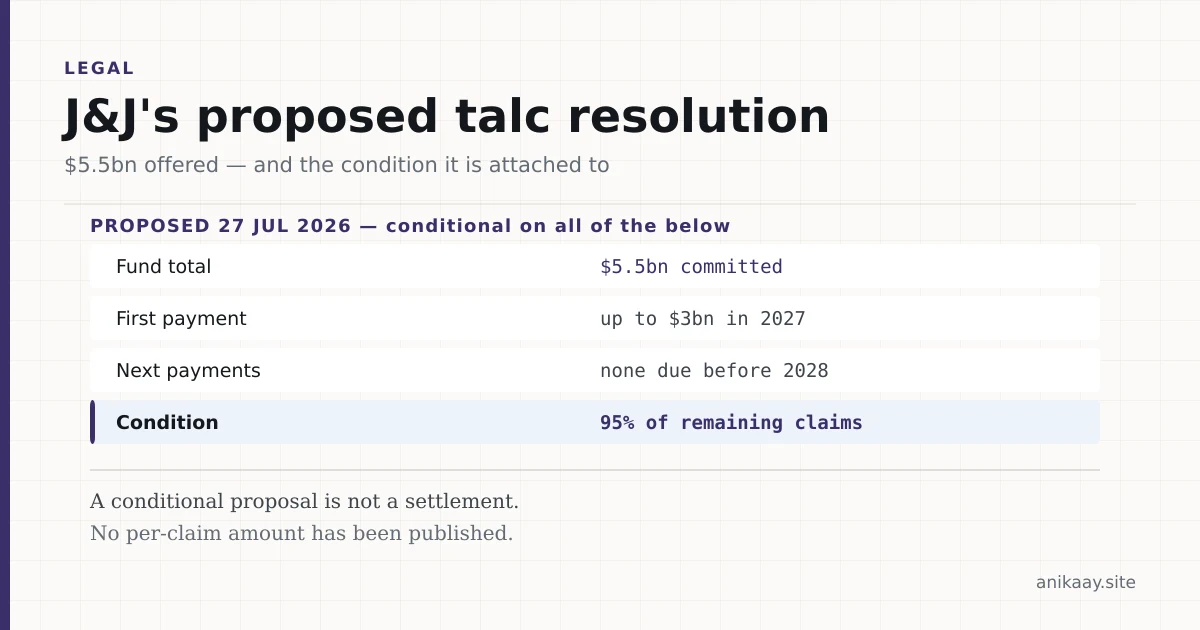
It is a proposal, not a settlement. Johnson & Johnson’s filing calls it an agreement for a comprehensive resolution, conditioned on criteria that include the express participation of plaintiff firms representing at least 95% of the remaining claims. A deal that has not met its own participation condition has not settled anything yet.
No per-claim figure has been published. The $5.5 billion is a company commitment, and the filing describes per-claim payments funded by it. It is not an amount anyone receives. The first payment is described as no more than $3 billion in 2027, with no additional payments due before 2028.
The largest mass tort in the country is still moving. According to the Judicial Panel on Multidistrict Litigation’s October 1, 2026 report, MDL 2738 had 69,340 actions pending — by some distance the largest of the 162 active federal MDLs, which together had 204,977 actions pending.
What actually happened
The announcement followed a ruling in the federal MDL. On July 22, 2026, the court ordered plaintiffs to show why the remaining pending talc claims should not be dismissed for inability to prove specific causation — the link between one person’s use of a talc product and that person’s own cancer.
Johnson & Johnson’s account of how it got there is that plaintiffs withdrew their specific-causation experts in two bellwether cases after a hearing the company says demonstrated the opinions were not based on reliable scientific methodologies.
That account is the company’s, and it should be read as such. But the underlying sequence is the kind of thing that happens in litigation: a judge asks a party to explain its case with evidence, and when the evidence is withdrawn, the party faces a motion about whether anything is left to prove.
The distinction that gets collapsed most often
There are two different scientific questions in this litigation, and the settlement announcement turns on the difference between them.
General causation asks whether a substance can cause a disease at all — whether talc is capable of causing ovarian cancer in some meaningful sense.
Specific causation asks whether this product caused this person’s cancer. It is a far narrower question, and it has to be answered case by case with evidence particular to the individual.
The July 22 order, as described by the company, went to specific causation. Plaintiffs alleging that talc products caused their ovarian cancer still have to show their own case. The company, in its filing, says the order confirms “that these claims lack scientific merit.” That is a characterisation of a ruling on specific causation, and it is worth holding loosely: a court requiring proof of specific causation is not the same thing as a court ruling that no claimant could ever establish causation, and the difference is the entire question for the 69,340 cases still pending.
Why the 95% condition is the whole story
The deal is conditioned on participation representing at least 95% of remaining claims. That threshold does an enormous amount of work, and it cuts in a direction that is easy to miss.
A conditional settlement with a high participation threshold is a device for resolving doubtful claims. It lets a defendant pay a known sum and walk away from the tail. It also puts pressure on everyone else: the people whose claims are weakest have the most reason to be skeptical of a grid that might not pay them what their lawyers think their case is worth, and the people whose claims are strongest have the most to lose by leaving a negotiated number on the table.
That is a structural feature of how mass torts settle, not a criticism of it. It is also why “is it settled” and “will I be paid” are separate questions with separate answers here, and why anyone telling you what a talc claim is worth right now is describing a grid that has not been published and may never pay out at all if participation falls short.
What is not covered
The proposal addresses ovarian cancer claims. Mesothelioma claims are a separate track on a separate timetable; Johnson & Johnson states it has previously settled about 95% of filed mesothelioma lawsuits. Consumer-protection claims and talc-supplier disputes are described as already resolved. A resolution of one category is not a resolution of the others.
Where the litigation actually stands
As of the Judicial Panel’s October 1, 2026 report, the largest active federal mass torts by number of pending actions were:
| MDL | Litigation | Court | Pending actions |
|---|---|---|---|
| 2738 | Johnson & Johnson talc powder | D.N.J. | 69,340 |
| 2846 | Davol / C.R. Bard polypropylene hernia mesh | S.D. Ohio | 23,324 |
| 2873 | Aqueous film-forming foams (PFAS) | D.S.C. | 15,264 |
| 3060 | Hair relaxer | N.D. Ill. | 12,381 |
| 2789 | Proton-pump inhibitors (No. II) | D.N.J. | 11,404 |
| 2666 | Bair Hugger forced air warming | D. Minn. | 8,424 |
Those are counts of cases filed in federal court, not verdicts, not settlements, and not claims. A case that settles is still a case that was filed. The same report lists 14 MDLs terminated between January 1 and October 1, 2026, including the Smith & Nephew Birmingham Hip Resurfacing litigation, which closed on September 28.
What to watch
- Whether the 95% participation threshold is met. Until it is, the proposal is a proposal.
- Whether the terms — grid, payment schedule, eligibility rules — are published, and what they say about who is inside and outside the fund.
- What happens to the cases of claimants who do not participate if the deal clears.
- Court approval. A private agreement between companies and plaintiff firms is not a court-approved fund until a court says so.
The bottom line
Johnson & Johnson has offered $5.5 billion to end the largest mass tort in the federal system, and it did so by filing with the SEC. That is a real event with real money attached. It is also a conditional offer to pay an unpublished amount under an unpublished grid to people who have not yet been through a court approval process, on a track where the company’s own filing says the leading plaintiffs withdrew their causation experts.
Both of those things are true. The honest reading is that a very large number is on the table, and that “on the table” is doing a lot of work.
This article reports public court records and a company’s regulatory filing. It is general information, not legal advice, and it is not a recommendation about any claim. Whether you have a claim, and what any deadline applies to you, depends on facts and law specific to your situation — talk to a lawyer who can assess it. If you are looking at a deadline, treat this article as a prompt to get advice, not as the deadline itself.
Topics
Frequently asked questions
Is the Johnson & Johnson talc settlement final?
No. As of October 2, 2026, what exists is a proposed resolution that Johnson & Johnson announced on July 27, 2026. The company's own filing describes it as an agreement conditioned on criteria including the participation of plaintiff firms representing at least 95% of remaining claims. A conditional proposal that has not cleared its own participation threshold is not the same thing as a court-approved settlement fund paying claims.
How much would each talc claim receive?
The proposal describes per-claim payments under a $5.5 billion commitment, with the first payment of no more than $3 billion to be made in 2027 and no additional payments due before 2028. Those are fund-level figures. No per-claim amount has been published, and an individual payout would depend on the claim's own facts and the payment grid. Anyone telling you a specific figure is quoting a number the record does not support.
What did the court decide about talc causing ovarian cancer?
The most recent development the company cited is a July 22, 2026 order in MDL 2738 directing plaintiffs to show why the remaining claims should not be dismissed for failure to prove specific causation — that is, that a particular claimant's cancer was caused by that claimant's talc use. The company characterises the order as favourable to it. That is the company's characterisation of a ruling that, on the company's own account, followed plaintiffs withdrawing their specific-causation experts in two bellwether cases. A dispute about general causation is not the same as a ruling that no claimant can ever establish causation.
Does this cover mesothelioma claims?
The proposed resolution concerns ovarian cancer claims. Johnson & Johnson states separately that it has previously settled about 95% of filed mesothelioma lawsuits. Those are different claim types on different tracks, and a resolution of one does not resolve the other.
Do I still have a claim if I do not sign up?
That depends on facts and deadlines specific to your situation, and it is a question for a lawyer. Participation in the proposed resolution is described as a condition of the deal itself, which means a resolution conditioned on 95% participation raises real questions for anyone who chooses not to participate. Nothing here is legal advice and nothing here establishes that you have or do not have a claim.
Sources and references
- Johnson & Johnson Announces a Proposed Resolution of Ovarian Talc Litigation (Exhibit 99.1) — U.S. Securities and Exchange Commission (EDGAR), accessed 2026-10-02
- Pending MDLs — Judicial Panel on Multidistrict Litigation — U.S. Judicial Panel on Multidistrict Litigation, accessed 2026-10-02
- MDL Statistics Report — Distribution of Pending MDL Dockets by Actions Pending (October 1, 2026) — U.S. Judicial Panel on Multidistrict Litigation, accessed 2026-10-02
- Now THAT Is A Case Vetting Order — Drug & Device Law, accessed 2026-10-02
Ask about this case
Johnson & Johnson Talc Settlement: What the Proposed $5.5 Billion Deal Does