AFFF MDL 2873: PFAS Foam Litigation Status and the Court's Latest Orders
Judge Richard M. Gergel oversees the largest PFAS docket in the country. The court record shows bellwether cases moving toward expert discovery, a Daubert schedule running into 2027, and four approved public water system settlements.
If you are following PFAS water contamination litigation, MDL 2873 is the docket that matters most. It is the third-largest active multidistrict litigation in the country, and it is the one case where claims from public water systems and claims from individual plaintiffs are moving through the same federal court on separate tracks.
This article reports what the court’s own record shows as of early October 2026. Where the record does not establish something, this article says so rather than filling the gap.
The short version
- 15,264 actions were pending in MDL 2873 in the Judicial Panel on Multidistrict Litigation’s report dated October 1, 2026, with 19,840 total actions historically.
- The case sits in the U.S. District Court for the District of South Carolina, before Judge Richard M. Gergel, under master docket 2:18-mn-02873-RMG.
- No trial date is set. The bellwether cases are still in the discovery process, and the next scheduled milestone is November 20, 2026.
- Four public water system class action settlements have received final approval from the judge, according to the court-appointed settlement administrator.
- The court denied a request for interlocutory review by certain water providers and clarified that denial on October 1, 2026.
What the case is
MDL 2873 is the multidistrict litigation for Aqueous Film-Forming Foams Products Liability Litigation. According to the court’s own introduction page, plaintiffs generally allege that aqueous film-forming foams containing perfluorooctanoic acid (PFOA) and/or perfluorooctane sulfonate (PFOS) — two types of PFAS — contaminated groundwater near military bases, airports and other industrial sites where the foams were used to extinguish liquid fuel fires.
The allegations vary by plaintiff group. The court’s introduction page describes claims including personal injury, a need for medical monitoring, property damage, and other economic losses.
The Judicial Panel on Multidistrict Litigation selected the District of South Carolina as the forum because the cases presented common questions of law and fact. The court describes the docket as comprising approximately 10,000 or more associated cases filed directly or transferred, involving tens of thousands of plaintiffs.
That scale is what makes the case structurally different from a typical product-liability suit. A case with tens of thousands of plaintiffs cannot try every claim individually, so the court handles it in stages: common discovery for everyone, then a small number of bellwether cases selected to test the hardest questions, then broader case resolution if the bellwethers work.
What the court has ordered
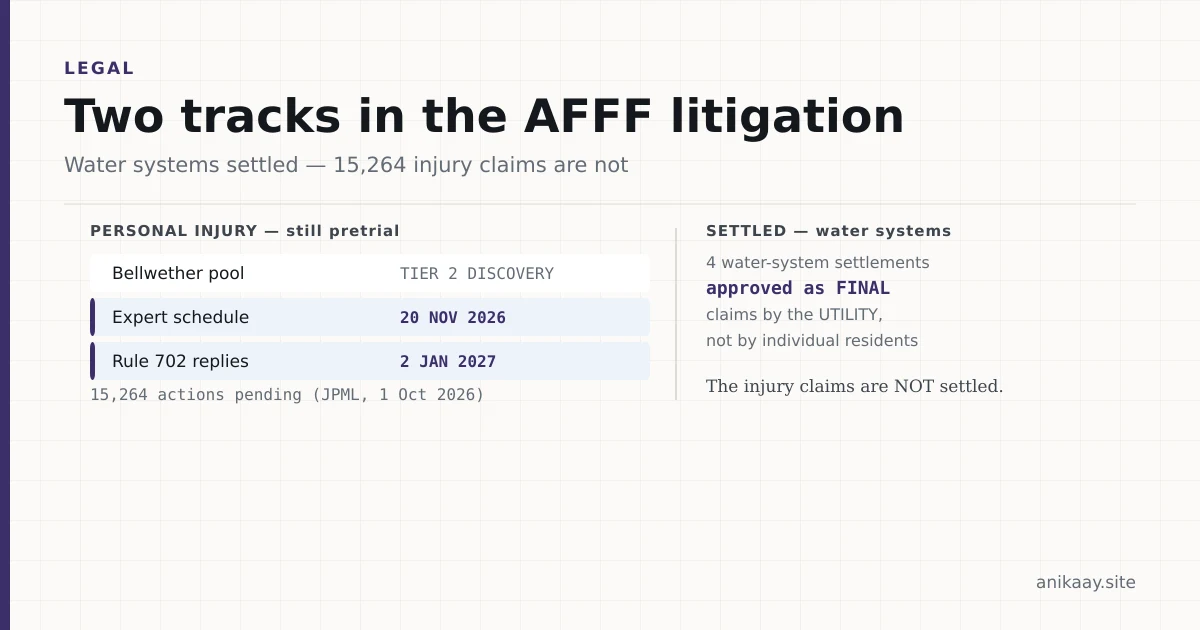
Bellwether cases are still in discovery. In Case Management Order No. 26.O, filed July 30, 2026, the court described the selection of the first Tier 2 personal injury bellwether trial pool and the subsequent progression of three plaintiffs alleging ulcerative colitis into Tier 2 discovery. The order set a deadline for the parties to propose which cases move into expert discovery. That deadline was amended to November 20, 2026, and the same date applies to the parties’ joint or competing proposals for an expert discovery schedule.
This is a meaningful shift in the calendar. An earlier order had set July 20, 2026 for that submission. The court moved it out by four months, which pushes the earliest realistic date for an expert discovery schedule into late 2026 or 2027.
The court is briefing expert-exclusion motions on cancer causation. Case Management Order No. 33F, filed August 31, 2026, set a schedule for Rule 702 motions addressing general causation experts related to thyroid cancer and/or liver cancer. Under that order, motions were to be filed by August 26, 2026, responses by November 20, 2026, and replies in support by January 22, 2027.
A Rule 702 motion asks the court to exclude or limit expert testimony that does not meet the reliability standard. In a mass tort built around exposure science, these motions are where the case is genuinely decided in practice. If the court limits the general causation experts, the personal injury cases that depend on general causation become substantially harder regardless of the merits of any individual claim. The court said it would advise the parties of any further process or hearing on these motions.
Duplicate personal injury filings are being consolidated. Case Management Order No. 38, filed June 3, 2026, addresses plaintiffs who have filed more than one personal injury action, often with different counsel in each case. The court directed the Portal Administrator, Eisner Advisory Group, to identify affected plaintiffs and report to counsel. Counsel then have 60 days from receipt of notice to resolve representation issues among themselves and file the appropriate dismissals. Dismissals filed under the order are without prejudice and, the order states, do not constitute an adjudication on the merits. Where disputes remain unresolved after 75 days, Special Master John Perry takes over, with a report and recommendation due within 120 days of the administrator’s notice.
Interlocutory review was denied. On October 1, 2026, the court entered an order clarifying that it intended to and did deny a request for interlocutory review because the statutory requirements were not met — specifically, that there was no ground for substantial disagreement as to the court’s rulings. A motion for clarification was denied.
What has been settled
Not every claim in MDL 2873 is heading to trial. The court-appointed settlement administrator’s site states that four class action settlements covering PFAS contamination in public water systems’ drinking water have each obtained final approval from Judge Gergel. A claims portal is open for public water system claimants.
The distinction here is important and easy to get wrong. The approved settlements resolve claims by public water systems as entities — the utility that operates the system. They are not, on the face of that information, settlements paying individual residents of those systems. The individual personal injury track is the separate set of cases addressed by the bellwether orders described above.
No per-claim payout figure for any of these settlements is stated on the administrator’s public page, so none is stated here. A total settlement fund is not an individual payment, and the difference matters to anyone assessing a claim.
The regulatory backdrop
The litigation runs alongside federal drinking water regulation. The EPA’s PFAS National Primary Drinking Water Regulation, published April 26, 2024, established health-based maximum contaminant level goals and enforceable maximum contaminant levels for six PFAS. For PFOA and PFOS taken individually, the enforceable MCL is 4.0 nanograms per liter (parts per trillion), with health-based goals of zero. The EPA also set 10 ng/L limits for PFHxS, PFNA and HFPO-DA, and a Hazard Index of 1 for mixtures containing two or more of those substances plus PFBS.
The rule requires systems to comply with the monitoring requirements by April 26, 2027, and the contaminant levels by April 26, 2029, with a nationwide capital improvement extension available for systems that need more time for the MCL deadlines.
The compliance dates and the litigation are not the same thing. A regulatory standard does not decide an individual tort claim, and this article does not suggest otherwise.
What is genuinely unresolved
Stating this plainly is more useful than smoothing it over:
- No trial date exists. Nothing in the orders reviewed here sets one.
- The Daubert outcome is unknown. The Rule 702 briefing does not conclude until replies in January 2027, and the court has not indicated how it will rule.
- The per-claim economics of the water system settlements are not public on the administrator’s site.
- The scope of the interlocutory appeal question is unsettled. The court denied interlocutory review, and a motion for reconsideration was filed on October 1, 2026 with a response date of October 15, 2026.
What happens next
The near-term calendar is set by two orders rather than by speculation:
- November 20, 2026 — bellwether selection and expert discovery proposals (CMO 26.O), and responses to the Rule 702 causation motions (CMO 33F).
- January 22, 2027 — replies in support of the Rule 702 motions.
- Ongoing — the 60/75/120-day multiple-representation process under CMO 38.
Frequently asked questions
What is MDL 2873 and which court is handling the AFFF cases?
MDL 2873 is the multidistrict litigation for Aqueous Film-Forming Foams Products Liability Litigation, held in the U.S. District Court for the District of South Carolina and assigned to Judge Richard M. Gergel.
How many AFFF cases are currently pending?
The Judicial Panel on Multidistrict Litigation reported 15,264 actions pending in MDL 2873 in its October 1, 2026 report, alongside 19,840 total historical actions.
Is there a trial date set in the AFFF personal injury litigation?
No trial date has been set. Under the scheduling order in CMO 26.O, the parties must propose which cases move into expert discovery by November 20, 2026.
What is a Rule 702 motion and why does it matter here?
A Rule 702 motion asks the court to exclude or limit expert testimony that does not meet the reliability standard. In MDL 2873, the court set a briefing schedule for such motions on general causation experts for thyroid and liver cancer.
Have any AFFF settlements been approved?
Yes. Four class action settlements covering public water systems have obtained final approval from the MDL judge, according to the court’s appointed settlement administrator.
What is the PFAS drinking water standard set by the EPA?
The EPA’s 2024 national drinking water regulation sets a maximum contaminant level of 4.0 nanograms per liter for PFOA and for PFOS taken individually.
Sources
This article draws on the court’s own filings and docket entries, the Judicial Panel’s October 1, 2026 report, the EPA’s final rule in the Federal Register, and the court-appointed settlement administrator’s public site. Law firm marketing pages were not used as a basis for any factual claim here, because such pages routinely disagree with each other and with the court record on the same case.
Full source links are listed in the references below.
This article is general information about publicly available court records, not legal advice. It is not a recommendation about your situation, and reading it creates no attorney-client relationship with anyone. If you have a claim, consult a licensed attorney about your own circumstances.
Topics
Frequently asked questions
What is MDL 2873 and which court is handling the AFFF cases?
MDL 2873 is the multidistrict litigation for Aqueous Film-Forming Foams Products Liability Litigation, held in the U.S. District Court for the District of South Carolina and assigned to Judge Richard M. Gergel.
How many AFFF cases are currently pending?
The Judicial Panel on Multidistrict Litigation reported 15,264 actions pending in MDL 2873 in its October 1, 2026 report, alongside 19,840 total historical actions.
Is there a trial date set in the AFFF personal injury litigation?
No trial date has been set. Under the scheduling order in CMO 26.O, the parties must propose which cases move into expert discovery by November 20, 2026.
What is a Rule 702 motion and why does it matter here?
A Rule 702 motion asks the court to exclude or limit expert testimony that does not meet the reliability standard. In MDL 2873, the court set a briefing schedule for such motions on general causation experts for thyroid and liver cancer.
Have any AFFF settlements been approved?
Yes. Four class action settlements covering public water systems have obtained final approval from the MDL judge, according to the court's appointed settlement administrator.
What is the PFAS drinking water standard set by the EPA?
The EPA's 2024 national drinking water regulation sets a maximum contaminant level of 4.0 nanograms per liter for PFOA and for PFOS taken individually.
Sources and references
- MDL 2873 — Aqueous Film-Forming Foams (AFFF) Products Liability Litigation, Introduction — U.S. District Court for the District of South Carolina, accessed 2026-10-03
- Case Management Order No. 38, Order Governing Personal Injury Plaintiffs with Multiple Filings and Representation (ECF 9598) — U.S. District Court for the District of South Carolina, accessed 2026-10-03
- Case Management Order No. 26.O, Scheduling Order Governing Group B Personal Injury Bellwether Trial Pool Cases (ECF 10497) — U.S. District Court for the District of South Carolina, accessed 2026-10-03
- Case Management Order No. 33F, Rule 702 briefing schedule (ECF 11298) — U.S. District Court for the District of South Carolina, accessed 2026-10-03
- MDL 2873 docket, master case 2:18-mn-02873-RMG — CourtListener (PACER docket data), accessed 2026-10-03
- Pending MDL Dockets by Actions Pending, report date October 1, 2026 — Judicial Panel on Multidistrict Litigation, accessed 2026-10-03
- PFAS National Primary Drinking Water Regulation, final rule — U.S. Environmental Protection Agency, accessed 2026-10-03
- Aqueous Film-Forming Foam (AFFF) Products Liability Litigation (MDL 2873) — Public Water System Settlements — Eisner Advisory Group, appointed MDL Portal and settlement administrator, accessed 2026-10-03
Ask about this case
AFFF MDL 2873: PFAS Foam Litigation Status and the Court's Latest Orders