Counterfeit Airbag Inflators Have Killed 10 People
On April 29, 2026 NHTSA banned the sale and import of airbag inflators marked "DTN60DB" and found they contain a safety defect. The agency's own decision lists 12 ruptures, 10 deaths and 2 severe injuries — and no estimate of how many are installed.
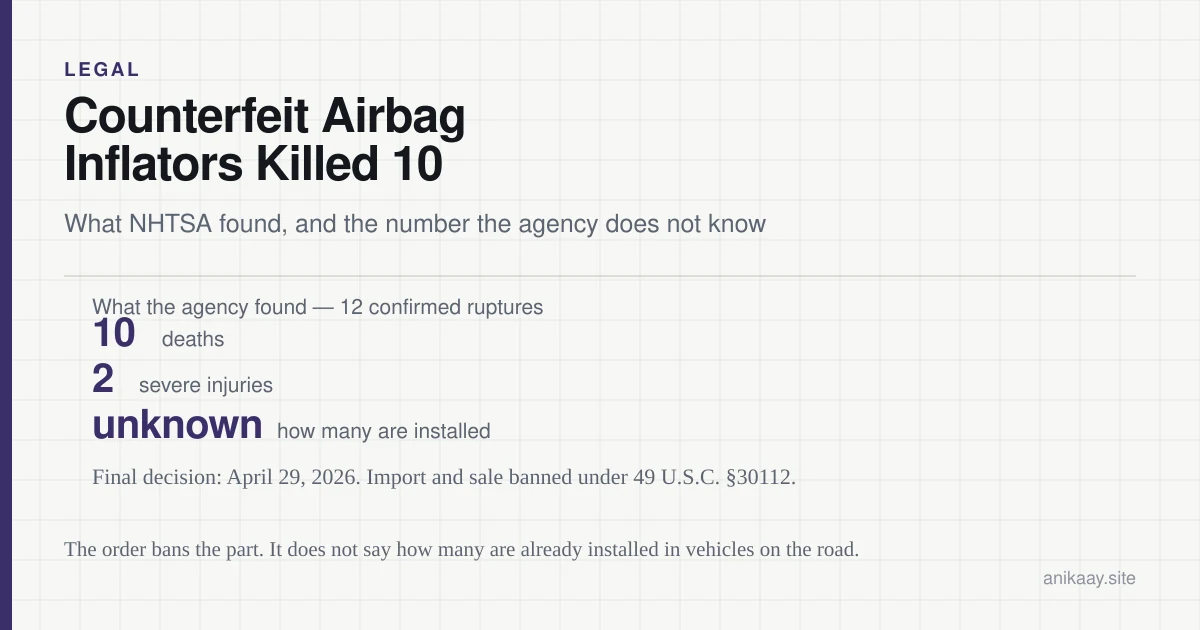
On April 29, 2026, the National Highway Traffic Safety Administration made a final decision that certain Chinese-made car airbag inflators contain a safety defect. The agency banned their sale and import into the United States. In its decision, NHTSA documented twelve confirmed ruptures of those inflators in American vehicles — ten deaths and two severe injuries — and stated plainly that it cannot estimate how many of the parts are installed in cars on American roads.
That last fact is the one that should worry anyone who has had an airbag replaced after a crash.
This article reports what NHTSA’s own final decision and the Federal Register notice establishing it say, as of October 3, 2026. Where the record is silent — on how many vehicles are affected, on who is responsible, on whether any court has ruled — this article says so instead of filling the gap.
The short version
- Ten people have died and two were severely injured in twelve confirmed ruptures of inflators marked “DTN60DB,” according to NHTSA’s final decision of April 29, 2026.
- Every rupture happened after the airbag was commanded to deploy — that is, the part failed at the moment it was supposed to protect the driver.
- In at least ten of the twelve incidents, the inflator had been installed as an aftermarket replacement after an earlier crash, not as original equipment from the automaker.
- The parts were imported by unknown importers, likely illegally. NHTSA says it “has been unable, despite substantial efforts, to obtain sufficient information to estimate the number of subject inflators in the United States.”
- The manufacturer, Jilin Province Detiannuo Safety Technology Co., Ltd. (DTN), denies selling inflators to the U.S. market and says the parts may be counterfeit copies of its products. NHTSA found that claim unsupported and made its decision anyway.
- No court has ruled. This is a regulatory safety-defect determination. It establishes no liability and awards no compensation.
What the part is, and what it did
An air bag inflator is a small pyrotechnic gas generator inside the air bag module. In a crash, the vehicle’s control unit ignites a propellant inside the inflator, which produces gas that fills the cushion and slows the occupant’s movement. The inflator is supposed to stay intact and do nothing more than release gas.
The defect NHTSA found is that these inflators rupture instead. The decision’s language is blunt about the consequence: rather than remaining intact within the module, “the metal inflator explodes — ejecting metal shrapnel from the module in a manner likely to kill or severely injure any human with which it makes direct contact.”
So the part that exists to save lives was actively killing the people it was deployed to protect. NHTSA’s own investigator summaries, cited in the final decision, describe findings such as a ruptured inflator cap deploying into the upper chest with sufficient force to cause immediate fatal injury, penetrative neck trauma from a cylindrical object marked “DTN60DB,” and a rounded metal object embedded in a victim’s brain.
The scale of what is being prevented is worth noting alongside the deaths. NHTSA states in the decision that frontal air bags have saved more than fifty thousand lives over the past thirty years, and that they have been federally required in all new vehicles since 1998. A rupture does not merely fail to deploy a bag. In the crashes NHTSA documented, it converted a survivable collision into a fatal one.
How to identify a DTN60DB inflator
NHTSA describes two markings, and both survive installation.
| Where to look | What you should see |
|---|---|
| Face of the inflator cap | An etched or labelled code beginning DTN60DB, followed by four digits for the year, two for the month, two for the day of manufacture, then a part sequence number |
| Electrical connector side | A bar code containing the number sequence 144415654 666631 or 144415654 666633 |
The decision states that this connector-side label “remains visible when the inflator is installed in an air bag module.” The subject inflators were likely manufactured in 2021 and 2022.
The important caveat: these markings are only present if a driver air bag has been replaced on your vehicle. The parts appear in the agency list as replacement or aftermarket equipment following an earlier crash, not as factory-installed original equipment.
The twelve ruptures on the agency’s own list
NHTSA set out each incident individually, with the date, the vehicle, the city, and the outcome. This is the complete list as published in the final decision.
| Date | Vehicle | Location | Inflator made | Outcome |
|---|---|---|---|---|
| May 30, 2023 | MY2018 Chevrolet Malibu | Dallas, TX | Dec 2021 | Driver killed |
| Jun 11, 2023 | MY2020 Chevrolet Malibu | Sarasota, FL | Nov 2021 | Driver killed |
| Sep 4, 2023 | MY2021 Chevrolet Malibu | Philadelphia, PA | Nov 2021 | Severe injury |
| Oct 25, 2023 | MY2020 Chevrolet Malibu | Fort Worth, TX | Unknown | Severe injury |
| Mar 1, 2024 | MY2022 Chevrolet Malibu | Oklahoma City, OK | Dec 2021 | Driver killed |
| Feb 3, 2025 | MY2017 Hyundai Sonata | Phoenix, AZ | Jun 2022 | Driver killed |
| Jul 30, 2025 | MY2019 Hyundai Sonata | West Valley City, UT | Mar 2022 | Driver killed |
| Sep 26, 2025 | MY2020 Chevrolet Malibu | Hayward, CA | Nov 2021 | Driver killed |
| Oct 31, 2025 | MY2018 Chevrolet Malibu | Wichita, KS | Dec 2021 | Driver killed |
| Dec 16, 2025 | MY2019 Chevrolet Malibu | Toledo, OH | Dec 2021 | Driver killed |
| Dec 16, 2025 | MY2018 Hyundai Sonata | Austin, TX | Jan 2022 | Driver killed |
| Feb 16, 2026 | MY2020 Chevrolet Malibu | Clarksdale, MS | Jun 2022 | Driver killed |
In every entry, NHTSA records the same cause: the driver “was killed by shrapnel expelled from the ruptured inflator,” or severely injured by it.
The agency adds a caution that matters for anyone assuming their own vehicle is unaffected: “there is no information indicating the problem is limited to those vehicles.” The Malibu and Sonata appear in this list because that is where ruptures have been found, not because the agency has bounded the risk to those two models.
How the investigation unfolded
June 16, 2023 — The Office of Defects Investigation received a Vehicle Owner Questionnaire (#11527380) alleging that an inflator rupture caused fatal injuries to the driver of a model year 2020 Chevrolet Malibu. ODI’s assessment was that the inflator was not original equipment and was manufactured by DTN.
June 2023 to July 2024 — ODI became aware of four further ruptures involving substandard air bag modules in Chevrolet Malibus. There was initially not enough information to identify the inflator manufacturer.
October 21, 2025 — ODI opened an Engineering Analysis, EA25005, prompted by reports of eight crashes involving inflator ruptures.
March to October 2025 — NHTSA learned of three further fatal ruptures, in a 2017 Hyundai Sonata and a 2019 Hyundai Sonata and a 2020 Chevrolet Malibu. Photographs showed the “DTN60DB” marking; fragment analysis confirmed it in three earlier incidents.
December 23, 2025 to March 23, 2026 — NHTSA sent DTN an information request on December 23, 2025, and received production and component data on February 3, 2026. NHTSA sent a supplemental request on March 6, 2026. DTN failed to respond by the March 23, 2026 due date, and had still not responded as of the final decision.
April 2, 2026 — NHTSA issued its initial decision, published in the Federal Register on April 6, 2026 at 91 FR 17327. It set a 15-day comment period rather than holding a public hearing, which it said it was forgoing “in consideration of the ten fatalities and two severe injuries.”
April 29, 2026 — NHTSA issued the final decision and order, effective on issuance.
The manufacturer’s denial, and why it did not change the outcome
DTN responded to the initial decision on two grounds, and NHTSA addressed both directly.
First: causation. DTN argued that “it cannot be proven that the accidents were caused by defective inflators,” noting that “the inflator is only one component of the system,” and that improper installation or defects in other components can cause crashes. NHTSA rejected this, pointing to its investigative file, which it says contains autopsy and police reports establishing that the subject inflators ruptured and directly caused the injuries and deaths. It added that DTN “provides neither any alternative cause for any of the incidents nor any evidence supporting any alternative cause.”
Second: whether DTN made them at all. DTN stated that “it cannot be proven that the inflators in question were indeed manufactured by DTN,” that it believes the inflator “is not a product manufactured by DTN, but rather a counterfeit of our product manufactured by another company,” and that it “has never directly sold any inflatable devices to the US market” except to the law firm Morgan & Morgan.
NHTSA noted that DTN provided no evidence supporting the counterfeiting allegation, and then made the point that makes the case unusual: it does not matter. The agency wrote that the final decision is appropriate “regardless of whether DTN can be proven to have manufactured the subject inflators,” because all known subject inflators involved in a crash ruptured and caused severe or fatal injuries — “even if those inflators were not manufactured by DTN.”
That is the crux of the matter. Whatever the label on the cap says, the part’s behaviour in a crash is what the agency regulated, and on this record the behaviour was lethal.
The Automotive Safety Council also commented, generally supporting the initial decision while providing no information specific to these inflators. A third comment, from Larry Dembrun, was found not relevant to the decision.
What the order actually does
The final decision is not a request. It is an order, and it has immediate legal effect.
It prohibits the parts. No person may sell, offer for sale, introduce or deliver for introduction into interstate commerce, or import into the United States:
- any air bag inflator marked “DTN60DB”
- any inflator labelled on the electrical connector side with a bar code containing 144415654 666631 or 144415654 666633
- any air bag module containing an inflator marked “DTN60DB”
- any air bag module containing an inflator with either of those bar code sequences
It compels notification and remedy. Under 49 U.S.C. § 30118(b)(2), NHTSA must order each manufacturer — and the statute defines “manufacturer” broadly enough to include any person importing motor vehicle equipment for resale — to notify owners, purchasers and dealers of the defect under § 30119 and remedy it under § 30120. Any such manufacturer must also file a report with NHTSA consistent with 49 CFR Part 573 within five business days of learning of the order.
It does not waive anything. The decision states that NHTSA “is not forgoing any remedies available to it under the law, including without limitation any civil or criminal action to seek penalties or other appropriate relief,” and reserves its rights to enforce the order.
Because the inflators are replacement equipment rather than original equipment, the prohibition attaches regardless of who sells them. A dealer, a repair shop, or a marketplace listing a subject inflator after this date is acting unlawfully.
What we do not know
Three gaps in the record are large enough that anyone reasoning about their own situation should know about them.
How many vehicles have these inflators. This is the most consequential unknown. NHTSA says that because the subject inflators “were likely imported illegally,” the agency “has been unable, despite substantial efforts, to obtain sufficient information to estimate the number of subject inflators in the United States.” The investigation “is continuing.” There is no number to check against, and none should be inferred from the twelve documented crashes.
Whether affected vehicles have been notified. The order requires the manufacturers and importers to notify owners, purchasers and dealers. Whether that notification has reached the owners of any given vehicle is not something the public record establishes. NHTSA’s own public guidance has urged consumers to have inflators inspected where an airbag has been replaced, but this article does not assert that any particular owner has or has not been contacted.
Who bears legal responsibility. The final decision reaches importers under the Safety Act’s definition of manufacturer. It does not adjudicate liability as between any particular parties, and it is not a court ruling. Whether a repair shop, a marketplace, an importer chain, or another party bears legal responsibility for a given vehicle depends on facts and law that no published decision has yet resolved. Anyone asserting that DTN alone is responsible, or that no one is, is going beyond the record.
Why this is different from the airbag recall most people remember
The Takata airbag scandal is the reference point most people reach for, and the comparison is instructive precisely because the mechanisms differ.
Takata’s propellant degraded over time in vehicles across the entire installed fleet, affecting tens of millions of original-equipment inflators. The failure was a design and manufacturing problem in a genuine, enormous, market-wide product. It was, in the ordinary sense, a recall of a defective car part.
The DTN inflators are different in ways the decision makes explicit. They are not original equipment. They are replacement parts, in at least ten of twelve incidents installed after an earlier crash — a period when a vehicle is most likely to be in a body shop rather than a franchised dealership. They arrived through unknown importers, likely illegally, so the agency cannot say how many exist or where they are. The manufacturer itself says the parts may be counterfeit and that it did not sell into the U.S. market.
NHTSA did not compare the two. This article does not either, beyond noting that both involve a metal inflator rupturing on deployment. The airbag lesson to carry forward is narrower and more practical: a replacement part is held to the same standard of care as the original, and the moment a car has been in a serious crash is exactly when its safety equipment needs to be right.
What a reader with a replaced airbag should do
The federal record supports a small number of concrete steps, and nothing beyond them.
- If the driver airbag was replaced after a crash, have the inflator physically inspected. The decision’s markings — the “DTN60DB” cap code and the connector-side bar code — are the only identification NHTSA has provided.
- Do not assume a repair shop’s invoice settles the question. The record does not establish that any particular installer used these parts.
- Treat a “recalled” airbag as not necessarily repaired. Because no affected-vehicle list exists, an owner cannot verify from public data that a completed repair did not involve a subject inflator.
- Check the recency. The subject inflators were likely manufactured in 2021 and 2022, which narrows the window of parts to look for.
- If you have been harmed, this is a matter for a licensed attorney in your state. The final decision is a regulatory finding. It is evidence of a serious defect, not a judgment awarding you anything.
Frequently asked questions
What are the DTN60DB airbag inflators? DTN60DB is the marking etched or labelled on the face of certain Chinese-made frontal driver air bag inflators. NHTSA found in its final decision of April 29, 2026 that inflators carrying this marking contain a defect related to motor vehicle safety. They rupture during deployment instead of inflating the bag, and they were imported into the United States by unknown importers, likely illegally.
How many people have died from the DTN60DB inflators? Ten. NHTSA’s final decision states that twelve confirmed subject inflator ruptures in the United States resulted in ten deaths and two severe injuries. You may see a figure of eleven deaths reported elsewhere; that number does not match the agency’s own decision document.
Were the DTN60DB inflators original equipment from GM or Hyundai? No. In at least ten of the twelve incidents, the subject inflators were installed as replacement or aftermarket equipment after the vehicle was involved in an earlier crash in which a driver air bag had deployed. NHTSA does not have information about how or why they were installed in the other two incidents.
Can I check whether my car has a DTN60DB inflator? Partly. If your driver air bag was replaced after a crash, the inflator cap should carry an etched code beginning “DTN60DB,” and a label on the electrical connector side should carry a bar code containing 144415654 666631 or 144415654 666633. That label stays visible once the inflator is installed in the module. NHTSA has not published a list of affected vehicles, so this is the only check available.
Has any court found these inflators defective? No court has. The finding reported here is NHTSA’s own regulatory safety-defect determination, not a judicial ruling, and it establishes no liability and awards no compensation. The separate question of who may be legally responsible for these parts has not been resolved by any published decision.
Is this a recall? NHTSA’s order requires each manufacturer, including importers, to notify owners, purchasers and dealers and to remedy the defect under the Safety Act. What does not exist is a conventional recall campaign with a published list of affected vehicles and VINs — precisely because the agency says it cannot estimate how many of the inflators are in the country.
Sources
Every factual claim in this article comes from NHTSA’s final decision of April 29, 2026, the Federal Register notice of the initial decision at 91 FR 17327, the public docket in NHTSA-2026-0793, or the statutes the order cites. The full list is in the references for this article.
This is not legal advice
This article reports publicly available federal records. It is not legal advice, and reading it does not create an attorney-client relationship with anyone. If you believe you have a claim, the deadlines that apply to you depend on your own facts and your own state, and some may be short. Consult a licensed attorney in your jurisdiction about your own situation. Federal records change — verify anything time-sensitive against NHTSA’s own materials before relying on it.
Topics
Legal
primary sources behind this article
01What this matter is made of
- Question
- counterfeit airbag inflator lawsuit
- what this article answers
- Sources
- 9
- primary sources cited
- Market
- United States
- the edition this was written for
- Questions answered
- 5
- in the FAQ below
02Pending actions across the largest multidistrict dockets
Bar chart of pending actions. MDL 2738 leads with 69,340 pending actions. The axis is logarithmic.
Logarithmic scale. A linear bar would hide every docket below 8,424 actions entirely. The 8.2× spread is real; the axis is stretched so you can see it.
Source: JPML multidistrict litigation report, 2026-10-01.
03How a mass tort case reaches this point
- Claims filedindividual actions in the district courts
- MDL formedconsolidated for pretrial
- Discovery and motionsthe record this article reports
- Resolutionsettlement or ruling
Twelve ruptures, ten dead
Every incident NHTSA set out in its final decision, with the vehicle, the city, and what happened to the driver.
NHTSA's final decision of April 29, 2026 lists twelve confirmed ruptures of inflators marked DTN60DB. Ten drivers were killed and two were severely injured, and in every case the agency recorded the cause as shrapnel from the ruptured inflator. The incidents run from a May 2023 crash in Dallas, Texas to a February 2026 crash in Clarksdale, Mississippi. The vehicles involved were Chevrolet Malibus and Hyundai Sonatas of model years 2017 to 2022. In at least ten of the twelve the inflator had been installed as an aftermarket replacement after an earlier crash; for the remaining two NHTSA said it did not know how they were installed.
These are the ruptures NHTSA could document, not the number of vehicles affected. The agency states it cannot estimate how many of these inflators are installed in the United States, so twelve is a floor and not a total.
- inflator built Dec 2021MY2018 Chevrolet MalibuDallas, TXDriver killed
The driver was killed by shrapnel expelled from the ruptured inflator.
- inflator built Nov 2021MY2020 Chevrolet MalibuSarasota, FLDriver killed
The driver was killed by shrapnel expelled from the ruptured inflator.
- inflator built Nov 2021MY2021 Chevrolet MalibuPhiladelphia, PASevere injury
The driver was severely injured by shrapnel expelled from the ruptured inflator.
- inflator built not statedMY2020 Chevrolet MalibuFort Worth, TXSevere injury
The driver was severely injured by shrapnel expelled from the ruptured inflator.
- inflator built Dec 2021MY2022 Chevrolet MalibuOklahoma City, OKDriver killed
The driver was killed by shrapnel expelled from the ruptured inflator.
- inflator built Jun 2022MY2017 Hyundai SonataPhoenix, AZDriver killed
The driver was killed by shrapnel expelled from the ruptured inflator.
- inflator built Mar 2022MY2019 Hyundai SonataWest Valley City, UTDriver killed
The driver was killed by shrapnel expelled from the ruptured inflator.
- inflator built Nov 2021MY2020 Chevrolet MalibuHayward, CADriver killed
The driver was killed by shrapnel expelled from the ruptured inflator.
- inflator built Dec 2021MY2018 Chevrolet MalibuWichita, KSDriver killed
The driver was killed by shrapnel expelled from the ruptured inflator.
- inflator built Dec 2021MY2019 Chevrolet MalibuToledo, OHDriver killed
The driver was killed by shrapnel expelled from the ruptured inflator.
- inflator built Jan 2022MY2018 Hyundai SonataAustin, TXDriver killed
The driver was killed by shrapnel expelled from the ruptured inflator.
- inflator built Jun 2022MY2020 Chevrolet MalibuClarksdale, MSDriver killed
The driver was killed by shrapnel expelled from the ruptured inflator.
On how these inflators reached these vehicles, NHTSA says only this: in at least ten of the twelve incidents the inflators were installed as aftermarket replacements after an earlier crash in which the driver air bag had deployed. The agency did not say which ten, and states it has no information about how or why the subject inflators were installed in the other two. This graphic therefore attributes installation to no individual row, because the record does not.
NHTSA adds that although every rupture it knows about involved a Chevrolet Malibu or a Hyundai Sonata, there is no information indicating the problem is limited to those vehicles. The two models are where ruptures were found, not the boundary of the risk.
What the record establishes, and what it cannot
The federal record is firm on the danger and deliberately silent on the scale.
NHTSA's final decision establishes that inflators marked DTN60DB contain a safety defect, that twelve ruptures killed ten drivers and severely injured two, and that the sale and import of the parts is now prohibited. The record does not state how many of the inflators are installed in the United States, whether owners have been notified, who bears legal responsibility, why the inflators were installed in two of the incidents, or when the investigation will end. No court has ruled on liability.
Established by the agency
- A safety defect was establishedNHTSA found the subject inflators contain a defect related to motor vehicle safety.
- Twelve ruptures, ten deathsDocumented individually in the decision, with date, vehicle and city for each.
- The cause was the inflatorEach entry records death or injury by shrapnel from the ruptured inflator.
- Sale and import are prohibitedThe April 29 order bans sale, offer, delivery and import with immediate effect.
- Importers are coveredThe order reaches any person importing motor vehicle equipment for resale.
Not answered by the record
- How many vehicles are affectedNHTSA says it cannot estimate the number, so there is no list to check.
- Whether owners have been notifiedNotification is ordered. Whether any given owner was reached is not published.
- Who bears legal responsibilityNo court has ruled. The order reaches importers by statute, which is not a finding of liability against any of them.
- Two installations are unexplainedFor two incidents NHTSA did not say how or why the inflator was fitted.
- When the investigation endsThe decision states the investigation is continuing.
NO FIGURE EXISTSHow many of these inflators are installed in the United States
NHTSA: because the inflators appear to have been imported illegally, the agency "has been unable, despite substantial efforts, to obtain sufficient information to estimate the number of subject inflators in the United States."
So there is no recall list, no VIN list and no count to check your car against. If your driver airbag was replaced after a crash, the only identification available is the physical markings on the part itself.
Where the record gives you something to check
- On the inflator cap
- an etched code beginning DTN60DB
- On the connector-side label
- bar code 144415654 666631 or 144415654 666633
- Manufacture window
- likely made 2021 or 2022
Frequently asked questions
What are the DTN60DB airbag inflators?
DTN60DB is the marking etched or labelled on the face of certain Chinese-made frontal driver air bag inflators. NHTSA found in its final decision of April 29, 2026 that inflators carrying this marking contain a defect related to motor vehicle safety. They rupture during deployment instead of inflating the bag, and they were imported into the United States by unknown importers, likely illegally.
How many people have died from the DTN60DB inflators?
Ten. NHTSA''s final decision states that twelve confirmed subject inflator ruptures in the United States resulted in ten deaths and two severe injuries. You may see a figure of eleven deaths reported elsewhere; that number does not match the agency''s own decision document.
Were the DTN60DB inflators original equipment from GM or Hyundai?
No. In at least ten of the twelve incidents, the subject inflators were installed as replacement or aftermarket equipment after the vehicle was involved in an earlier crash in which a driver air bag had deployed. NHTSA does not have information about how or why they were installed in the other two incidents.
Can I check whether my car has a DTN60DB inflator?
Partly. If your driver air bag was replaced after a crash, the inflator cap should carry an etched code beginning "DTN60DB," and a label on the electrical connector side should carry a bar code containing 144415654 666631 or 144415654 666633. That label stays visible once the inflator is installed in the module. NHTSA has not published a list of affected vehicles, so this is the only check available.
Has any court found these inflators defective?
No court has. The finding reported here is NHTSA''s own regulatory safety-defect determination, not a judicial ruling, and it establishes no liability and awards no compensation. The separate question of who may be legally responsible for these parts has not been resolved by any published decision.
Sources and references
- Final Decision That Certain Frontal Driver Air Bag Inflators Contain a Safety Defect (EA25-005), signed April 29, 2026 — U.S. Department of Transportation, National Highway Traffic Safety Administration, accessed 2026-10-03
- Initial Decision That Certain Frontal Driver Air Bag Inflators Manufactured by Jilin Province Detiannuo Safety Technology Co., Ltd. (DTN) Contain a Safety Defect, 91 FR 17327 — Office of the Federal Register, accessed 2026-10-03
- Docket NHTSA-2026-0793, comment from Jilin Province Detiannuo Safety Technology Co., Ltd. — U.S. Department of Transportation, accessed 2026-10-03
- Docket NHTSA-2026-0793, comment from the Automotive Safety Council — U.S. Department of Transportation, accessed 2026-10-03
- Engineering Analysis EA25005 — Notice (In re: DTN60DB inflators) — NHTSA Office of Defects Investigation, accessed 2026-10-03
- NHTSA — What to Know: Deadly Air Bag Replacements — U.S. Department of Transportation, National Highway Traffic Safety Administration, accessed 2026-10-03
- 49 U.S.C. § 30118 — Actions of manufacturers of defective motor vehicles and equipment — Legal Information Institute, Cornell Law School, accessed 2026-10-03
- 49 U.S.C. § 30112 — Prohibitions on importation of noncomplying motor vehicle equipment — Legal Information Institute, Cornell Law School, accessed 2026-10-03
- 49 CFR § 573 — Motor vehicle recall reporting — Electronic Code of Federal Regulations, accessed 2026-10-03
Ask about this case
Counterfeit Airbag Inflators Have Killed 10 People