Mass Torts, MDLs and the Machinery of Large-Scale Litigation
A mass tort is thousands or millions of claims sharing a defect or a defendant. This explains the machinery courts use to handle them — consolidation into a multidistrict litigation, bellwether trials that sample the range, and the deal structures that end it.
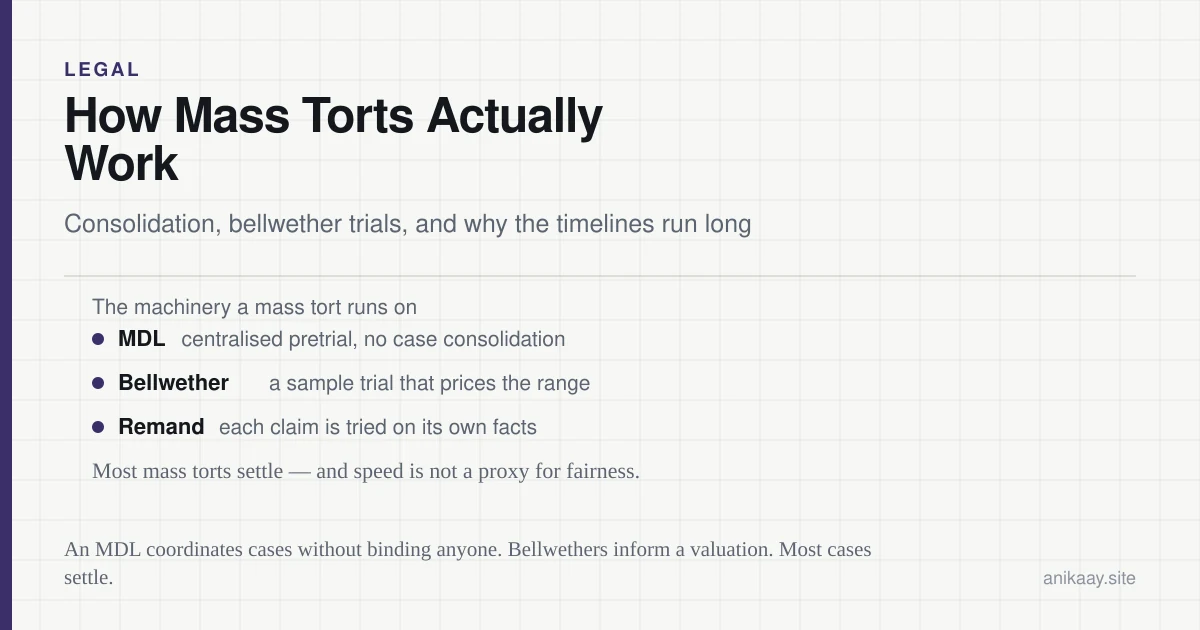
The short version
A mass tort is not a legal procedure. It is a description of a situation: many separate people, each with a claim small enough that bringing it alone would cost more than it recovers, all arising from the same defect or the same defendant.
Courts handle that situation with ordinary civil machinery plus two tools that exist largely for this purpose: consolidation (so thousands of cases do not proceed independently) and sampling through bellwether trials (so both sides learn what a jury does with the evidence before betting the whole case on it).
Everything else — the headline verdicts, the settlement numbers, the decade-long timelines — follows from those two moving parts.
What makes a case a mass tort
Four features usually coincide:
Commonality. The same product, drug, device or course of conduct. This is what lets one court hear one set of motions for everyone.
Large numbers. Enough claims that individual litigation is economically impossible. The threshold is not a fixed legal number; it is where the cost of coordination exceeds the value of the coordination.
Individual smallness. Most claims are far below the cost of a jury trial on their own. This is precisely why consolidation and class mechanisms exist.
Common legal and factual questions. Not identical facts — that is what makes it a mass tort rather than a class action — but shared enough to be worth litigating once.
Consolidation: what an MDL actually does
When the same kind of case appears in federal courts across many districts, the Judicial Panel on Multidistrict Litigation (JPML) can centralise the docket under 28 U.S.C. § 1407. The panel is made up of federal judges; the decision is administrative, not adversarial.
A consolidated MDL case is usually handled like this:
- Centralised pretrial. All parties are directed into one master docket before one judge — commonly in a district with subject-matter relevance.
- Common motion practice. Motions to dismiss, Daubert challenges to expert evidence, and class-certification issues are briefed once and applied to everyone.
- Shared discovery. Depositions and expert work are not repeated case by case.
- Remand for trial. Individual cases go back to their original courts — or are severed — to be tried on their own facts.
Three misconceptions are worth clearing up, because they are extremely common:
An MDL does not consolidate the claims into one case. It coordinates them. Each plaintiff still has an individual claim, and losing the master case does not by itself extinguish it.
An MDL is not class certification. The two solve overlapping problems and often run in the same litigation. A class requires commonality, typicality and adequacy of representation to be judicially established and binds absent members who take no part. An MDL requires only common facts and is administrative, and binds nobody.
Filing an MDL motion does not move your case on its own. Transfer happens only if the JPML grants it, and it is not automatic even when the criteria look satisfied.
Bellwether trials, and why the spread matters
A bellwether is a case tried as a representative sample. It is the most useful single thing that can happen to a mass tort, because it converts an argument about millions into a fact about a jury.
The three things it produces:
Information about liability treatment. Juries are inconsistent on causation and damages in ways that documents are not. A single verdict tells the parties how this particular judge and jury received the proof.
A damages range. Verdict spreads in mass torts are often enormous, and the spread is informative rather than embarrassing. A $8.5 million result and a $5,000 result from the same docket tell you something real about the underlying claims’ individual value — and, importantly, about which fact patterns are strong and which are weak.
A settlement anchor. Because roughly nine out of ten mass torts settle, the most valuable moment in one is usually before trial, and bellwethers are how parties find out what they are actually arguing about.
Bellwethers do not bind the remaining cases. Their results inform valuation; they do not set a per-claim number that anyone is automatically entitled to.
How mass torts end
Most settle, and the structures are worth recognising:
Traditional settlement. A per-claim payment structure with deductions, often after an attorney fee award. Simple, but it does not scale to millions of claimants, which is one reason it suits the smaller end of the range.
Class settlements. Used where a class has been certified and the plan allocates a fixed fund. These scale better and require real certification work.
Claimant funds. An administrator processes claims against a pooled fund. Common where the number of claimants is very large and individual claims are small.
Whatever the structure, the recurring dispute is how to value and allocate — and the question that most often decides whether a settlement is accepted: what does the plan do with the weak claims, and who bears that cost.
Why timelines are so long
The slow factors are identifiable:
- Scientific or causation disputes. Where liability depends on contested science, Daubert fights and expert battles can consume years.
- Number of claimants. Coordination cost grows faster than the number of claims.
- Ascertainability. How do you identify the exposed population? Where records do not exist, the defendant has no reliable way to size the group, and settlement discussions stall.
- Asset position. A defendant that cannot fund an adverse judgment negotiates very differently from one that can.
- Second-instance litigation. Appeals, and especially attempts to obtain a nationwide resolution, add years.
Speed is not a proxy for fairness. A quick resolution after a decisive appellate ruling can be entirely reasonable; a long one can be delay by a solvent defendant. Conversely, a settlement reached quickly can be inadequate and provoke exactly the criticism a complicated one avoids.
Mass torts and class actions, side by side
| Mass tort | Class action | |
|---|---|---|
| Who is bound | No one, absent settlement terms | Absent class members, after certification |
| Who decides | The JPML, administratively | The court, on the Rule 23 standard |
| Why it exists | Individually small claims, common facts | Commonality plus a class mechanism |
| Individual variation | Expected and tolerated | Must be adequately represented |
| Scale | Millions of claims possible | Practically limited by certification |
They are frequently used together. A class can be certified within an MDL for a subset of claims that genuinely share common questions, while the remaining individualized claims proceed on the MDL docket.
How to read a headline about a mass tort
When a figure appears in coverage, four questions usually decide whether it means anything:
- Verdict, settlement, or per-claim average? These are routinely conflated and they are different quantities by orders of magnitude.
- How many claims does it represent? One bellwether out of thousands says very little about the total.
- Is it proposed, preliminary, or final? Preliminary approvals are not approvals.
- What is excluded? Opt-out rates, fee arrangements and claim denials change what a headline figure actually pays.
Our reporting convention is to state the posture explicitly — alleged, proposed, decided, or unresolved — and to name the court and docket number, so any figure can be checked against the record rather than taken on trust.
Nothing here is legal advice
This is an explanation of how mass-tort litigation is structured in the United States. It is not legal advice, and it cannot tell you whether you have a claim. Whether you have one depends on facts and law specific to your situation, including the date of any exposure and the statute of limitations that applies to it. If you are asking about your own circumstances, that is a question for a licensed attorney.
For current docket information on any specific multidistrict litigation, the CourtListener docket search and the JPML’s own docket list are the authoritative sources.
Topics
Legal
primary sources behind this article
01What this matter is made of
- Question
- what is a mass tort
- what this article answers
- Sources
- 4
- primary sources cited
- Market
- United States
- the edition this was written for
- Questions answered
- 4
- in the FAQ below
02Pending actions across the largest multidistrict dockets
Bar chart of pending actions. MDL 2738 leads with 69,340 pending actions. The axis is logarithmic.
Logarithmic scale. A linear bar would hide every docket below 8,424 actions entirely. The 8.2× spread is real; the axis is stretched so you can see it.
Source: JPML multidistrict litigation report, 2026-10-01.
03How a mass tort case reaches this point
- Claims filedindividual actions in the district courts
- MDL formedconsolidated for pretrial
- Discovery and motionsthe record this article reports
- Resolutionsettlement or ruling
Frequently asked questions
What is a mass tort?
A mass tort is a large group of civil claims that share a common defect, product or course of conduct, brought by many separate people against one or more defendants. The claims are individually small and factually similar, which is what makes it economical to handle them together. A mass tort is a category of case, not a specific legal procedure; courts use ordinary civil rules plus consolidation mechanisms to manage it.
What is a multidistrict litigation, or MDL?
An MDL is a case docket created by the United States Judicial Panel on Multidistrict Litigation. When claims involving common facts are filed in many federal district courts, the JPML can centralise them before a single judge for pretrial purposes — motions, discovery and settlement work — after which individual cases may be sent back to their original courts for trial. It does not create a new cause of action and it does not decide anything; it manages procedure.
What is a bellwether trial?
A bellwether is one case tried as a representative sample of many. Its purpose is to give the parties and the judge a concrete sense of how a jury reacts to the evidence and to the damages, which is far more useful for valuing a settlement than thousands of depositions. Bellwethers inform valuation; they do not bind the other cases unless a settlement says so.
How long does a mass tort take to resolve?
Commonly many years, and the range is wide. The slow cases are usually the ones with large claimant numbers, contested scientific evidence, or a defendant that can fund prolonged litigation. Speed is not evidence that a settlement is unfair in either direction: some quick resolutions follow a decisive appellate ruling, while some elaborate settlements are still criticised by plaintiffs as inadequate.
Sources and references
- Federal Judicial Center — Multidistrict Litigation — Federal Judicial Center, accessed 2026-10-03
- 28 U.S.C. § 1407 — Transfer of Actions to a Common District — Legal Information Institute, Cornell Law School, accessed 2026-10-03
- In re: Uber Technologies, Inc., Passenger Sexual Assault Litigation (MDL No. 3084) — CourtListener / RECAP, accessed 2026-10-03
- In re: Aqueous Film-Forming Foams Products Liability Litigation (MDL No. 2873) — CourtListener / RECAP, accessed 2026-10-03
Ask about this case
Mass Torts, MDLs and the Machinery of Large-Scale Litigation