Uber MDL 3084: Two Verdicts, One Eve-of-Trial Settlement
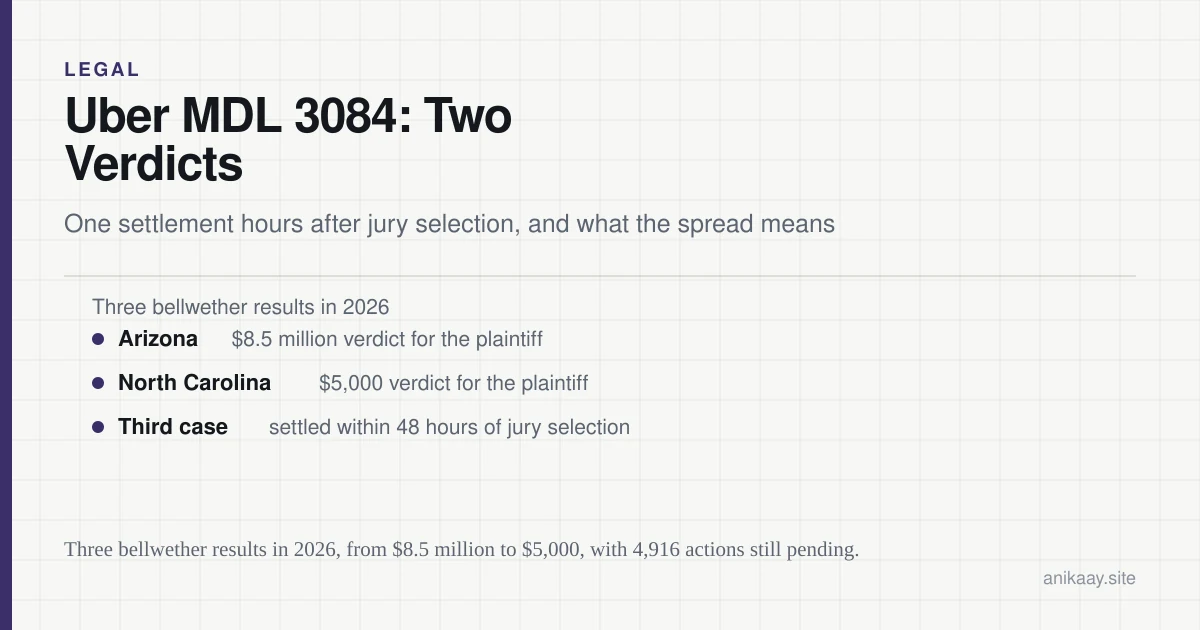
The Uber passenger assault multidistrict litigation has now produced three bellwether results in 2026 — two verdicts for plaintiffs worth $8.5 million and $5,000, and one case settled within 48 hours of jury selection. What the spread between those results actually means for the other 4,916 pending actions.
In a little over eight months, the federal Uber passenger-assault litigation has gone from no trials to three bellwether results. That is unusual speed for a multidistrict docket of this size, and the three results disagree with each other so sharply that the case is now generating its own problems of interpretation.
This article reports what the public record shows as of October 3, 2026. Where the record does not establish something, this article says so.
The short version
- 4,916 actions were pending in MDL 3084 in the Judicial Panel on Multidistrict Litigation’s report dated October 1, 2026, with 5,221 filed in total.
- The case sits in the U.S. District Court for the Northern District of California, before Judge Charles R. Breyer, under master docket 3:23-md-03084-CRB.
- Three bellwether trials have now produced a result. An $8.5 million Arizona verdict, a $5,000 North Carolina verdict, and a confidential Texas settlement on October 2, 2026.
- No global settlement has been announced, and the multidistrict litigation has not been dismissed.
- The spread between the two verdicts is roughly 1,700 to 1. That gap, not the headline number, is the thing to understand.
What the case is
MDL 3084 consolidates federal claims that passengers were sexually assaulted by drivers they booked through Uber’s app. The Judicial Panel on Multidistrict Litigation selected the Northern District of California as the central forum, and Judge Breyer presides over the docket.
The central liability theory is apparent agency — that by building a branded, driver-rated, GPS-tracked marketplace, Uber created a relationship with the passenger that a jury can treat as something more than a commercial transaction between strangers. It is a theory about the design of the product rather than about any one driver’s conduct.
That distinction matters for everything that follows. If liability turned on driver negligence, the analysis would be case-specific and the results would scatter. Because it turns on the platform’s design, the same question — did Uber’s design create an apparent agency — comes before every jury. The verdicts differ because juries answer that shared question differently.
The three results
1. Arizona: $8.5 million, February 5, 2026
The first federal bellwether, Dean v. Uber, was tried in the U.S. District Court for the District of Arizona over roughly four weeks. The jury found Uber liable and ordered $8.5 million in compensatory damages.
The jury reached that result on the apparent-agency theory and rejected the negligence and design-defect claims. No punitive damages were awarded. Plaintiff Jaylynn Dean had sought approximately $144 million.
This is the headline result and it is a plaintiff win — but note what it is not. It is not a finding that Uber caused an assault. It is a finding that the platform’s structure mattered.
2. North Carolina: $5,000, April 20, 2026
The second result, reported by Reuters, came six weeks later. A jury in the Western District of North Carolina ordered Uber to pay $5,000.
The small number was not the jury being unsympathetic. Judge Breyer had already held that Uber was a common carrier under North Carolina law, which carries a non-delegable duty, and damages in the case were capped at the value of a single 24-hour period of transit. This was a case Uber itself had selected as a defense bellwether.
Same theory. Different jurisdiction, different legal constraints, different number.
3. Texas: settled, October 2, 2026
The third bellwether, Jane Doe QLF 001 v. Uber, was set for trial in the Western District of Texas. Before opening statements, Uber stipulated during jury selection that it would not contest that the assault occurred. The case settled less than 48 hours later.
Terms are confidential and not public. The driver in that case, Victor Huynh Le, was criminally convicted in 2022 and sentenced to 11 years.
The stipulation is the legally significant detail. It means Uber stopped defending the central fact in the case — not the design question, but the assault itself — which is what removed what was left to try. Plaintiffs’ co-lead counsel used the settlement to call on the company to pursue a global resolution.
Why the spread matters
Taken together, the three results tell a story that is easy to misread in either direction.
Reading it as “Uber is liable” is wrong. Two verdicts are two jury decisions. One jury in North Carolina found for the plaintiff and awarded a token amount; a California state jury reached a defense verdict in September 2025 in the parallel JCCP litigation. Verdicts in this litigation have pointed in both directions.
Reading it as “nothing has happened” is also wrong. Two plaintiff verdicts and a settlement at the eve of trial are the mechanism by which these cases resolve one at a time. The Texas case in particular is a data point about how these cases end, and it ended quietly and quickly.
The real signal is the variance. A 1,700-fold spread between two verdicts on the same theory, in the same year, tells you that damages in this litigation are driven by jurisdiction-specific legal constraints and jury composition far more than by the underlying facts of any individual assault. Anyone modelling their own case off the $8.5 million headline is reading the wrong number.
What this means for the remaining cases
Uber has said it intends to appeal both verdicts. A notice of appeal does not stop a jury verdict from being a verdict, but it does mean the Arizona and North Carolina results may change before they are final.
The docket itself is growing, not shrinking. The Judicial Panel’s own counts show pending actions rising from 3,078 in January 2026 to 4,916 on October 1, 2026. A litigation that produced three bellwether results in eight months and is still adding claims a quarter is not winding down.
No MDL-wide settlement has been announced, and the multidistrict litigation has not been dismissed.
A note on the DOJ
A common error in coverage of this case is to connect it to the U.S. Department of Justice. It should be handled carefully.
The 2020 Department of Justice indictment of Uber concerned the 2016 data breach cover-up, not passenger assault. Separately, a 2020 corporate indictment in the Northern District of California did concern the company’s handling of assault and misconduct reports; that matter was resolved in 2022. Neither is the same case as MDL 3084, and no Department of Justice plaintiff is a bellwether in this multidistrict litigation.
The Department’s separate ADA suit, United States v. Uber, is likewise a distinct case.
What this article does not do
This is a report on a litigation record. It does not tell you whether you have a claim, whether your claim is covered, or what it would be worth — and nothing here should be read as legal advice.
A bellwether verdict is a fact about one case and one jury. Given that two verdicts on the same theory eight weeks apart differed by a factor of roughly 1,700, using any of these numbers to estimate an individual outcome would be a mistake. If you have a potential claim, the question that matters is one a local lawyer has to answer from your facts and your state’s law.
Topics
Legal
actions pending in the docket this article covers
01What this matter is made of
- Docket
- MDL 3084
- N.D. Cal. · 3:23-md-3084
- Presiding judge
- Breyer, Charles R.
- as recorded in the JPML report
- Pending actions
- 4,916
- as at 2026-10-01
- Historical actions
- 5,221
- all time
02Pending actions across the largest multidistrict dockets
Bar chart of pending actions. MDL 2738 leads with 69,340 pending actions. This article covers MDL 3084. The axis is logarithmic.
Logarithmic scale. A linear bar would hide every docket below 4,916 actions entirely. The 14.1× spread is real; the axis is stretched so you can see it.
Source: JPML multidistrict litigation report, 2026-10-01. This article covers MDL 3084.
03How a mass tort case reaches this point
- Claims filedindividual actions in the district courts
- MDL formedconsolidated as MDL 3084, before Breyer, Charles R.
- Discovery and motionsthe record this article reports
- Pending now4,916 actions pending
Three bellwethers, 1,700x apart
Why the spread between two verdicts on the same theory matters more than the $8.5M headline
Three federal bellwether cases in MDL 3084 have resolved in 2026. An Arizona jury on 5 February 2026 awarded 8.5 million dollars in compensatory damages, finding Uber liable on an apparent-agency theory while rejecting negligence and design-defect claims. A North Carolina jury on 20 April 2026 awarded 5,000 dollars, where damages were capped at the value of a single 24-hour fare. A Texas case settled on 2 October 2026 less than 48 hours after jury selection; its terms are confidential and no figure is public. The 1,700-fold gap between the two verdicts indicates damages in this litigation follow jurisdiction-specific caps and jury composition rather than the facts of any individual assault. No global settlement has been announced and the multidistrict litigation has not been dismissed.
LOGARITHMIC SCALE — A linear bar would hide the $5,000 verdict entirely. Each decade is a tenfold step.
Frequently asked questions
What is MDL 3084 and which court handles it?
MDL No. 3084 is In re: Uber Technologies, Inc., Passenger Sexual Assault Litigation, consolidated in the U.S. District Court for the Northern District of California before Judge Charles R. Breyer under master docket 3:23-md-03084-CRB. It brings together federal claims that passengers were sexually assaulted by drivers they booked through the Uber app.
How many cases are in MDL 3084?
The Judicial Panel on Multidistrict Litigation reported 4,916 actions pending and 5,221 total actions in its report dated October 1, 2026. That is up from 3,078 pending at the start of 2026.
Has Uber been found liable in a trial yet?
Yes, twice in 2026. A jury in Arizona returned an $8.5 million compensatory verdict on February 5, 2026, and a jury in North Carolina returned a $5,000 verdict on April 20, 2026. A third bellwether was settled on October 2, 2026 with the terms confidential.
Why was the third bellwether case settled so quickly?
Uber stipulated during jury selection that it would not contest that the assault occurred. With no dispute left on the central fact, the case settled less than 48 hours later, before opening statements.
Has MDL 3084 reached a global settlement?
No. No global settlement has been announced in MDL 3084 and the multidistrict litigation has not been dismissed. The three bellwethers are individual case resolutions.
What does this mean for someone with a similar claim?
This article reports the litigation record. It does not tell you whether you have a claim or what your claim is worth. A verdict in a bellwether case is a fact about that case and that jury, not a prediction for any other case, and outcomes in similar cases have differed by a factor of 1,700.
Sources and references
- Pending MDL Dockets by Actions Pending, report date October 1, 2026 — Judicial Panel on Multidistrict Litigation, accessed 2026-10-03
- Uber loses another US driver sex assault trial, ordered to pay $5,000 — Reuters, accessed 2026-10-03
- Federal jury finds Uber liable for actions of driver who grabbed passenger's inner thigh — Associated Press, accessed 2026-10-03
- Jury Finds Uber Liable in Sexual Assault Case Involving 19-Year-Old Passenger; Awards $8.5 Million in Damages — PR Newswire (plaintiffs' trial counsel release), accessed 2026-10-03
- Uber Settles Background Check Sexual Assault Case Less Than 48 Hours After Jury Selection — PR Newswire (plaintiffs' co-lead counsel release), accessed 2026-10-03
- MDL 3084 docket, master case 3:23-md-03084-CRB — CourtListener (PACER docket data), accessed 2026-10-03
Ask about this case
Uber MDL 3084: Two Verdicts, One Eve-of-Trial Settlement