What a Federal Conviction in Political Corruption Actually Requires
Political corruption is the one crime area where the legal standard is unusually demanding and the evidence burden unusually high. This sets out what has to be proven, why so few cases survive trial, and which convictions are actually final.
Why this subject needs more care than usual
Political corruption reporting is unusually prone to error, and the errors are not usually about facts. They are about legal posture — about describing something as established when it has not been.
Three distinctions do most of the damage when they get blurred:
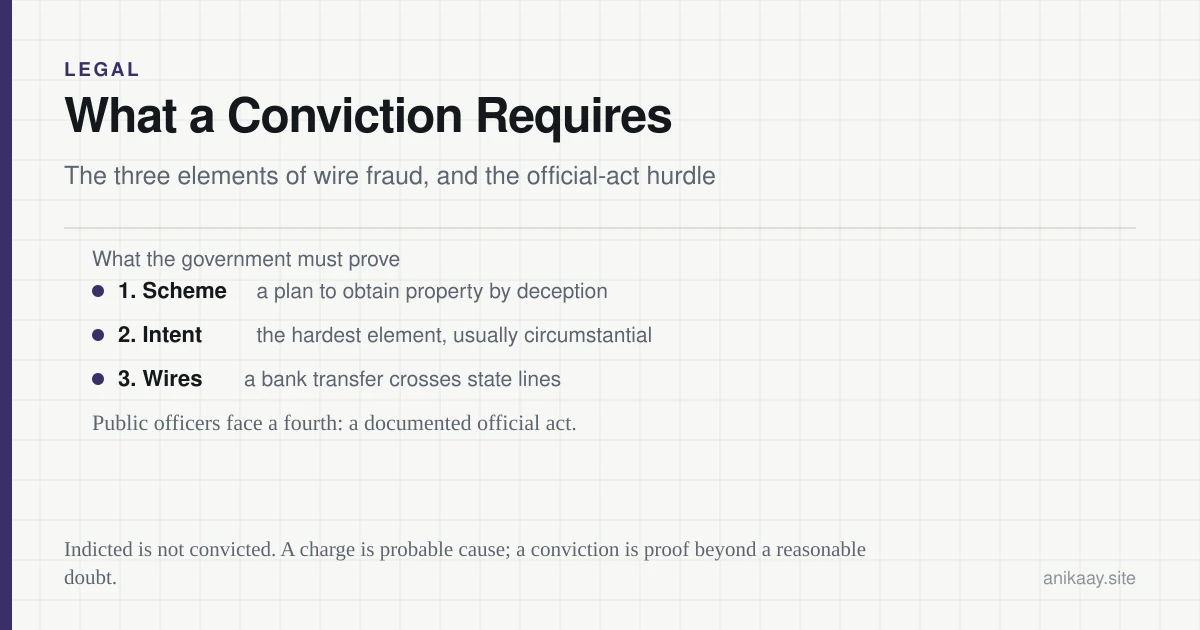
- Indicted is not convicted. An indictment is a probable-cause finding that charges should be brought. A conviction requires proof beyond a reasonable doubt.
- Investigated is not indicted. A referral, a search warrant, or an opened file is an investigative step with no evidentiary conclusion attached.
- Ethics violation is not a crime. The Office of Congressional Ethics is a congressional body, not a law-enforcement agency.
Publishing an indictment as though it were a conviction is actionable defamation when the charges are dismissed or the defendant is acquitted. That is not a hypothetical risk — it has been litigated repeatedly.
This article covers the law instead, which does not decay as cases move through appeal.
The basic charge: wire fraud
Most federal political corruption cases begin, directly or by predicate, at 18 U.S.C. §1343. It requires three elements:
- A scheme to defraud.
- An intent to defraud — meaning an intent to deprive another of property or to obtain property by deception.
- Use of the interstate wires.
The third is usually satisfied easily. A bank transfer across state lines is a wire. The difficulty is almost always the intent element.
Intent to defraud is a mental state, and the government rarely proves it directly. It is established circumstantially — from what was said, what was hidden, whether records were altered, and whether the defendant knew what the money was for. A defendant who genuinely believed a payment was a legitimate fee has no fraud intent, and that belief is a complete defence on this element.
The extra hurdle: the official-act requirement
Where the defendant is a public official, most federal circuits add a further requirement: the government must prove the defendant took an official act, defined in substance as something done through the authority of the office, or something the defendant believed would have that effect.
The Supreme Court narrowed this considerably in McDonnell v. United States (2015). An intrinsic promise to use influence over an official act, without any further actual step, is not an official act. The Court reasoned that an expansive reading would criminalise ordinary political activity — constituent service, arranging meetings, advocating for a cause.
The circuit split over how much further step is needed was extensive, and the resulting case law is the most-cited boundary in this area. What survived is narrower than the government wanted and broader than the defence hoped.
The practical consequence is a headline-shaped one: a payment, a promise, or a bundled benefit is not, by itself, a federal crime for an officeholder. There must be a documented official act, and a documented link between the payment and that act. Where that link is inferential rather than documented, the case is correspondingly weak.
Cases where the outcome is actually final
The following are convictions, not accusations. They are listed because they are what “convicted” is supposed to mean, and because the contrast with the far larger set of pending matters is instructive.
George Santos, former U.S. Representative for New York’s 3rd Congressional District, pleaded guilty and was sentenced in April 2025 to 87 months in prison. The convictions were for wire fraud, aggravated identity theft, making false statements to Congress, theft from campaign donors, and false filing of campaign finance reports. The Department of Justice Eastern District of New York press release is the primary record.
Rod Blagojevich, former Governor of Illinois, was convicted on 17 counts including wire fraud, attempted extortion, conspiracy to commit mail fraud, and abuse of office. The central alleged conduct was an attempt to trade or sell a vacant United States Senate seat, enacted shortly before he himself was elected to that seat — an act of official extortion directed at the appointing authority itself.
These two illustrate the two common shapes. Santos is a pattern-of-deception case built largely from documents. Blagojevich is a quid-pro-quo case built around a specific transaction.
Where the outcome is not final, and why that matters
Robert McDonnell, former Governor of Virginia, was convicted in 2014 on five federal counts, including wire fraud, arising from a $170,000 personal loan and roughly $90,000 in gifts extended by a businessman while McDonnell was in office.
The conviction history is real and the trial record was extensive. But the legal boundary was genuinely contested, and the Supreme Court of Virginia later vacated part of the judgment and remanded on the narrow question of what constituted an official act. That sequence is why a careful account of this case cites both the conviction and the remand. Reporting only the conviction overstates finality; reporting only the remand understates what happened.
The lesson generalises: in corruption cases, check the appellate posture before writing. A conviction under appeal is not a conviction that has survived.
Michael Madigan, the former Speaker of the Illinois House and the longest-serving legislative leader in United States history, spent years in federal court on corruption charges alleging bribes and a “loot-for-lawsuits” arrangement. A long prosecution is not a conviction, and coverage of a decade-long case must track its actual posture.
Chris Finley, the Lieutenant Governor of Hawaii, was indicted in 2026. As of this writing that is a charge. Nothing has been proven. Any sentence asserting otherwise would be defamation without qualification.
Why the conviction rate is so low
The number is low for reasons that are structural rather than accidental:
The offence is consensual in appearance. A bribe looks like a payment for help. Proving that the payment was for an official act, rather than for a campaign contribution, a consulting fee, or a genuine loan, is frequently the entire case.
The government must prove a mental state. Circumstantial proof of intent is possible but rarely conclusive, and defendants present evidence of an alternative reading.
Constitutional doctrine cuts against breadth. McDonnell restricted official-act liability precisely because the alternative would chill legitimate political activity. That is a deliberate feature of the law, not a loophole to be exploited in either direction.
Elections are evidence. A politician can win after being indicted, and sometimes after being convicted. Electoral success is not evidence of innocence — nor is it evidence of guilt. It is a fact about voters.
How to read a political crime story
When a claim about a politician appears, four questions separate reporting from speculation:
- What is the posture? Indicted, referred, investigated, tried, convicted, or overturned. If the story does not say, that is the first thing to establish.
- What is the alleged conduct, specifically? “Corruption” is a conclusion. The underlying act is what can be checked.
- Is there an official act? In a public-officer case, without one there is generally no federal crime — whatever else may be true.
- What does the court actually say? The opinion, the indictment, and the press release are three different documents, and they diverge often.
Reporting standards we hold
On this subject, Anikaay applies the rules in our editorial policy without exception:
- Every figure and date traces to a named source, cited by URL.
- A charge is described as a charge. A conviction is described as a conviction.
- Posture is stated explicitly — alleged, indicted, tried, convicted, decided, or under appeal.
- Where an appellate development has changed the significance of an event, that is stated alongside the event rather than omitted.
- No conduct is attributed to any person without a primary record: a court docket, a filing, an official release, or a published opinion.
This is not legal advice
This is an explanation of how federal corruption law works in the United States. It is not legal advice and it is not an assessment of any person. If you have a question about a specific matter, the authoritative sources are the court docket, the charging document, and the opinion — in that order, and not a summary of them.
For a live docket, CourtListener carries RECAP filings for federal courts, and each Department of Justice United States Attorney’s Office publishes its own press releases for cases it brings.
Topics
United States
primary sources behind this article
01What this article is built from
- Question
- political corruption conviction
- what this article answers
- Sources
- 5
- primary sources cited
- Market
- United States
- the edition this was written for
- Questions answered
- 4
- in the FAQ below
02How this article is organised
- Why are so few political corruption cases prosBecause the legal elements are demanding and the proof is often circumstanti…
- What is the difference between an indictment aAn indictment is a grand jury's finding that charges should be brought. It i…
- Does an ethics violation by a lawmaker become Not by itself. The Office of Congressional Ethics is a congressional body, n…
- Can a conviction be overturned?Yes, and some have been. Former Virginia Governor Robert McDonnell was convi…
Frequently asked questions
Why are so few political corruption cases prosecuted successfully?
Because the legal elements are demanding and the proof is often circumstantial at best. A wire-fraud prosecution requires proof of an intent to defraud, a scheme to obtain money or property by deception, and a qualifying use of the interstate wires. Where a public official is the defendant, most circuits also require proof of an "official act" — something done through the authority of the office. An extrinsic promise to influence an official act, without a further step, is generally not enough. Cases fail on intent, on causation, or on the link between a payment and any governmental act.
What is the difference between an indictment and a conviction?
An indictment is a grand jury's finding that charges should be brought. It is an accusation, not a finding of guilt, and the standard is merely "probable cause" — which is far lower than proof beyond a reasonable doubt. A conviction is a finding of guilt after trial or a guilty plea, and it requires proof beyond a reasonable doubt. Reporting that treats a pending indictment as established wrongdoing is the most common error in coverage of political cases, and it is actionable defamation when the accused is later exonerated or the charges are dismissed.
Does an ethics violation by a lawmaker become a crime?
Not by itself. The Office of Congressional Ethics is a congressional body, not a law enforcement agency. It can publish a public report, refer a matter for investigation, and in certain circumstances recommend discipline. Its findings do not create criminal liability. Criminal liability requires a separate process through the Department of Justice or the Office of Independent Counsel, which applies a different standard of proof.
Can a conviction be overturned?
Yes, and some have been. Former Virginia Governor Robert McDonnell was convicted in 2014 on wire fraud and official-act counts arising from a loan and gifts during his tenure. The Supreme Court of Virginia later vacated part of the judgment and remanded on a narrow question about what constituted an official act; the case illustrates how genuinely contested the legal boundary is even for a matter that produced a conviction.
Sources and references
- Ex-Congressman George Santos Sentenced to 87 Months in Prison for Wire Fraud and Aggravated Identity Theft — U.S. Attorney’s Office, Eastern District of New York, accessed 2026-10-03
- McDonnell v. United States — 576 U.S. 356 (2015), opinion summary — Supreme Court of the United States, accessed 2026-10-03
- McDonnell v. United States — 568 U.S. 342 (2013), opinion summary — Supreme Court of the United States, accessed 2026-10-03
- 18 U.S.C. § 1343 — Fraud and related activity in connection with wire transfers — Legal Information Institute, Cornell Law School, accessed 2026-10-03
- Office of Congressional Ethics — Reports and Referrals — Office of Congressional Ethics, U.S. House of Representatives, accessed 2026-10-03