How a Mass Tort Claim Actually Moves: From Injury to Resolution
A mass tort is shared infrastructure; your claim is personal. This follows one claim from exposure to resolution, and explains why the limitation period — not the strength of your evidence — is usually the deadline that matters.
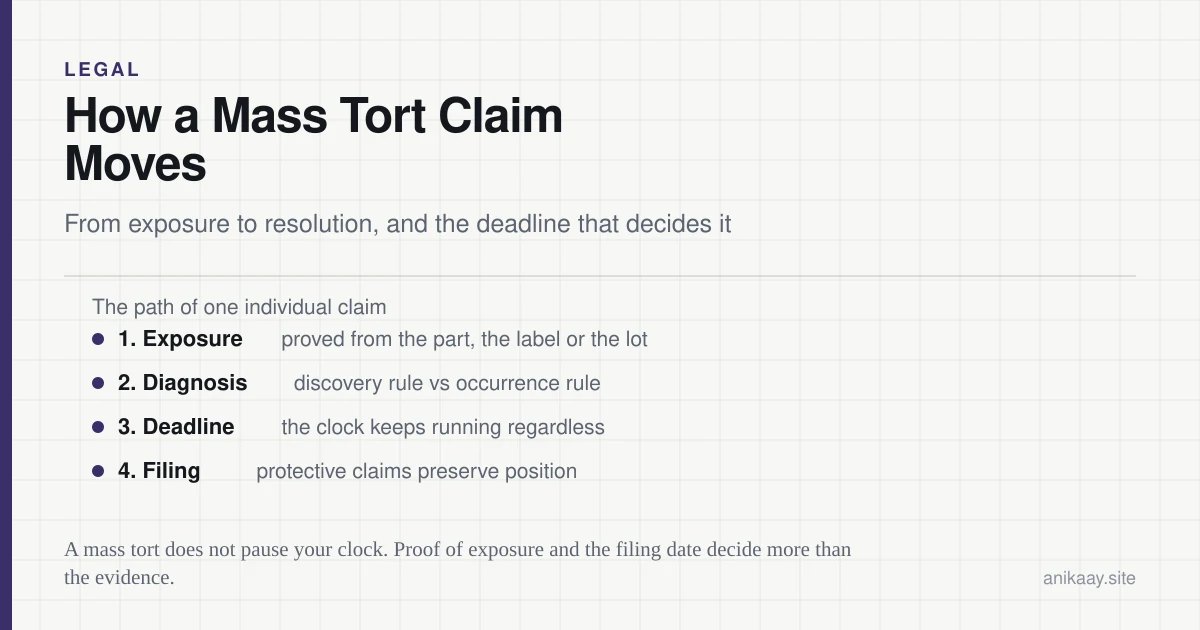
A mass tort is shared infrastructure; your claim is not
The machinery described in our explainer on how mass torts work — the multidistrict docket, the shared discovery, the bellwether trials — exists to manage thousands of individual claims efficiently. None of it decides anything on its own. What decides your claim is ordinary litigation: whether you were exposed, whether the exposure caused your injury, what damages a court would award, and whether you filed before the deadline expired.
This follows that individual path. It is deliberately general, because the specifics depend on your state, your diagnosis, and the defendant.
Stage one: exposure, and proving it
Exposure is a factual question and it is where most cases are won or lost, because the defendant will usually contest it.
What establishes exposure varies by the product. It may be:
A physical mark on the part itself. Some parts carry an etched code, a label, or a bar code on the connector that stays visible after installation. In the current DTN60DB airbag litigation, the agency’s own decision identifies affected inflators by exactly that kind of marking, because there is no database of which vehicles received them.
A purchase or service record. Warranty paperwork, an invoice, a receipt, a repair order.
Manufacturer records. For an implanted or administered product, the relevant lot, batch, or serial number is often the most important fact you have.
Circumstantial evidence. Where direct proof is impossible — a chemical exposure, for instance, where your claim is corroborated by where you lived and worked and by others exposed alongside you — courts do accept inference. It is weaker, and it is contested.
The practical rule: the harder your exposure is to prove, the more the rest of your case depends on it.
Stage two: diagnosis, and the date that starts the clock
The second date that matters is when the injury was diagnosed. It is frequently the one people assume controls, and it may not.
Most jurisdictions apply one of three rules, and which one is decisive:
Discovery rule. The clock runs from when you discovered, or reasonably should have discovered, the injury. Favourable where symptoms appear years later.
Occurrence rule. The clock runs from the event itself. If the product was sold to you in 2009, the deadline may have passed years ago regardless of when you were diagnosed.
Statute of repose. A hard outer limit, often ten or twenty years from sale or from delivery, after which no claim may be brought no matter when the injury appeared.
A latency period between exposure and diagnosis is common in these matters — cancers with long onset periods, implant-related conditions, property damage discovered slowly. The discovery rule exists precisely for that situation, which is why the occurrence rule can be fatal in a case that would otherwise be strong.
The critical point: a mass tort does not pause your clock. Litigation that takes years can make that feel like a formality. It is not.
Stage three: the deadline nobody notices
There are typically at least two deadlines, and the dangerous one is rarely the obvious one:
The limitations deadline. Statutory, and often the only hard cut-off that cannot be argued about.
The claim-registration deadline. If the matter settles, registration usually closes on a fixed date set by the court. In the current Depo-Provera settlement programme, eligible claimants must register by a specific date, and missing it is far more common than people expect — people who are actively participating simply do not register.
A registration deadline is not an extension of time. It closes, and the claim that was not registered is generally gone.
Stage four: filing, and the protective claim
Whether you may file your own suit while the MDL is pending is governed by local rules, and this varies more than most readers expect. Some jurisdictions stay individual actions; some require them to wait; some let a claimant file but hold the case in abeyance; some give the central court a say.
A protective claim — filed to preserve your position without incurring the full cost of litigation — is common practice. It is not a lesser filing, and it does not weaken your case; it preserves your ability to proceed.
Which route is available to you is a question for a lawyer in your state, and it is worth asking before the limitation period expires rather than after.
Stage five: resolution
If the matter settles, you will be asked to decide whether to participate. The decision turns on a small number of concrete things:
What the release does. It normally extinguishes the claims it covers, permanently. Once signed, you cannot reopen them. Read what is being released, not what the notice is called.
How the plan treats your claim type. Settlement allocations usually differentiate. A claim with an unusual injury, a documented exposure, and a clean medical record is often treated differently from one without those.
Whether there is an attorney fee, and how it interacts with your recovery. In some structures the fee is deducted from what you receive; in others it is paid separately. That difference can be a large part of the net figure.
What happens if you decline. Some plans offer nothing to claimants who opt out. Others continue to pursue the defendant on their behalf. This is worth asking directly, because the answer determines whether declining is a real option or a technicality.
Deadlines pressure this decision. The registration date is the date by which you must have decided, which is not the same as the date by which you have had time to think.
What to do now, before anything else
This is the part that is useful regardless of your specific situation.
Photograph everything. The defect, the part number, the label, the packaging. Before any repair, before any disposal, before a dealer replaces it.
Keep documents. Purchase records, repair orders, warranty paperwork, correspondence, recall notices. Digitise them; physical records get lost in moves.
Keep medical records, with dates. The diagnosis date, the treating clinician, and the records linking the condition to the exposure.
Do not repair or discard a part before documenting it. If it is evidence, it is the evidence.
Do not miss a registration deadline. If you are participating in a settlement programme, put the deadline in a calendar with a reminder well before it.
Get advice before signing a release. A release is final. That is the single most consequential step in this entire process and the one most often taken under time pressure.
Two questions I could not resolve
I am flagging these rather than leaving them implicit, because they are genuinely underdetermined from public information:
Whether any individual protective filing is available in your state right now. This turns on local rules and on the current posture of the specific MDL, and both change. It has to be asked locally.
Whether a particular exposure standard has changed. Regulators revise exposure guidance periodically, and a threshold that applied when you were diagnosed may not be the one that applies to your claim.
Both are answerable, but not by general reasoning — they need the current local rule text and the current docket.
This is not legal advice
This is an explanation of how mass-tort claims move through the process. It is not legal advice, and it cannot tell you whether you have a claim, whether your claim is timely, or what it is worth. Whether you have one depends on facts and law specific to your situation, including the date and manner of your exposure and the statute of limitations that applies in your jurisdiction. Deadlines are the failure point in this area more than any other, and only a licensed attorney can advise on yours.
Topics
Legal
primary sources behind this article
01What this matter is made of
- Question
- mass tort claim process
- what this article answers
- Sources
- 3
- primary sources cited
- Market
- United States
- the edition this was written for
- Questions answered
- 4
- in the FAQ below
02Pending actions across the largest multidistrict dockets
Bar chart of pending actions. MDL 2738 leads with 69,340 pending actions. The axis is logarithmic.
Logarithmic scale. A linear bar would hide every docket below 8,424 actions entirely. The 8.2× spread is real; the axis is stretched so you can see it.
Source: JPML multidistrict litigation report, 2026-10-01.
03How a mass tort case reaches this point
- Claims filedindividual actions in the district courts
- MDL formedconsolidated for pretrial
- Discovery and motionsthe record this article reports
- Resolutionsettlement or ruling
Frequently asked questions
Do I have to wait for the mass tort to end before filing my own case?
Generally no, and in some situations waiting is a mistake. Filing a protective claim is common practice because it preserves your position while the multidistrict litigation works out its own schedule. But whether an individual suit may proceed while an MDL is pending is governed by the local rules of the court where you would file, and in some jurisdictions the MDL has a stay or a veto. That is a question for a lawyer in your state, and the answer changes from state to state.
When does the deadline start running?
Usually from the date of the event that caused the injury, or in some circumstances from the date you discovered or should have discovered the injury — the discovery rule. Which rule applies, and whether it has been tolled or extended by the litigation itself, depends on the claim and the jurisdiction. The important practical point is that the clock is generally not paused because a mass tort exists.
What evidence should someone keep right now?
Keep the product or its identifying marks, all documentation of purchase and repair, and every medical record showing the diagnosis and its date. Photographs of the defect and of the part number matter more than most people expect. Do not discard or repair anything without photographing it first, and do not dispose of packaging. If a recall applies, keep the notice.
Does joining a settlement harm my ability to claim later?
It depends entirely on the release you sign. A release normally extinguishes the claims it covers, and that is permanent — you cannot reopen them later. This is why the decision to participate should never be made under deadline pressure without advice, and why the trade-offs in a settlement should be explained before you sign anything.
Sources and references
- 28 U.S.C. § 1407 — Transfer of Actions to a Common District — Legal Information Institute, Cornell Law School, accessed 2026-10-03
- Federal Judicial Center — Multidistrict Litigation — Federal Judicial Center, accessed 2026-10-03
- In re: Aqueous Film-Forming Foams Products Liability Litigation (MDL No. 2873) — CourtListener / RECAP, accessed 2026-10-03
Ask about this case
How a Mass Tort Claim Actually Moves: From Injury to Resolution