Collateral Estoppel in a Mass Tort: What a Prior Verdict Does and Does Not Bind
When one claimant in a mass tort wins a big verdict, what happens to the others? Collateral estoppel can bind a defendant on issues it already lost — but only under conditions a judge decides. Here is what a prior verdict does and does not decide for your claim.
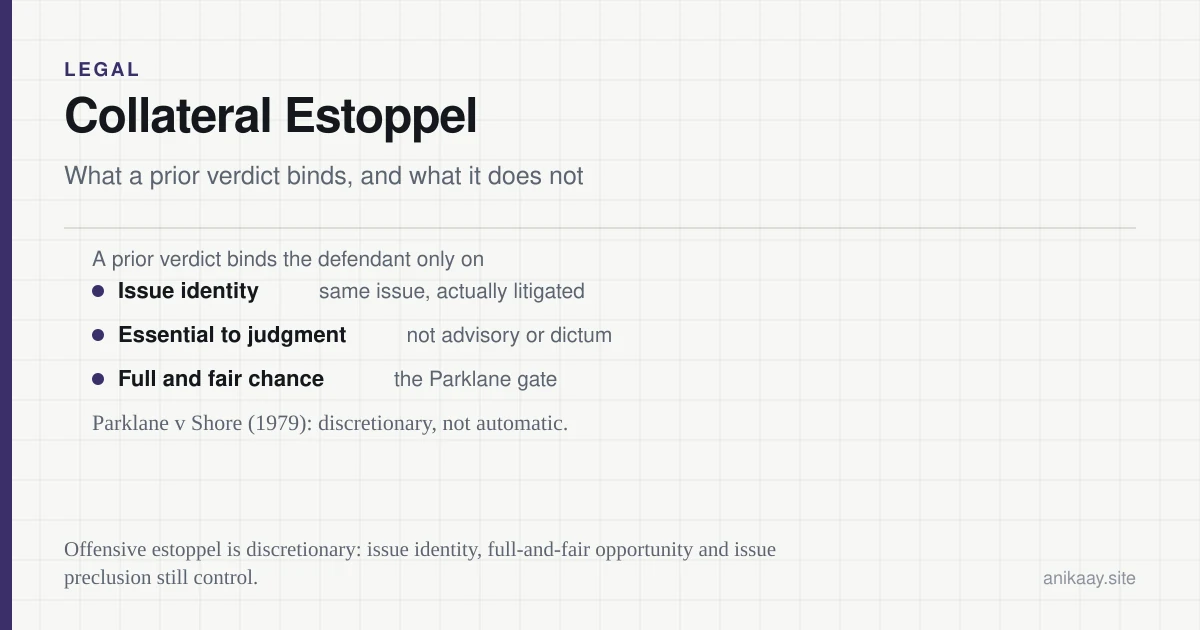
What a verdict against one claimant does to the rest of a mass tort
When a claimant in a large product-liability docket wins a seven-figure verdict, the headline tells only part of the story. What the court actually decided — and, just as important, what it declined to decide — determines whether that verdict can be used by every other person with a claim against the same defendant, or only by the one person who tried the case.
That question is governed by collateral estoppel, also known as issue preclusion. The rule is older than mass torts: it says that once a court has actually litigated an issue of fact or law and decided it as necessary to the judgment, that issue is conclusive in a later case between the same parties. It is not a verdict on the whole claim. It is a verdict on a specific issue, and it becomes binding only when a second judge decides that the preclusion requirements were met.
In a mass tort the doctrine is unusually powerful and unusually fragile at the same time. Defendants have an incentive to use it once a plaintiff has won, and claimants have an incentive to use it once a plaintiff has lost against their common adversary. Yet a preclusion finding in an individual case does not automatically reach the thousands of claims on the docket. Something has to happen first: a party has to ask the court to apply it, and a judge has to decide that the particular facts justify freezing the issue in place.
What is collateral estoppel?
Collateral estoppel is one half of the broader concept of claim preclusion. Claim preclusion, or res judicata, says a party cannot relitigate a whole cause of action it has already had its day in court on. Collateral estoppel goes narrower and deeper: it says a party cannot relitigate a particular issue — causation, defect, warning adequacy, failure to inspect, knowledge — even in a different cause of action.
The classic definition, stated in the Restatement (Second) of Judgments § 27, has four elements. An issue is precluded only if it is (1) identical to an issue in the earlier case, (2) actually litigated and decided in the earlier case, (3) essential to the earlier judgment, and (4) litigated fully and fairly by the party against whom preclusion is asserted.
The fourth element is the one that matters most in a mass tort. Each claimant in a large docket has a different exposure history, a different diagnosis, a different treatment course and a different document record. That makes “actually litigated and fully and fairly” a question for the second judge rather than a fact that falls into place by itself. The doctrine assumes one full and fair opportunity to litigate an issue; in a docket that treats thousands of claims as administratively identical, that assumption is exactly what gets tested.
The practical consequence is that collateral estoppel works issue by issue, not case by case. A court can hold a defendant estopped on the issue of whether the product was defective while leaving the issue of what damages each claimant suffered entirely open. Causation and damages are handled separately in most mass torts, and preclusion rarely crosses that divide.
The difference between offensive and defensive collateral estoppel
The same doctrine has two faces, and the direction matters.
Defensive collateral estoppel is used by a defendant. A claimant sues Defendant A on a product defect, loses on the merits, and then sues Defendant B on the same facts. Defendant B can invoke preclusion to prevent the claimant from re-arguing the defect issue. This use is the traditional form and it is broadly accepted in every jurisdiction: the objection that “you did not have your day in court” does not apply against someone who already had it and lost.
Offensive collateral estoppel is used by a plaintiff. Claimant A wins a major verdict against Defendant on the defect issue, and Claimant B — who was never part of that case — asks the court to treat the defect issue as already decided against Defendant and move straight to damages. This use is the more controversial form. It is not automatic anywhere; it is discretionary with the trial judge, and in federal court its boundaries were drawn by the Supreme Court in Parklane Hosiery Co. v. Shore, 439 U.S. 322 (1979).
| Defensive use | Offensive use | |
|---|---|---|
| Who invokes it | A defendant | A plaintiff |
| Why it is invoked | To block relitigation of an issue the plaintiff already lost | To freeze an issue the defendant already lost |
| “You didn’t have your day in court” objection | Not available — the plaintiff already had it | Available, and central to the analysis |
| Automatic or discretionary | Broadly accepted | Discretionary with the judge |
| Leading authority | Restatement (Second) of Judgments § 29 | Parklane Hosiery Co. v. Shore, 439 U.S. 322 (1979) |
The asymmetry is deliberate. A claimant who litigated and lost has already had a fair shot at the issue, so there is no systemic reason to let them take a second bite. A claimant who was never a party to the first case is asking a court to benefit from a trial they did not fund, run or participate in, and in which the defendant may not have fought as hard as it would have had they known their result would control thousands of other claims.
Why offensive collateral estoppel exists
The argument for offensive use is judicial economy, and it is a real one. A mass tort is typically built on a small number of common factual questions: whether the product was defective, whether the manufacturer knew or should have known, whether the warnings were adequate. In a docket with thousands of claims, those questions would otherwise be retried hundreds of times if each claimant had to prove them from scratch. A single, reliable verdict on the defect issue converts a question that would be relitigated thousands of times into a question that is answered once — and the remaining litigation becomes, in substance, a damages exercise.
The same logic supports defensive use. The Restatement (Second) of Judgments § 29 states the general principle plainly: a party against whom estoppel is asserted should be barred from relitigating an issue where they had a “full and fair opportunity” to litigate it in the earlier case. Once that opportunity has been used and failed, the law treats the issue as resolved rather than merely tried.
But judicial economy is only one value at stake. There is also the value of individualized adjudication — the idea that each person’s claim should be decided on its own facts — and the value of encouraging vigorous defense of every case. If a party knows that losing this case will end the same issue in hundreds of future cases, the stakes of the first trial become enormous, and the party’s behavior in it may change in ways that distort the fact-finding. That is the real cost of offensive preclusion, and it is what the Parklane test exists to measure.
The Parklane test — when a judge allows it
Parklane Hosiery Co. v. Shore, 439 U.S. 322 (1979), is the decision that made offensive collateral estoppel available in federal court. A plaintiff in a securities class action relied on an SEC enforcement action in which the defendant had already been found to have made materially false and misleading proxy statements. The defendant objected that the plaintiff had not been a party to the SEC action, and therefore the old mutuality requirement should bar preclusion.
The Court rejected the mutuality argument. It held that the historical requirement that both sides be bound by the same judgment no longer applied, and that removing it did not offend the Seventh Amendment. But the Court was careful to stop short of making offensive preclusion automatic. It declared the rule discretionary: the general rule should be that a judge should not permit offensive estoppel in cases where the plaintiff could easily have joined the earlier action, or where its application would be unfair to the defendant.
The Parklane opinion then sketched the situations that can make application unfair. Four of them have become the working checklist in federal courts:
| Situation that can defeat offensive preclusion | Why it matters under Parklane |
|---|---|
| The claimant could have easily joined the earlier action | The claimant did not need this shortcut; denying it does not waste anything |
| The defendant had little incentive to defend the first case vigorously | A weakly defended first trial is not a “full and fair” opportunity |
| The two cases present different or additional evidence on the same issue | Preclusion assumes the issue was litigated the same way both times |
| The first case proceeded in a procedural form unsuited to full defense | Procedural limits on the first case can undermine its reliability as a precedent |
A fifth consideration, drawn from the opinion’s fairness concern and widely added to the list, is a change in the controlling legal standard. If an appellate court has decided the governing question differently after the first trial, the second judge should not apply a preclusion rule that the law has since moved on from.
Notice what this list is doing. It is not a mechanical test with a pass/fail outcome. It is a set of factors a judge weighs, and the outcome depends on how each one plays out in the particular case. That is why the same defendant can be held estopped on the defect issue in one jurisdiction and relitigate it in another, and why a preclusion ruling is always worth reading on its own facts rather than generalizing from it.
The four gatekeepers a judge considers
Beyond the discretionary Parklane factors, four structural gatekeepers limit how far collateral estoppel can reach. Each one is a separate opportunity for a mass tort claim to escape preclusion.
Issue identity. The issue in the second case must be the same issue as in the first. This is not as straightforward as it sounds in a product case. “Defect” is a category, not a fact. One verdict may have decided that a specific component failed at a specific stress level; the next claimant may need defect proven through a different theory, a different test, or a different allegation. If the issues are not identical, estoppel does not apply regardless of how dramatic the first verdict was.
Actually litigated and decided. A default, a stipulation, or a settlement does not count. The issue must have been fought and resolved. This is why mass tort defendants are often reluctant to stipulate away common issues early in a docket, and why settlement agreements frequently include express language about whether any adjudication is intended to have preclusive effect.
Essential to the judgment. The issue must have been necessary to the earlier verdict. A judge’s comment in an opinion, a dictum, or a holding on a preliminary matter is not necessarily essential, and therefore not necessarily preclusive. An advisory finding about general causation, if the verdict actually turned on something else, will not bind a later trial.
Full and fair opportunity. This is the fourth and most mass-tort-specific gatekeeper. The party against whom preclusion is asserted must have had a genuine chance to litigate the issue in the first case. A small first docket with modest exposure, a defendant with no notice that a thousand-claim docket was coming, or a first trial confined by discovery limits can each defeat preclusion on this ground.
Collateral estoppel versus claim preclusion
The two are often conflated, and the distinction is the difference between losing your case once and losing it twice.
Res judicata, or claim preclusion, ends a whole cause of action. Once you have sued Defendant on the defect and lost, you cannot sue Defendant again on the same defect — the claim is merged into the judgment or barred by it. The rule is strict, and it applies between the same parties or their privies.
Collateral estoppel ends a single issue. It can operate across different causes of action, because it reaches the issue rather than the claim. A claimant can bring a new cause of action — a new legal theory, a different defendant, a later injury from the same product — and still be barred on the specific issue the earlier case decided.
The practical upshot in a mass tort is that a claimant can lose an individual case and still have the docket turn on its outcome, while a claimant who wins can have that win count only for the specific issues won. Preclusion is the mechanism that lets the docket’s individual trials propagate their effect; it is also the mechanism that keeps that propagation bounded to what was actually decided.
The government is a special case
There is one important limit on offensive collateral estoppel that does not apply in private litigation. The Supreme Court held in United States v. Mendoza, 464 U.S. 154 (1984), that the doctrine does not apply against the United States in the same way it applies between private litigants. The Court’s reasoning was that government litigation is conducted differently: the government litigates to develop rules of general applicability, it may not have the same incentive structure as a private defendant, and its resources are committed to public policy rather than to winning a single dispute.
Mendoza does not change how collateral estoppel works between private parties in a mass tort. It does mean that if the government is a party — as it sometimes is, through an SEC enforcement action or a Medicare lien — a claimant cannot simply adopt the government’s prior victory as binding preclusion the way they could against a private defendant.
Collateral estoppel in an MDL docket
An MDL changes the context but not the doctrine. Because 28 U.S.C. § 1407 centralizes pretrial proceedings before one judge, an MDL can produce preclusion-like effects in a form that resembles class certification without being one. A master protocol, common fact discovery, a master complaint and shared bellwether trials mean that the same issues are litigated once for the whole docket.
That is functionally close to preclusion, but it is not the same thing. A bellwether verdict in an MDL does not bind the remaining cases, as explained in the site’s explainer on how a mass tort is not a class action. Bellwethers inform valuation; they do not preclude relitigation. What produces preclusion is a final judgment on the merits in an individual case, followed by a second-party motion to apply estoppel to a second case.
One practical consequence of the MDL structure is that the two sides of the estoppel question usually converge on the same issues. When the transferee judge manages discovery and motions centrally, the issue that gets tried in a bellwether is the same issue that a claimant would seek to estop on in a later filing. The difference is that preclusion still requires the separate judicial step in the second case.
When a prior verdict does nothing in your case
The most important thing for a reader to understand is that a verdict against a mass tort defendant — whether the headline result is a $100,000 verdict or a $10 billion punitive award — does not decide your claim. It may decide a shared issue for you if a judge grants offensive preclusion, but the decision to grant it is itself uncertain, and it can be denied for any of the reasons above.
The following table separates what the first verdict actually fixes from what it leaves open for every other claimant.
| What the first verdict decides | What it does not decide for other claimants |
|---|---|
| The defect issue, if the court held that issue essential | Your individual damages, which depend on your own exposure and injury |
| The defendant’s liability on the pleaded theory | Whether you are bound by it, which requires a separate preclusion ruling |
| Causation, if it was actually litigated and necessary to the verdict | Whether the issue was fully and fairly litigated as to you |
| The defendant’s knowledge, if that was the actual contested issue | Your own exposure date, product model, lot number or diagnosis |
| Damages for the winning claimant | Any claimant’s damages — those are individualized by design |
| A factual finding that survives appeal as necessary to judgment | A finding that was tentative, advisory or superseded by later law |
The last row is the one most likely to surprise people. A verdict can be reversed, modified or overridden by a subsequent appellate decision, and the preclusion rule depends on the judgment standing. Where the law on an issue has been clarified by an appellate court after the first verdict, a later claimant should expect the current standard to control rather than the earlier finding.
Does a verdict against one defendant bind another defendant?
This is a common question, and the answer is that preclusion runs against parties and their privies, not against everyone with a common interest. A second defendant that was never a party to the first case — a different manufacturer, a different seller, a different service provider — is not bound by the first verdict simply because the products were sold in the same channel.
The exception is privity. Two defendants can be in privity when their interests are so closely aligned that they are treated as the same party for preclusion purposes. In a supply chain where one manufacturer designed and built the component and another simply assembled it into the final product, a court may find privity and treat the second defendant as bound. But privity is fact-specific, and in a mass tort with many defendants the safer position is that each defendant must be reached by its own preclusion analysis.
That is why mass tort plaintiffs often face a landscape in which one defendant has been estopped on the defect issue and another has not. It is also why a preclusion ruling against one defendant in a docket does not tell you anything certain about the next defendant, even when the allegations are identical.
Can a mass tort defendant use collateral estoppel against a claimant?
Yes — and this is the more frequently successful use. A claimant who loses a case on an essential issue is the classic candidate for defensive collateral estoppel. Because the claimant already had a full and fair opportunity to litigate and lost, the objection that limits offensive use does not apply. The defendant’s burden is narrower: it must show issue identity, that the issue was actually litigated and essential, and that the claimant is the same party or in privity.
This is why defendants in mass torts carefully preserve every issue through every round of motion practice, discovery and trial. A loss on general causation in a bellwether-style trial, if it is properly preserved and pleaded as preclusive, can end the claim of every later claimant with the same exposure history — which is precisely why the site’s guide to summary judgment emphasizes what survives on the written record. The same discipline that defends against Rule 56 is the discipline that builds a preclusion case for later.
Where the primary sources are
- Parklane Hosiery Co. v. Shore, 439 U.S. 322 (1979) — the leading decision on offensive collateral estoppel: mutuality is not required, but application is discretionary and may be refused where the plaintiff could have joined the earlier action or where preclusion would be unfair to the defendant. Full U.S. Reports text: https://tile.loc.gov/storage-services/service/ll/usrep/usrep439/usrep439322/usrep439322.pdf
- Blonder-Tongue Laboratories, Inc. v. University of Illinois Foundation, 402 U.S. 313 (1971) — the decision that abandoned the mutuality requirement for defensive use and replaced it with the full-and-fair-opportunity standard. Full U.S. Reports text: https://tile.loc.gov/storage-services/service/ll/usrep/usrep402/usrep402313/usrep402313.pdf
- United States v. Mendoza, 464 U.S. 154 (1984) — the limit on offensive collateral estoppel against the United States. Full U.S. Reports text: https://tile.loc.gov/storage-services/service/ll/usrep/usrep464/usrep464154/usrep464154.pdf
- Restatement (Second) of Judgments § 27 (general rules of preclusion) and § 29 (estoppel against a party), which state the four elements used above. Available through the Legal Information Institute: https://www.law.cornell.edu/wex/collateral_estoppel
- 28 U.S.C. § 1407 — the statute that centralizes mass torts in an MDL; it changes pretrial procedure but does not alter collateral estoppel, which applies after individual judgments on the merits. Cornell Law: https://www.law.cornell.edu/uscode/text/28/1407
- In re: Aqueous Film-Forming Foams Products Liability Litigation (MDL No. 2873) — an example of a large product-liability docket in which common issues were tried centrally while each claimant retained an individual claim and an individual preclusion analysis. CourtListener: https://courtlistener.com/docket/8408916/in-re-aqueous-film-forming-foams-products-liability-litigation-mdl-2873
The doctrine develops case by case, and the same issue can be treated differently across districts. Check the current state of the law in your jurisdiction and the specific preclusion order in the docket before relying on any earlier verdict.
Frequently asked questions
What is collateral estoppel in a mass tort?
Collateral estoppel, also called issue preclusion, is the rule that an issue of fact or law actually litigated and necessarily decided in an earlier case cannot be relitigated between the same parties. In a mass tort it means a verdict against a defendant on a common issue — such as whether the product was defective or the warnings inadequate — can become binding for later claimants, once a judge decides the preclusion requirements are met.
What is the difference between offensive and defensive collateral estoppel?
Defensive collateral estoppel is used by a defendant: it blocks a plaintiff from relitigating an issue the plaintiff previously lost against another defendant. Offensive collateral estoppel is used by a plaintiff: it asks the court to freeze a defendant on an issue that defendant lost in an earlier case with a different plaintiff. The two are mirror images of the same doctrine.
What did Parklane Hosiery v. Shore change?
Parklane Hosiery Co. v. Shore, 439 U.S. 322 (1979), is the leading Supreme Court decision on offensive collateral estoppel. It removed the old mutuality requirement and allowed a plaintiff who did not participate in the first case to rely on a defendant’s prior loss, but held that the decision is discretionary and should be refused where the plaintiff could have joined the first action or where applying preclusion would be unfair to the defendant.
Why do judges sometimes refuse to use collateral estoppel in a mass tort?
A judge may refuse offensive collateral estoppel for four reasons drawn from Parklane: the claimant could have joined the earlier action; the defendant had little incentive to defend the first case; the two cases present different evidence on the same issue; or a later appellate decision has changed the governing legal standard. These are discretionary findings, not automatic rules.
Does a verdict against one defendant bind another defendant in the same mass tort?
Not automatically. Collateral estoppel runs against the party that actually litigated the earlier issue. A second defendant that was not a party to the first case, or that did not have a full and fair opportunity to litigate, is not bound. Where defendants share liability for a common defect they may be in privity, but privity is itself a fact-specific question.
Can a mass tort defendant use collateral estoppel against a claimant?
Yes, and more commonly than not. Defensive collateral estoppel is the older, established form: it prevents a claimant who already litigated and lost an essential issue from bringing it up again. Because a lost claim ends the case for that claimant, the “could have joined” objection that limits offensive use does not apply against a defendant.
This is not legal advice
This is an explanation of how collateral estoppel works in mass tort litigation. It is not legal advice, and it cannot tell you whether a prior verdict applies to your claim. Preclusion is individualized: it turns on which issues were actually litigated, whether the opportunity to litigate was full and fair, and the standards in force in the relevant jurisdiction. Whether an earlier verdict binds your claim is a question for a licensed attorney reviewing the docket and the specific orders in it.
Topics
Frequently asked questions
What is collateral estoppel in a mass tort?
Collateral estoppel, also called issue preclusion, is the rule that an issue of fact or law actually litigated and necessarily decided in an earlier case cannot be relitigated between the same parties. In a mass tort it means a verdict against a defendant on a common issue — such as whether the product was defective or the warnings inadequate — can become binding for later claimants, once a judge decides the preclusion requirements are met.
What is the difference between offensive and defensive collateral estoppel?
Defensive collateral estoppel is used by a defendant: it blocks a plaintiff from relitigating an issue the plaintiff previously lost against another defendant. Offensive collateral estoppel is used by a plaintiff: it asks the court to freeze a defendant on an issue that defendant lost in an earlier case with a different plaintiff. The two are mirror images of the same doctrine.
What did Parklane Hosiery v. Shore change?
Parklane Hosiery Co. v. Shore, 439 U.S. 322 (1979), is the leading Supreme Court decision on offensive collateral estoppel. It removed the old mutuality requirement and allowed a plaintiff who did not participate in the first case to rely on a defendant's prior loss, but held that the decision is discretionary and should be refused where the plaintiff could have joined the first action or where applying preclusion would be unfair to the defendant.
Why do judges sometimes refuse to use collateral estoppel in a mass tort?
A judge may refuse offensive collateral estoppel for four reasons drawn from Parklane: the claimant could have joined the earlier action; the defendant had little incentive to defend the first case; the two cases present different evidence on the same issue; or a later appellate decision has changed the governing legal standard. These are discretionary findings, not automatic rules.
Does a verdict against one defendant bind another defendant in the same mass tort?
Not automatically. Collateral estoppel runs against the party that actually litigated the earlier issue. A second defendant that was not a party to the first case, or that did not have a full and fair opportunity to litigate, is not bound. Where defendants share liability for a common defect they may be in privity, but privity is itself a fact-specific question.
Can a mass tort defendant use collateral estoppel against a claimant?
Yes, and more commonly than not. Defensive collateral estoppel is the older, established form: it prevents a claimant who already litigated and lost an essential issue from bringing it up again. Because a lost claim ends the case for that claimant, the "could have joined" objection that limits offensive use does not apply against a defendant.
Case enquiry
Ask about Collateral Estoppel in a Mass Tort: What a Prior Verdict Does and Does Not Bind
Send your details and we will reply within one working day. Three short steps — you can go back at any point.
No obligation. We do not share your details.