Summary Judgment in a Mass Tort: What Rule 56 Actually Decides
Summary judgment asks whether a claim has a real dispute, not whether a plaintiff will win. In a mass tort the dispute usually survives, because exposure, dose and diagnosis differ claim by claim. Here is what Rule 56 does, what Celotex and Anderson changed, and the four ways a motion loses on its own papers.
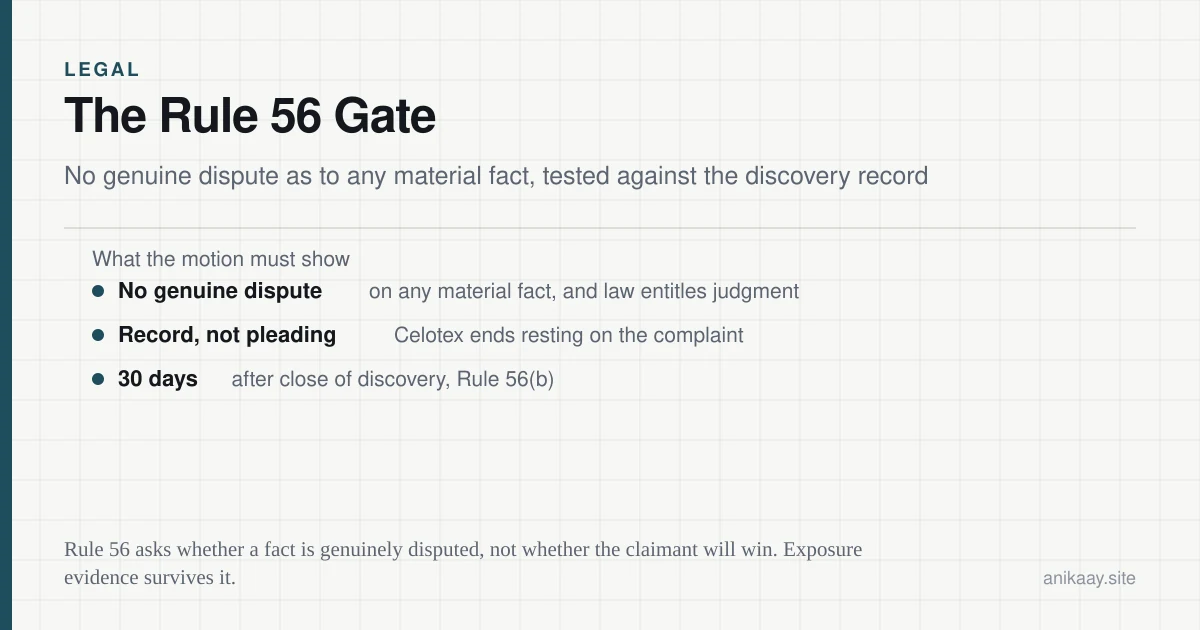
A mass tort defendant that files for summary judgment is asking the court to end the case without a trial on the strength of the written record alone. It wins only if there is no genuine dispute about any material fact and it is entitled to judgment as a matter of law. In a mass tort that standard is hard to clear on the whole docket and easier to clear on one claimant, because the answer usually turns on facts — dose, duration, route of exposure, diagnosis, alternative causes — that differ from person to person.
What summary judgment actually decides
Rule 56(a) is unusually direct about the standard: the court “shall grant summary judgment if the movant shows that there is no genuine dispute as to any material fact and the movant is entitled to judgment as a matter of law,” and “should state on the record the reasons for granting or denying the motion.”
Two features of that sentence matter in a mass tort. First, it is disjunctive in effect: the movant must show both halves, so a case with a genuine dispute on even one material fact survives on that issue no matter how weak the rest of the movant’s showing is. Second, the rule contemplates that some facts are not for the jury. Rule 56(g) says that if the court does not grant all the relief requested, it may enter an order stating any material fact — including an item of damages — that is not genuinely in dispute and treating it as established. That is how a mass tort docket moves: not wholesale, but by narrow written orders that fix a handful of facts and leave the rest to trial.
Summary judgment is also available to the plaintiff. A claimant can move for partial summary judgment on liability while damages remain to be proven, which is how the mechanism gets used offensively as well as defensively.
The two decisions that set the standard
For decades the motion was a pleading exercise: the movant pointed to the complaint and asked the court to accept its own version of the facts. Two 1986 decisions ended that.
In Celotex Corp. v. Catrett, 477 U.S. 317 (1986), the Supreme Court held that a party making a summary judgment motion may discharge its burden by showing — by referring to particular parts of the materials in the record, or by showing that the materials cited do not establish the presence or absence of a genuine dispute, or that the adverse party cannot produce admissible evidence to support the fact — that there is an absence of evidence as to some element for which the nonmovant bears the burden. The practical effect was to move the summary judgment inquiry off the pleadings and into the record.
Anderson v. Liberty Lobby, Inc., 477 U.S. 242 (1986), supplied the test the courts still apply. The Court held that the dispute is not genuine if the facts construed in the way most favorable to the party against whom the motion is made give rise to no reasonable basis in evidence for that party’s claim. Its three-part formulation became standard everywhere: viewing the evidence in the light most favourable to the nonmovant, drawing all reasonable inferences in the nonmovant’s favour, and asking whether a reasonable jury could return a verdict for that party.
| Element of the Rule 56 inquiry | What the court does | What it means for a mass tort claimant |
|---|---|---|
| View the evidence favourably to the nonmovant | Reads conflicts in the claimant’s favour | Unexplained discrepancies between records usually do not defeat the motion |
| Draw all reasonable inferences for the nonmovant | Refuses to infer causation where the record does not compel it | Missing exposure data is treated as a dispute, not a gap |
| Ask whether a reasonable jury could rule for that party | Decides only what is beyond a jury’s honest disagreement | Element-by-element, which is why partial grants dominate |
The third row is why the motion’s real function in a mass tort is element-by-element rather than all-or-nothing.
What the party moving has to attach
The current rule puts the evidentiary burden on the movant. Rule 56(c)(1) requires a party asserting that a fact cannot be — or is genuinely — disputed to support the assertion either by citing to particular parts of materials in the record (depositions, documents, electronically stored information, affidavits or declarations, stipulations, admissions, interrogatory answers) or by showing that the cited materials do not establish the presence or absence of a genuine dispute, or that the adverse party cannot produce admissible evidence.
Rule 56(c)(3) narrows what the court must look at: “The court need consider only the cited materials, but it may consider other materials in the record.” A defendant that files a motion without attaching the records it relies on is asking the court to accept its assertion, which is exactly what Celotex removed as a permissible route.
Rule 56(c)(4) sets the standard for every affidavit and declaration: made on personal knowledge, setting out facts that would be admissible in evidence, and showing that the affiant is competent to testify on the matters stated. In an exposure case that last clause does real work — an affidavit restating a party’s theory rather than a witness’s knowledge of dose or duration is not Rule 56 evidence.
The four ways a motion loses on its own papers
Rule 56 supplies four mechanisms that quietly dispose of motions. Each is a way the motion fails without the court ever reaching the merits.
Rule 56(e) — failure to support. If a party fails to properly support an assertion of fact, or fails to properly address another party’s assertion as the rule requires, the court may give an opportunity to properly support or address the fact, consider the fact undisputed for purposes of the motion, grant summary judgment if the motion and supporting materials show the movant is entitled to it, or issue any other appropriate order. The remedy is discretionary, and the “any other appropriate order” tail is broad enough that a court may simply deny the motion.
Rule 56(d) — the nonmovant cannot get its facts in. If a nonmovant shows by affidavit or declaration that, for specified reasons, it cannot present facts essential to justify its opposition, the court may defer considering the motion or deny it, allow time to obtain affidavits or declarations or to take discovery, or issue any other appropriate order. This is the provision that converts a premature motion into a scheduling event rather than a loss.
Rule 56(f) — judgment that nobody asked for. After giving notice and a reasonable time to respond, the court may grant summary judgment for a nonmovant, grant the motion on grounds not raised by a party, or consider summary judgment on its own after identifying for the parties material facts that may not be genuinely in dispute. A court invoking 56(f)(3) takes the motion into its own hands, and the notice requirement is doing real work in that case.
Rule 56(h) — bad faith. If satisfied that an affidavit or declaration is submitted in bad faith or solely for delay, the court may, after notice and a reasonable time to respond, order the submitting party to pay the other party the reasonable expenses including attorney’s fees that resulted, and may hold the offending party or attorney in contempt or impose other sanctions.
The deadlines in the rule
| Provision | What it fixes | Effect on the docket |
|---|---|---|
| Rule 56(b) | Motion may be filed until 30 days after the close of all discovery, unless a local rule or court order sets otherwise | Sets the outside limit; a case management order usually sets an earlier date |
| Rule 56(c)(2) | Objection that cited material cannot be presented in a form admissible in evidence | Lets the nonmovant disqualify documents rather than merely dispute them |
| Rule 56(d) | Court may allow time to obtain declarations or take discovery | A missing-evidence showing buys time instead of ending the case |
| Rule 56(f), (h) | “After giving notice and a reasonable time to respond” | Two procedures require notice that the moving party did not necessarily ask for |
Rule 56(f) and Rule 56(h) are the two places the rule speaks to timing without naming a number, which is worth noticing: for a court granting a motion on its own initiative, or imposing a sanctions order for a bad-faith declaration, the rule requires notice and a reasonable opportunity to respond rather than a fixed day count.
Where this sits alongside the rest of the site
If you want the sequence rather than this stage, how mass tort litigation works covers the MDL and bellwether machinery. How discovery works in a mass tort covers the phase that produces the record a Rule 56 motion is measured against, and how a mass tort case gets dismissed covers the earlier pleadings stage, where the same claim is tested without any evidence at all.
Frequently asked questions
What is summary judgment in a mass tort case?
It is a written request that the court decide the case, or part of it, without a trial because no genuine dispute exists about a material fact and the movant is entitled to judgment as a matter of law. Rule 56(a) states the standard in those words. In a mass tort the motion is almost always filed by the defendant after discovery, arguing that no claimant can produce admissible evidence that exposure to the product caused the injury.
Can a mass tort defendant win summary judgment?
Rarely on the whole case, and often on part of it. A motion directed at a single claimant is much more likely to succeed than one directed at the docket, because the answer turns on that claimant’s own exposure, diagnosis and medical history rather than on general causation. Courts routinely grant partial summary judgment on specific issues while leaving liability and damages for trial.
What did Celotex and Anderson change?
Before them, a movant with a plausible claim to no genuine dispute could simply rest on the pleadings. In Celotex Corp. v. Catrett, 477 U.S. 317 (1986), the Supreme Court held that the movant may discharge its burden by showing an absence of evidence on an element for which the nonmovant bears the burden, and by showing that the nonmovant cannot produce admissible evidence. Anderson v. Liberty Lobby, Inc., 477 U.S. 242 (1986), added that the court draws all reasonable inferences in favour of the nonmoving party and asks whether a reasonable jury could return a verdict for that party.
What happens if a party does not properly support its facts?
Rule 56(e) gives the court four options: an opportunity to cure, treating the fact as undisputed for the motion, granting the motion if the undisputed facts entitle the movant to judgment, or any other appropriate order. Rule 56(c)(4) separately requires an affidavit or declaration to be made on personal knowledge, to set out facts that would be admissible in evidence, and to show the affiant can testify on the matters stated.
When does a summary judgment motion have to be filed?
Unless a local rule or a court order sets a different time, Rule 56(b) permits the motion at any time until 30 days after the close of all discovery. That is the presumptive deadline, not a jurisdictional one, and courts routinely set their own schedule in a case management order. Where a nonmovant shows by declaration that it cannot present essential facts, Rule 56(d) lets the court defer or deny the motion, allow time to take discovery, or issue another appropriate order.
Where the primary sources are
- Federal Rule of Civil Procedure 56 — the standard, the filing deadline, the support
requirement, and the four provisions that dispose of motions without a merits ruling —
text and advisory committee notes at
law.cornell.edu/rules/frcp/rule_56 - Celotex Corp. v. Catrett, 477 U.S. 317 (1986), official U.S. Reports text at
tile.loc.gov/storage-services/service/ll/usrep/usrep477/usrep477317/usrep477317.pdf - Anderson v. Liberty Lobby, Inc., 477 U.S. 242 (1986), official U.S. Reports text at
tile.loc.gov/storage-services/service/ll/usrep/usrep477/usrep477242/usrep477242.pdf - Fed. R. Civ. P. 16 — pre-trial procedure and the case management order that usually fixes the actual summary judgment date inside the 30-day window
- 28 U.S.C. § 1407 — the statutory authority for the MDL transfer that puts mass tort plaintiffs in one court, which is where the single shared discovery record comes from
Rules and holdings change. Check the current text of the rule and the current version of any order before relying on a specific provision or deadline.
This is not legal advice
This describes how Rule 56 is structured and what the governing decisions hold. It cannot tell you whether any particular motion will be filed, granted or denied, and a ruling on one claimant’s exposure says nothing about any other claim in the same docket. Only a lawyer reviewing the actual record can do that.
Topics
Legal
primary sources behind this article
01What this matter is made of
- Question
- summary judgment mass tort
- what this article answers
- Sources
- 0
- primary sources cited
- Market
- United States
- the edition this was written for
- Questions answered
- 5
- in the FAQ below
02Pending actions across the largest multidistrict dockets
Bar chart of pending actions. MDL 2738 leads with 69,340 pending actions. The axis is logarithmic.
Logarithmic scale. A linear bar would hide every docket below 8,424 actions entirely. The 8.2× spread is real; the axis is stretched so you can see it.
Source: JPML multidistrict litigation report, 2026-10-01.
03How a mass tort case reaches this point
- Claims filedindividual actions in the district courts
- MDL formedconsolidated for pretrial
- Discovery and motionsthe record this article reports
- Resolutionsettlement or ruling
Frequently asked questions
What is summary judgment in a mass tort case?
It is a written request that the court decide the case, or part of it, without a trial because no genuine dispute exists about a material fact and the movant is entitled to judgment as a matter of law. Rule 56(a) states the standard in those words. In a mass tort the motion is almost always filed by the defendant after discovery, arguing that no claimant can produce admissible evidence that exposure to the product caused the injury.
Can a mass tort defendant win summary judgment?
Rarely on the whole case, and often on part of it. A motion directed at a single claimant is much more likely to succeed than one directed at the docket, because the answer turns on that claimant's own exposure, diagnosis and medical history rather than on general causation. Courts routinely grant partial summary judgment on specific issues while leaving liability and damages for trial.
What did Celotex and Anderson change?
Before them, a movant with a plausible claim to no genuine dispute could simply rest on the pleadings. In Celotex Corp. v. Catrett, 477 U.S. 317 (1986), the Supreme Court held that the movant may discharge its burden by showing an absence of evidence on an element for which the nonmovant bears the burden, and by showing that the nonmovant cannot produce admissible evidence. Anderson v. Liberty Lobby, Inc., 477 U.S. 242 (1986), added that the court draws all reasonable inferences in favour of the nonmoving party and asks whether a reasonable jury could return a verdict for that party.
What happens if a party does not properly support its facts?
Rule 56(e) gives the court four options: an opportunity to cure, treating the fact as undisputed for the motion, granting the motion if the undisputed facts entitle the movant to judgment, or any other appropriate order. Rule 56(c)(4) separately requires an affidavit or declaration to be made on personal knowledge, to set out facts that would be admissible in evidence, and to show the affiant can testify on the matters stated.
When does a summary judgment motion have to be filed?
Unless a local rule or a court order sets a different time, Rule 56(b) permits the motion at any time until 30 days after the close of all discovery. That is the presumptive deadline, not a jurisdictional one, and courts routinely set their own schedule in a case management order. Where a nonmovant shows by declaration that it cannot present essential facts, Rule 56(d) lets the court defer or deny the motion, allow time to take discovery, or issue another appropriate order.
Ask about this case
Summary Judgment in a Mass Tort: What Rule 56 Actually Decides