How Discovery Works in a Mass Tort: Master Protocols and Rule 26
A mass tort runs on one master discovery protocol, not thousands of individual ones. Common fact depositions let one plaintiff testify for many, and most claims are resolved on documents alone.
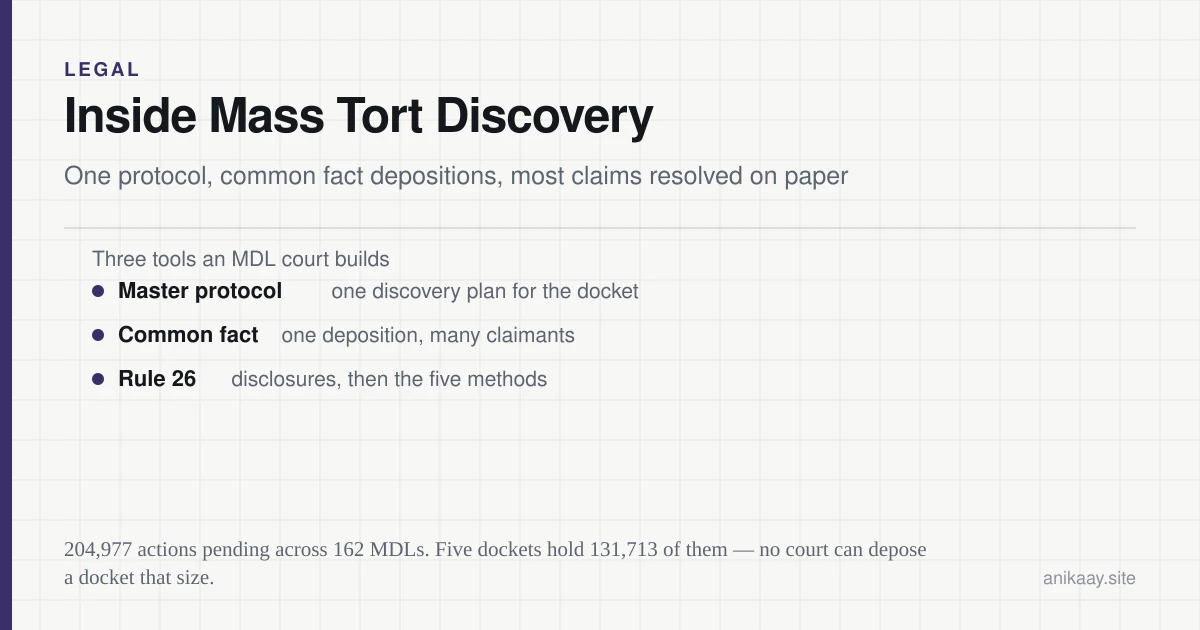
Discovery is the phase where a mass tort stops being a set of complaints and becomes an evidence problem, and it is the phase almost no individual claimant ever sees. It is run by one judge, under one written protocol, against a list of demands that would be absurd if there were only one case. Understanding that structure is most of what there is to understand about mass tort discovery.
What discovery actually is
Discovery is the phase between the pleadings and trial in which each side obtains information from the other and from third parties. Federal Rule of Civil Procedure 26(a) requires each party to make disclosures without being asked: the identity of witnesses, documents held in the party’s possession or control, damages computation, and insurance agreements. Everything else is permissive — those are the tools a party can request.
Rule 26(b)(1) lists the methods. Depositions and interrogatories are the two that carry most of the load in product liability. Requests for production, requests for admission, and depositions of third parties on the usual terms fill out the rest.
The object of discovery is narrower than people expect. It is not to prove the case. It is to find out what the other side says, and to take away the ability of either side to be surprised at trial.
Why an ordinary case cannot be copied here
A normal products case might involve three plaintiffs. Discovery is expensive, and the proportionality rules are workable because the numbers are small.
A mass tort involves thousands of claimants against the same defendant over the same product, raising what are usually the same legal questions. Running Rule 26 independently in each case would mean thousands of document requests, thousands of depositions on identical subjects, and a discovery dispute in every file. It would also be unfair: the plaintiff who happened to be assigned a patient, cooperative defendant would get a case that was better prepared than everyone else’s.
So the MDL judge builds a single discovery architecture for the whole docket.
What the judge builds
A master discovery protocol. This is the central order. It defines the scope of production, the format documents must take, the deadlines, how privilege is handled, whether confidentiality designations get a clawback period, and — usually — a standing procedure for resolving discovery disputes, often through a dedicated discovery judge or magistrate.
Common fact depositions. This is the single most distinctive feature of mass tort discovery, and it is worth understanding. Rather than deposing thousands of individual plaintiffs, the court identifies a limited number of representative claimants and takes their testimony subject to being used as substantive evidence for other cases with the same or a similar injury. That single mechanism is what lets a 69,000-plaintiff docket be discovered at all.
Standard interrogatories and document requests. Instead of each case drafting its own, the protocol supplies a common set. Both sides answer the same questions in the same format, which makes the answers comparable across the docket.
Case-specific discovery. A protocol usually leaves room for discovery tailored to individual claimants — the particular medical record, the specific product lot, the specific employer. It is expensive and generally granted only for the cases that need it.
Why most claimants are never deposed
This is the question most people ask, and the answer explains the shape of the entire process. As of the JPML’s October 1, 2026 report, 162 MDLs were active with 204,977 actions pending. Those actions are distributed extremely unevenly:
| Measure (JPML report, October 1, 2026) | Figure |
|---|---|
| Active MDLs | 162 |
| Actions pending across all MDLs | 204,977 |
| Actions historically filed across all MDLs | 717,525 |
| MDLs with 1,000 or more pending actions | 21 |
| MDLs with between 1 and 999 pending actions | 136 |
| MDLs with no pending actions | 5 |
| MDLs terminated so far in 2026 | 14 |
The five largest pending dockets — talc (69,340), polypropylene hernia mesh (23,324), AFFF firefighter foams (15,264), hair relaxer (12,381) and proton pump inhibitors (11,404) — account for 131,713 of the 204,977 pending actions. The concentration is the point: a substantial share of all mass tort litigation in the country sits in five files.
No court can depose 69,340 people. What it does instead is select a small number of cases for full development, take a limited set of common fact depositions, and then negotiate a resolution for the remainder on the strength of the developed cases plus documents already produced. A claim that is never deposed is not being neglected. It is being resolved on a record that other people’s depositions built.
What that means for an individual claim
Realistically, a claimant’s participation in discovery usually means answering written interrogatories and producing medical records — not sitting for a deposition. The levers a person controls are completing a medical records release, answering written questions accurately, and keeping their own documentation current.
The risk to watch is not being deposed; it is a missed production deadline in a case that was selected. Courts sanction non-compliance, and in a mass tort the sanctions are applied to individuals in the same way they are applied to institutions.
Where discovery sits between the other stages
Discovery follows the pleadings and precedes the bellwether trials that set the value of the cases. If you want the sequence rather than this stage, how mass tort litigation works covers the MDL and bellwether machinery, and how a mass tort case gets dismissed covers the pleadings stage immediately before it. How an individual claim moves follows a single claimant through exposure, diagnosis and filing — the part that happens before discovery ever reaches them.
Frequently asked questions
What is discovery in a mass tort case? Discovery is the pre-trial phase in which the parties exchange information about the claims: documents, medical records, product data and testimony. In a mass tort it is run centrally by the MDL judge under a master discovery protocol rather than case by case, because the same questions have to be answered thousands of times. It is governed by Federal Rule of Civil Procedure 26 and the disclosure rules that follow it.
Why have I not been asked to give a deposition? Usually because you are not one of the selected cases. An MDL tries a small number of bellwether cases and negotiates the rest, so the judge picks a limited group of plaintiffs for depositions. Common fact depositions, where one carefully selected plaintiff testifies on behalf of many, were specifically built to extend discovery coverage without deposing the entire docket.
What is a master discovery protocol? It is a court-issued order that sets one discovery plan for the whole multidistrict litigation, defining what must be produced, in what form, by when, and how disputes get resolved. Without it, thousands of individual cases would each negotiate their own scope, which is unworkable at that volume. The protocol also normally includes clawback and confidentiality terms.
What happens if a party refuses to comply with a discovery request? The requesting party can move to compel under Rule 37, and if the failure is unjustified the court can sanction the party that refused, up to dismissing its claims or barring it from presenting evidence. In a mass tort the practical stakes are usually set earlier, by the cost of the motion and by the damage a missed deadline does to a party’s position at trial.
Does my claim move faster if I give a deposition? Not necessarily, and it is not required. Deposition testimony is one input among several, and courts select cases for it based on how well the documents and the legal issues are developed, not on individual merit. Providing records and answering written interrogatories often matters more to how quickly a claim is evaluated.
Where the primary sources are
- Federal Rule of Civil Procedure 26 — initial disclosures, discovery methods, scope and
order, at
law.cornell.edu/rules/frcp/rule_26 - Federal Rule of Civil Procedure 37 — motions to compel and sanctions for failure to comply
with a discovery obligation, at
law.cornell.edu/rules/frcp/rule_37 - 28 U.S.C. § 1407 — the statutory authority for MDL transfer and centralization, which is what makes a single master protocol possible
- Judicial Panel on Multidistrict Litigation, Pending MDLs report dated October 1, 2026,
jpml.uscourts.gov— the source for every count in the table above
Rules and the pending-case counts change. Check the current text and the current report before relying on a specific provision or figure.
This is not legal advice
This is a description of how the process is structured. It cannot tell you whether you have a claim, whether your case is progressing, or what to do about a deadline in your own file. Only a lawyer reviewing your records can do that.
Topics
Legal
primary sources behind this article
01What this matter is made of
- Question
- mass tort discovery
- what this article answers
- Sources
- 0
- primary sources cited
- Market
- United States
- the edition this was written for
- Questions answered
- 5
- in the FAQ below
02Pending actions across the largest multidistrict dockets
Bar chart of pending actions. MDL 2738 leads with 69,340 pending actions. The axis is logarithmic.
Logarithmic scale. A linear bar would hide every docket below 8,424 actions entirely. The 8.2× spread is real; the axis is stretched so you can see it.
Source: JPML multidistrict litigation report, 2026-10-01.
03How a mass tort case reaches this point
- Claims filedindividual actions in the district courts
- MDL formedconsolidated for pretrial
- Discovery and motionsthe record this article reports
- Resolutionsettlement or ruling
Frequently asked questions
What is discovery in a mass tort case?
Discovery is the pre-trial phase in which the parties exchange information about the claims: documents, medical records, product data and testimony. In a mass tort it is run centrally by the MDL judge under a master discovery protocol rather than case by case, because the same questions have to be answered thousands of times. It is governed by Federal Rule of Civil Procedure 26 and the disclosure rules that follow it.
Why have I not been asked to give a deposition?
Usually because you are not one of the selected cases. An MDL tries a small number of bellwether cases and negotiates the rest, so the judge picks a limited group of plaintiffs for depositions. Common fact depositions, where one carefully selected plaintiff testifies on behalf of many, were specifically built to extend discovery coverage without deposing the entire docket.
What is a master discovery protocol?
It is a court-issued order that sets one discovery plan for the whole multidistrict litigation, defining what must be produced, in what form, by when, and how disputes get resolved. Without it, thousands of individual cases would each negotiate their own scope, which is unworkable at that volume. The protocol also normally includes clawback and confidentiality terms.
What happens if a party refuses to comply with a discovery request?
The requesting party can move to compel under Rule 37, and if the failure is unjustified the court can sanction the party that refused, up to dismissing its claims or barring it from presenting evidence. In a mass tort the practical stakes are usually set earlier, by the cost of the motion and by the damage a missed deadline does to a party's position at trial.
Does my claim move faster if I give a deposition?
Not necessarily, and it is not required. Deposition testimony is one input among several, and courts select cases for it based on how well the documents and the legal issues are developed, not on individual merit. Providing records and answering written interrogatories often matters more to how quickly a claim is evaluated.
Ask about this case
How Discovery Works in a Mass Tort: Master Protocols and Rule 26