How a Mass Tort Case Gets Dismissed: Motions to Dismiss and Personal Injury
A mass tort does not have to win at trial to die early. Most end on a defense motion to dismiss under Federal Rule of Civil Procedure 12, argued on the pleadings alone, before any discovery. Here is the test, the four grounds that succeed, and why the allegations in a real mass complaint tend to clear the bar.
The short version
A mass tort does not have to lose at trial to end. A large share of mass tort cases are resolved before a single deposition is taken — and the mechanism that ends them is almost always the same: a motion to dismiss under Federal Rule of Civil Procedure 12.
The rule does something narrow and useful. It says: read the complaint as it is written, accept well-pleaded facts as true, draw reasonable inferences in the plaintiff’s favour, and ask only whether a claim has been stated. It is not a trial, and a defendant who wins one has not proved anything about the underlying facts.
This matters for understanding mass torts, because the dismissal stage explains a lot of what happens later. Most mass tort complaints are not dismissed and most never reach a verdict. They settle — usually after discovery, sometimes during it. The dismissal motion is the filter that runs over the population of cases at the start.
The four grounds
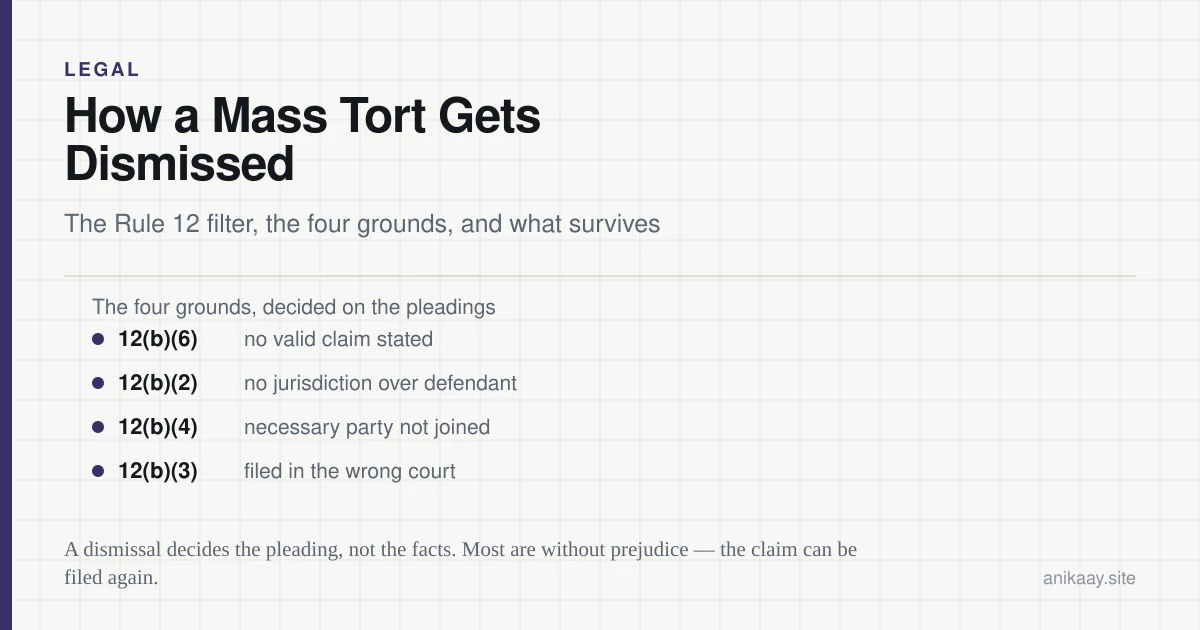
Rule 12 lists several. Four account for nearly every mass tort dismissal:
Lack of personal jurisdiction — Rule 12(b)(2). The court has power over the case but not over the defendant. In mass torts this is usually raised early and cheaply: the plaintiff’s connection to the forum state and the defendant’s purposeful contact with it are questions of fact that can defeat the motion outright, or support it.
Failure to state a claim — Rule 12(b)(6). The most common. The complaint is attacked as legally insufficient: it does not allege an element the cause of action requires. This is the ground that draws the most attention, because it is the one where the shape of the pleading genuinely matters.
Failure to join a necessary party — Rule 12(b)(4). Someone whose presence is required for the relief sought has not been joined. In a products case this regularly means a manufacturer, distributor or component supplier who is not named as a defendant.
Improper venue — Rule 12(b)(3). The case is filed somewhere the law does not permit — too far from the subject of the claim, or outside the district’s coverage.
These can be filed together, and in practice a defense often leads with the jurisdictional argument precisely because it is dispositive if it succeeds and says nothing about the merits if it fails.
The plausibility test, stated precisely
The standard for a 12(b)(6) motion is deliberately demanding on the defendant:
- Well-pleaded factual allegations are taken as true.
- Legal conclusions are not treated as facts.
- Reasonable inferences are drawn in the plaintiff’s favour.
- A claim survives if it is plausible, not if it is probable.
“Plausible” is the operative word. It asks whether, accepting the facts as alleged, the plaintiff has stated something a reasonable person could recognise as a claim. It does not ask whether the plaintiff will win, and courts are explicit that a motion to dismiss is not a mechanism to resolve disputes about fact or the credibility of witnesses — none of that evidence exists yet at this stage.
Why real mass tort complaints usually clear the bar
The instinct is that a complaint listing thousands of similar injuries must be full of generic allegations, and generic allegations fail. In practice mass tort complaints survive more often than not, because of what they must contain to be actionable at all.
Each named plaintiff’s pleading has to connect the injury to the defendant. That means alleging exposure (what the person came into contact with, and when and how much), injury (the specific harm claimed), and causation (the mechanism linking the exposure to the injury). Those are not rhetorical elements; they are what the elements of negligence, failure to warn or product liability require.
The usual dispute is not “did they allege enough” but “how much particularity is enough, and whose knowledge must the complaint show”. A defendant will argue that the complaint must plead the company’s state of mind about the risk, or must attach specific studies showing the product caused this plaintiff’s particular injuries. The general rule is that a complaint need not prove its case at the pleading stage, and courts have declined to hold mass tort plaintiffs to a standard that would force disclosure of the merits before discovery.
The complaints that fail are the ones where that connective tissue is missing — where the allegations name a product and an injury without connecting them, or where the plaintiff pleads only the fact of a diagnosis with no exposure alleged at all.
The right that matters most: with prejudice or without
If the case is dismissed, the operative detail is not the dismissal. It is the wording of the order.
Without prejudice means the claim is not barred from being refiled. A plaintiff may replead, usually with amendments addressing whatever the court identified, and the limitation period may still permit it. A dismissal without leave to amend effectively cancels a case that would have succeeded.
With prejudice is final. The claim cannot be refiled, and this is ordered where the complaint fails in a way no amendment can cure — a statute of limitations that has already run, or a party that could never have stated the claim.
Where a plaintiff has genuinely run out of time, the court often gives leave to amend first and dismisses with prejudice only on the second attempt. Where the defect is curable on its face, the case is dismissed without prejudice and refiled. Reading the order is the whole job at this stage.
What a dismissal is not
It is not a finding on the merits. Nothing at this stage establishes that the defendant acted negligently, or that it did not.
It is not a predictor of the outcome. A case dismissed without prejudice is not weaker than one that was not dismissed at all.
It is not rare. Because mass tort filings arrive in volume and many are repetitive or thinly connected, a meaningful share is cleared early. That is what the filter is for.
And it is not the end of most mass torts. The ones with real injuries and real exposure alleged get through it, then go into discovery, then settle — which is where the great majority of mass tort claims actually end.
Where this sits alongside the rest of the site
If you want the sequence rather than this one stage, how a mass tort actually works covers the MDL and bellwether machinery, and how an individual claim moves covers exposure, diagnosis and the deadline that decides it. This article covers only the stage before discovery begins.
Where the primary sources are
- Federal Rule of Civil Procedure 12 (grounds for dismissal) — text at the Legal Information
Institute,
law.cornell.edu/rules/frcp/rule_12 - 28 U.S.C. § 1407 (multidistrict litigation) — the authority the JPML acts under
- Fed. R. Civ. P. 8 (pleading requirements) and Rule 10(b) (particularity required of allegations)
Statutes and rules can change. Check the current text before relying on a specific provision.
Topics
Legal
primary sources behind this article
01What this matter is made of
- Question
- mass tort motion to dismiss
- what this article answers
- Sources
- 0
- primary sources cited
- Market
- United States
- the edition this was written for
- Questions answered
- 5
- in the FAQ below
02Pending actions across the largest multidistrict dockets
Bar chart of pending actions. MDL 2738 leads with 69,340 pending actions. The axis is logarithmic.
Logarithmic scale. A linear bar would hide every docket below 8,424 actions entirely. The 8.2× spread is real; the axis is stretched so you can see it.
Source: JPML multidistrict litigation report, 2026-10-01.
03How a mass tort case reaches this point
- Claims filedindividual actions in the district courts
- MDL formedconsolidated for pretrial
- Discovery and motionsthe record this article reports
- Resolutionsettlement or ruling
Frequently asked questions
What is a motion to dismiss in a mass tort case?
It is a written request that the court throw out the complaint before any discovery happens, arguing that the complaint fails to state a valid legal claim. In a mass tort it is typically filed under Federal Rule of Civil Procedure 12(b)(6) for failure to state a claim, and it is argued entirely on the face of the pleadings. A defendant can also use Rule 12(b)(1) to challenge the court''s jurisdiction, or Rule 12(b)(3) to argue the case was filed in the wrong place.
Do most mass tort cases actually get dismissed?
Most mass tort cases are not dismissed, and they rarely end at trial either; they settle, most often during or after discovery. A motion to dismiss is instead a filter that runs over every case at the start: weak or repetitive complaints are weeded out early at low cost, while genuine claims survive and continue toward discovery and settlement. The dismissal rate is a poor measure of whether mass torts succeed, because a case dismissed with leave to amend is not a dead case.
What is the Rule 12(b)(6) standard?
A complaint survives a motion to dismiss if it plausibly states a claim for relief. Plausibly means enough factual matter to suggest a right to relief, accepting well-pleaded allegations as true and drawing reasonable inferences in the plaintiff''s favour. Courts do not decide whether the claim will ultimately win, and do not weigh conflicting evidence or judge credibility at this stage.
What are the main grounds for dismissing a mass tort complaint?
Four grounds account for nearly all of them. Lack of personal jurisdiction over the defendant. Failure to state a claim, where the allegations do not establish every element the cause of action requires. Failure to join a necessary party, such as an absent manufacturer or a co-defendant needed for complete relief. And improper venue, where the case was filed somewhere the law does not permit.
What happens if my mass tort case is dismissed?
Most dismissals are without prejudice, which means the plaintiff may file the complaint again, usually with amendments, and the limitation period may still allow it. A dismissal with prejudice is final and forecloses refiling, and it is ordered only where the complaint fails in a way that amendment cannot fix, such as the statute of limitations having already run. Whether the dismissal is with or without prejudice is the single most important detail to check in the order.
Ask about this case
How a Mass Tort Case Gets Dismissed: Motions to Dismiss and Personal Injury