Class Certification in Mass Torts: Why These Cases Are Not Certified Under Rule 23
Mass torts are big because the docket is big, not because the claims are common. Federal courts apply the same Rule 23 gate to a 200,000-action multidistrict docket as to a three-plaintiff case. Here is what certification requires, which test controls, and why the asbestos settlement in 521 U.S. 591 failed it.
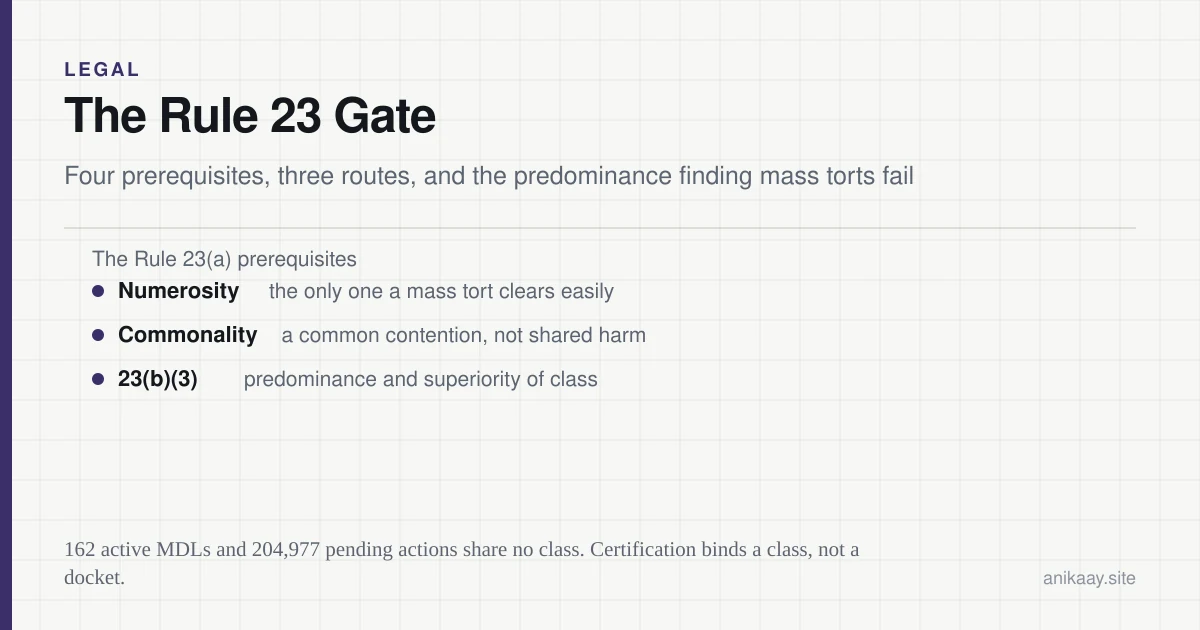
A mass tort is big because the docket is big. It does not follow that its claims are common, and the reason thousands of individual claims get resolved individually rather than as a single class action is the gate in Federal Rule of Civil Procedure 23. That gate — class certification — is where the distinction between a class action and a mass tort is drawn, and it is drawn on a test that has nothing to do with the number of claimants.
What class certification actually decides
Certification is a pretrial order, not a judgment. Before a case proceeds as a class action, the court must decide by order whether the case may be maintained on behalf of everyone in a defined class. Rule 23(c)(1)(A) requires that decision at an early practicable time, and Rule 23(c)(1)(B) requires that an order certifying a class define the class and the claims, issues or defenses being certified, and appoint class counsel.
Two consequences follow from the fact that certification is only an authorisation to proceed collectively. First, it can be amended or altered before final judgment. Second, and more important for a mass tort, it can be issued as to a single issue rather than the whole case, which is the technique that lets courts use class procedure without pretending that every claimant’s claim is the same.
Class certification is also an immediately appealable decision, unusually so. Rule 23(f) allows an interlocutory appeal, and requires the petition for permission to appeal to be filed within 14 days of the order — or 45 days where the United States is a party. That deadline is short on purpose: it forces the class question to be settled before the case consumes the resources that the collective treatment was supposed to save.
The four prerequisites in Rule 23(a)
Every class action, in every category, must clear four prerequisites:
| Prerequisite | What it requires | What defeats it in a mass tort |
|---|---|---|
| Numerosity (23(a)(1)) | The class is so numerous that joining everyone is impracticable | Never the difficulty — mass torts clear it easily |
| Commonality (23(a)(2)) | Questions of law or fact common to the class | Different products, doses, exposure routes and injury types |
| Typicality (23(a)(3)) | The representatives’ claims are typical of the class’s | Individual claimants whose disease differs from the class’s |
| Adequacy (23(a)(4)) | The representatives will fairly and adequately protect the class’s interests | Conflicts of interest among differently situated claimants |
Numerosity is the one prerequisite a mass tort satisfies by definition. The other three are where mass torts are decided, and they interact: a class that is too heterogeneous to be common will also produce representatives who are not typical and who cannot adequately speak for everyone in it.
Commonality is a question about the claims, not the product
Commonality asks whether there are questions of law or fact common to the class. In Wal-Mart Stores, Inc. v. Dukes, 564 U.S. 338 (2011), the Supreme Court made the point sharply: the question is not whether the plaintiffs have been harmed the same way by a defendant doing similar things, but whether there is a common contention that could produce a common answer to an important question. The Court held that a nationwide sex discrimination class failed commonality where the plaintiffs’ statistical and anecdotal evidence did not show that the alleged discriminatory practices operated the same way in each of the company’s roughly 3,400 separately managed stores.
Transposed to a mass tort, this is the central difficulty. Thousands of claimants may all have used a company’s product and all believe they were harmed. That does not establish that a common question exists, because the answer to each claim turns on facts that differ claimant by claimant: which lot, what dose, how long, what other exposures, what diagnosis, what damages. The question a mass tort actually shares tends to be a question about liability in general — was the product defective — which is why that question can sometimes be certified on its own.
Predominance and superiority are the test that mass torts fail
If commonality is the first gate, Rule 23(b)(3) is the second, and it is where mass tort claims usually end. A class may be maintained under 23(b)(3) only if the court finds that common questions predominate over questions affecting only individual members, and that a class action is superior to other available methods for fairly and efficiently adjudicating the controversy. The rule then lists four matters pertinent to that finding: the class members’ interest in individually controlling prosecution or defence, the extent and nature of litigation already begun, the desirability of concentrating the litigation in the particular forum, and the likely difficulties in managing a class action.
The rule lists four factors. They do not govern the outcome; the two findings do. A court that can identify a manageable amount of individualised fact-finding need not find predominance, whatever it says about the other three factors.
Wal-Mart v. Dukes read the two findings together. The Court held that individualized monetary claims do not belong in a Rule 23(b)(2) class, and that the Rule’s own structure places them in Rule 23(b)(3) with its procedural protections of predominance, superiority, mandatory notice and the right to opt out. The point for a mass tort is that the opt-out architecture of 23(b)(3) is the mechanism designed to handle the claimant who wants out — and no mass tort gives its claimants that choice, because each case is filed, prosecuted and resolved by an individual.
Where the leading case on asbestos failed
Amchem Products, Inc. v. Windsor, 521 U.S. 591 (1997), is the decision that explains most of what courts do with mass tort class actions. The settling parties proposed a settlement class of all future asbestos claimants. The Supreme Court held the certification improper on all three of the Rule 23(b)(3) findings.
On commonality, the Court explained, the class included millions of people who were exposed to asbestos in different ways for different durations, some of whom were latently injured. On adequacy, the interests of those claimants diverged: the class included people with current claims whose value depended on their illness, and people with future claims whose rights depended on a settlement fund that they had not agreed to. Plaintiff counsel’s duties to existing clients could conflict with their duty to the undiscovered future claimants. And on superiority, the parties’ own agreement that individualised monetary relief was involved counted against them — a settlement that depends on how much each person is owed is not obviously superior to resolving each case on its own facts.
The lesson that survived Amchem is structural, not asbestos-specific. A settlement or certification that still has to price each claimant’s individual harm is not solving a problem the class device solves.
Why narrow certification is the device that works
Rule 23(c)(4) allows a class action to be brought or maintained “with respect to particular issues,” and Rule 23(c)(5) allows the court to divide a class into subclasses that are each treated as a class. This is what real mass tort class practice looks like.
A court can certify a class on the narrowest questions the mass tort shares — whether one specific product line was mislabelled, whether the defendant knew of a hazard at a particular date and concealed it from a defined group, whether a particular marketing representation was made to a defined class of purchasers — and leave every claimant’s injury, damages and eligibility to be resolved individually. Class members get binding resolution of the certified issue, which saves duplicative work; they do not get a single recovery, and they do not lose the right to prove their own loss.
Rule 23(c)(2)(B) also imposes what is effectively a notice architecture on the process. A court must direct to class members the best notice practicable, including individual notice to members identifiable through reasonable effort, and that notice must state in plain language the nature of the action, the definition of the class, the claims certified, the right to enter an appearance, and the right to request exclusion. That is a significant constraint in a mass tort, where the certified class may be defined by a manufacturing date range or a purchase window and identifying the members requires custodian records.
The difference from a multidistrict docket, in numbers
The contrast is easy to miss because both are called “mass” litigation, but the two mechanisms are unrelated in their legal basis. Multidistrict litigation is a procedural centralisation under 28 U.S.C. § 1407, handled by the Judicial Panel on Multidistrict Litigation; it consolidates cases for pretrial purposes and binds no one to a judgment. Class certification under Rule 23 is the mechanism that binds a defined class.
As of the JPML’s October 1, 2026 report, 162 MDLs were active with 204,977 actions pending:
| Measure (JPML report, October 1, 2026) | Figure |
|---|---|
| Active MDLs | 162 |
| Actions pending across all MDLs | 204,977 |
| Actions historically filed across all MDLs | 717,525 |
| MDLs with 1,000 or more pending actions | 21 |
| MDLs with between 1 and 999 pending actions | 136 |
| MDLs terminated so far in 2026 | 14 |
A Rule 23 class is not one of these numbers and does not appear in them. Every one of those 204,977 actions is an individual case, filed by an individual, with individual pleadings, individual discovery responses and an individual share of any recovery.
How certification fits in the sequence
Certification is a gate that runs early, and if it closes, the case simply continues as an individual action inside the MDL. Nothing about the rest of the docket changes. If you want the sequence rather than this gate, how mass tort litigation works covers the MDL and bellwether machinery, and how discovery works in a mass tort covers the phase where common fact depositions substitute for deposing each claimant. How a mass tort case gets dismissed covers the pleadings stage that runs before certification is ever reached.
Frequently asked questions
Why are mass torts not certified as class actions?
Because the size of a docket says nothing about whether its claims raise common questions. A mass tort aggregates thousands of individual injuries with different products, doses, exposure lengths and medical histories, and Rule 23(b)(3) requires that those individual questions not predominate. Courts can and do certify narrow classes within a mass tort — a single product, a single fraudulent concealment theory, a single failure to warn — but a class covering the whole docket nearly always fails at commonality or predominance.
What are the four requirements for class certification?
Federal Rule of Civil Procedure 23(a) sets four prerequisites that apply to every class action: the class must be so numerous that joining everyone is impracticable; there must be questions of law or fact common to the class; the representative parties’ claims must be typical of the class; and the representatives must fairly and adequately protect the class’s interests. A class must also fit one of the three routes in Rule 23(b).
What is the predominance requirement?
It is the Rule 23(b)(3) requirement that common questions of law or fact outweigh questions affecting only individual members. In a mass tort, every claimant’s injury history, exposure and damages are individual questions, so they tend to predominate. The Supreme Court rejected classwide certification for individualized monetary claims in Wal-Mart Stores, Inc. v. Dukes, 564 U.S. 338 (2011).
Can any mass tort get class certification?
Yes, and courts do it. A class limited to a single product, a single fraudulent concealment scheme or a single failure-to-warn theory can satisfy commonality, typicality and adequacy. The device that makes narrow certification workable is issue or subclass certification under Rule 23(c)(4) and (c)(5), which binds the class only on the certified issue while leaving each claim’s value to be resolved individually.
What did the Supreme Court decide in Amchem Products?
In Amchem Products, Inc. v. Windsor, 521 U.S. 591 (1997), the Court held that a proposed settlement class covering all present and future asbestos claims could not be certified. The asbestos exposures were not sufficiently similar for commonality, individualised concerns about future claimants’ health and settlement rights defeated adequacy of representation, and the parties’ own agreement that individualised monetary relief was involved defeated the Rule 23(b)(3) superiority showing.
Where the primary sources are
- Federal Rule of Civil Procedure 23 — prerequisites, the three routes, certification and
notice orders, issue and subclass certification, settlement approval, and the
interlocutory appeal deadline, at
law.cornell.edu/rules/frcp/rule_23 - Amchem Products, Inc. v. Windsor, 521 U.S. 591 (1997), official U.S. Reports text at
cdn.loc.gov/service/ll/usrep/usrep521/usrep521591/usrep521591.pdf - Wal-Mart Stores, Inc. v. Dukes, 564 U.S. 338 (2011), official U.S. Reports text at
tile.loc.gov/storage-services/service/ll/usrep/usrep564/usrep564338/usrep564338.pdf - 28 U.S.C. § 1407 — the statutory authority for MDL transfer, which is the separate mechanism and the reason the JPML docket counts below are not class figures
- Judicial Panel on Multidistrict Litigation, Pending MDLs report dated October 1, 2026,
jpml.uscourts.gov— the source for every count in the table above
Rules, holdings and the pending-case counts change. Check the current text of the rule and the current report before relying on a specific provision or figure.
This is not legal advice
This is a description of how the certification gate is structured. It cannot tell you whether any case has been or will be certified, or what a certification order means for a particular claim. Only a lawyer reviewing the pleadings in the actual case can do that.
Topics
Legal
primary sources behind this article
01What this matter is made of
- Question
- class certification mass tort
- what this article answers
- Sources
- 0
- primary sources cited
- Market
- United States
- the edition this was written for
- Questions answered
- 5
- in the FAQ below
02Pending actions across the largest multidistrict dockets
Bar chart of pending actions. MDL 2738 leads with 69,340 pending actions. The axis is logarithmic.
Logarithmic scale. A linear bar would hide every docket below 8,424 actions entirely. The 8.2× spread is real; the axis is stretched so you can see it.
Source: JPML multidistrict litigation report, 2026-10-01.
03How a mass tort case reaches this point
- Claims filedindividual actions in the district courts
- MDL formedconsolidated for pretrial
- Discovery and motionsthe record this article reports
- Resolutionsettlement or ruling
Frequently asked questions
Why are mass torts not certified as class actions?
Because the size of a docket says nothing about whether its claims raise common questions. A mass tort aggregates thousands of individual injuries with different products, doses, exposure lengths and medical histories, and Rule 23(b)(3) requires that those individual questions not predominate. Courts can and do certify narrow classes within a mass tort — a single product, a single fraudulent concealment theory, a single failure to warn — but a class covering the whole docket nearly always fails at commonality or predominance.
What are the four requirements for class certification?
Federal Rule of Civil Procedure 23(a) sets four prerequisites that apply to every class action: the class must be so numerous that joining everyone is impracticable; there must be questions of law or fact common to the class; the representative parties'' claims must be typical of the class; and the representatives must fairly and adequately protect the class''s interests. A class must also fit one of the three routes in Rule 23(b).
What is the predominance requirement?
It is the Rule 23(b)(3) requirement that common questions of law or fact outweigh questions affecting only individual members. In a mass tort, every claimant''s injury history, exposure and damages are individual questions, so they tend to predominate. The Supreme Court rejected classwide certification for individualized monetary claims in Wal-Mart Stores, Inc. v. Dukes, 564 U.S. 338 (2011).
Can any mass tort get class certification?
Yes, and courts do it. A class limited to a single product, a single fraudulent concealment scheme or a single failure-to-warn theory can satisfy commonality, typicality and adequacy. The device that makes narrow certification workable is issue or subclass certification under Rule 23(c)(4) and (c)(5), which binds the class only on the certified issue while leaving each claim''s value to be resolved individually.
What did the Supreme Court decide in Amchem Products?
In Amchem Products, Inc. v. Windsor, 521 U.S. 591 (1997), the Court held that a proposed settlement class covering all present and future asbestos claims could not be certified. The asbestos exposures were not sufficiently similar for commonality, individualised concerns about future claimants'' health and settlement rights defeated adequacy of representation, and the parties'' own agreement that individualised monetary relief was involved defeated the Rule 23(b)(3) superiority showing.
Ask about this case
Class Certification in Mass Torts: Why These Cases Are Not Certified Under Rule 23