Removal to Federal Court in a Mass Tort and the One-Year Deadline
A mass tort filed in state court reaches a federal MDL by a defined route: the defendant removes under 28 U.S.C. § 1441 if diversity jurisdiction exists, and the one-year clock in § 1446(d) decides what happens next. Here is what each step requires and how the deadline is computed.
Most mass tort coverage explains what happens once a case is inside the federal system. This article explains the step before that: how a case leaves state court for federal court, and the deadline that decides whether that step is still available.
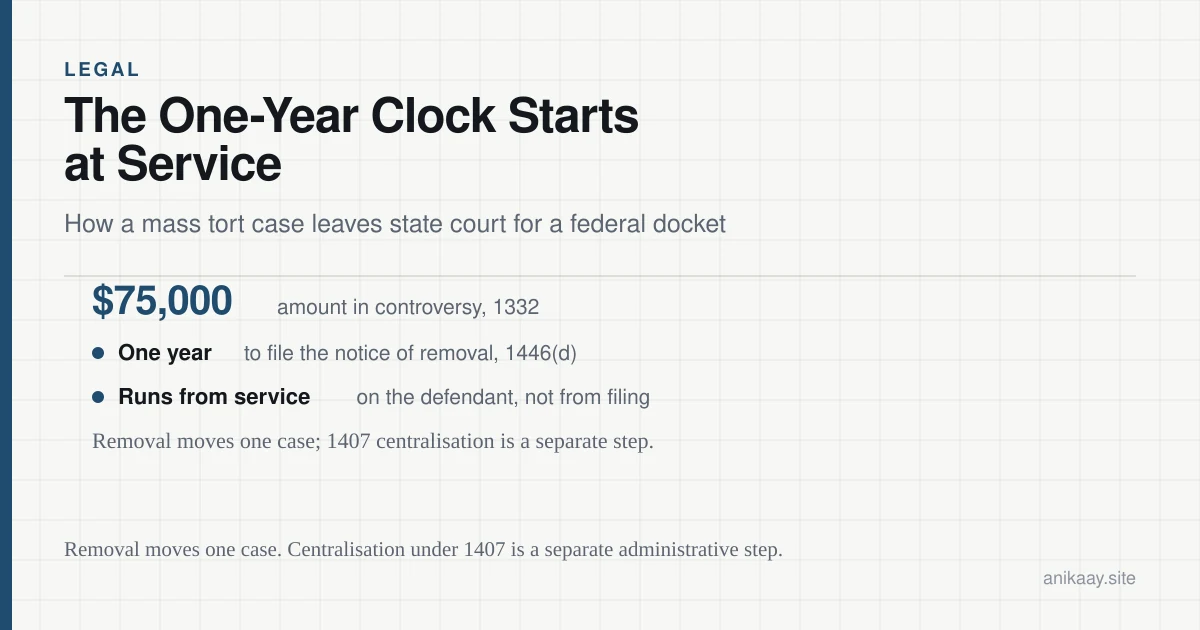
The answer has two parts. A defendant moves the case from state court to federal court under 28 U.S.C. § 1441, and only if a federal district court would have had original jurisdiction — in a mass tort, almost always diversity jurisdiction under § 1332. And the notice of removal must be filed within one year of service of the complaint, under 28 U.S.C. § 1446(d). Miss that year and the case stays where it was filed.
What does removal to federal court actually mean in a mass tort?
Removal is a procedural transfer of a single case. It does not merge anything, does not move other plaintiffs’ claims, and does not create a docket.
The full picture is easier to understand as three separate mechanisms that people frequently conflate:
| Mechanism | Statute | What moves | Decided by |
|---|---|---|---|
| Original federal jurisdiction | 28 U.S.C. § 1332 | Nothing — a case is filed federal from the start | The plaintiff chooses |
| Removal | 28 U.S.C. § 1441 | One state case into one federal district | The defendant, within § 1446(d)’s year |
| Centralisation | 28 U.S.C. § 1407 | Related federal cases from many districts into one | The Judicial Panel on Multidistrict Litigation |
If you want the shape of the litigation itself — what an MDL is, what bellwether trials are for, and why these cases are not certified under Rule 23 — start with what is a mass tort and how MDLs work. This article is about the threshold that comes before all of that.
When does federal jurisdiction exist in a mass tort?
For the mass torts that produce the largest dockets, federal jurisdiction is usually diversity of citizenship under § 1332(a)(2). The statute requires three things:
- Complete diversity — every plaintiff is a citizen of one state and every defendant is a citizen of another state or of a foreign country. A single plaintiff or defendant whose citizenship matches another’s on the same side defeats it. Where a defendant is a corporation, its citizenship includes the state of incorporation and the state of its principal place of business, which means an incorporated-insurer defendant frequently destroys complete diversity on its own.
- Amount in controversy exceeding $75,000 exclusive of interest and costs. Mass tort plaintiffs usually plead in far excess of that, but a single-claimant pro se filing sometimes does not.
- Original jurisdiction, meaning the case could have been brought in federal court in the first place. Federal courts are courts of original jurisdiction, not appellate courts, so a plaintiff cannot create diversity jurisdiction by appeal.
A small but important minority of mass tort claims reach federal court on federal question jurisdiction under § 1331 rather than diversity, and some reach it through federal employment law such as the Black Lung Benefits Act or the Federal Mine Safety and Health Act, which the courts have held carry concurrent jurisdiction.
How does the one-year removal deadline get computed?
Section 1446(d) fixes the outer limit: a notice of removal must be filed within one year after the defendant has been served with the complaint. The trigger is service on the defendant, so the date that matters is the date process was effected on that defendant — not the date the plaintiff filed, and not the date any later federal proceeding begins.
The mechanics are short and are set out in Rules 4 and 12 of the Federal Rules of Civil Procedure as made applicable to removed cases:
- The defendant is served with the summons and complaint under Rule 4.
- The summons carries a statement that the case will be removed to federal court if not removed within the applicable period.
- Before answering, the defendant files the notice of removal — a short paper, not a motion — in the state court where the action is pending.
- The state court orders the action transferred to the federal district court for the district where the state court sits.
Because the deadline is tied to service rather than to filing, a plaintiff who delays service does not extend the defendant’s window; a plaintiff who serves promptly starts the defendant’s clock promptly.
What happens to a case that is removed too late?
If the one-year period has run, the notice of removal is untimely. Section 1446(d) provides that a state court in such a case shall not ordinarily consider the action removed, which in practical terms means the state court keeps jurisdiction and the case proceeds there.
That is not the end of the story, because § 1407 does not depend on removal timing. A case that remains in state court cannot be centralised by the Judicial Panel, which acts only on federal actions. The practical result is a case that may proceed alone in a state court while the bulk of the same product’s litigation is coordinated elsewhere.
Removal after the case has already been removed is governed by § 1446(b): a second defendant seeking to remove must file within 90 days of receiving the state court’s removal order, subject to the same one-year outer limit where that has not yet passed.
What is the “one-year” period measured in, and is it shortened?
The period runs from service to the defendant, and a defendant who has not been served within the state’s applicable service period generally may seek an extension under Rule 4 and § 1446(d), which preserve the case-specific scheduling rules in the forum state. Courts have also applied the deadline strictly in both directions: it is not extendable by agreement or by conduct, and it is not shortened by an earlier discovery schedule.
A less common route to federal court worth knowing is notice of removal by supplemental complaint under § 1443(b), used where new claims are added that themselves satisfy § 1442(a), the federal-question analogue of diversity removal.
Does removal lead automatically to MDL centralisation?
No. Removal ends at the federal district level.
Centralisation is administrative and separate. The Judicial Panel on Multidistrict Litigation, staffed by federal district judges, decides whether related actions across districts should be transferred to a single district for pretrial purposes. The Panel’s authority comes from § 1407(a), which permits transfer where common facts or common law questions are likely to arise, and from § 1407(g), which directs creation of a discovery depot for use in the consolidated action.
If the Panel declines to centralise — and it does, in many substantial product matters — the federal cases simply proceed in the districts where they were filed. The explanation of why these cases are not certified as class actions covers that branch in detail.
What happens after removal, at the motions stage?
Removal is not the end of the litigation’s early phase. Once a case is in federal court, it proceeds to the same first motions any federal personal injury action faces, on a federal schedule. The pleading-stage motion that usually matters is the motion to dismiss under Rule 12(b)(6) — covered here at the Rule 12 motion in a mass tort. Later, if the case survives dismissal and discovery is complete, summary judgment under Rule 56 becomes available, which this site covers in what Rule 56 actually decides.
The sequence worth remembering is: service starts the clock, the clock runs one year, and the federal docket begins. Anything that happens in federal court after that is ordinary federal civil procedure.
Why the removal step matters more in a mass tort than in an ordinary case
In an ordinary two-party case, removal is a strategic choice with modest consequences. In a mass tort it is a structural one, because:
- Discovery law changes on removal. State procedural rules, including state limitations on discovery, no longer govern once the case is in federal court under Rules 26–37. A case that was comfortable in state court can face materially different discovery obligations.
- Remand unwinds all of it. If a federal court finds improper removal and remands under § 1446(e), the case returns to the state court it started in, having spent the interim under federal rules.
- Coordination depends on the case being federal. Centralisation, bellwether selection and case-specific management plans all operate on federal cases. A case stuck in a state court sits outside that machinery entirely.
Where the primary sources are
- 28 U.S.C. § 1332 — Jurisdiction of the United States courts in diversity, including the $75,000 amount-in-controversy requirement and complete diversity. https://www.law.cornell.edu/uscode/text/28/1332
- 28 U.S.C. § 1407 — Transfer of actions to a common district, the authority under which the Judicial Panel on Multidistrict Litigation centralises related federal actions. https://www.law.cornell.edu/uscode/text/28/1407
- 28 U.S.C. § 1441 — Removal of cases from State courts, the general removal provision. https://www.law.cornell.edu/uscode/text/28/1441
- 28 U.S.C. § 1443 — Removal by the United States or a State agency, including § 1443(b) notice of removal by supplemental complaint. https://www.law.cornell.edu/uscode/text/28/1443
- 28 U.S.C. § 1446 — Procedure for removal, containing the one-year notice deadline in § 1446(d), the 90-day window in § 1446(b) for additional defendants, and the remand provision in § 1446(e). https://www.law.cornell.edu/uscode/text/28/1446
- Federal Rules of Civil Procedure, Rules 4, 12 and 26. https://www.law.cornell.edu/rules/frcp
- Judicial Panel on Multidistrict Litigation — the panel’s rules and docket information. https://www.jpml.uscourts.gov/
Topics
Legal
primary sources behind this article
01What this matter is made of
- Question
- removal to federal court mass tort
- what this article answers
- Sources
- 0
- primary sources cited
- Market
- United States
- the edition this was written for
- Questions answered
- 6
- in the FAQ below
02Pending actions across the largest multidistrict dockets
Bar chart of pending actions. MDL 2738 leads with 69,340 pending actions. The axis is logarithmic.
Logarithmic scale. A linear bar would hide every docket below 8,424 actions entirely. The 8.2× spread is real; the axis is stretched so you can see it.
Source: JPML multidistrict litigation report, 2026-10-01.
03How a mass tort case reaches this point
- Claims filedindividual actions in the district courts
- MDL formedconsolidated for pretrial
- Discovery and motionsthe record this article reports
- Resolutionsettlement or ruling
Frequently asked questions
How does a mass tort case end up in federal court?
Almost always by removal under 28 U.S.C. § 1441. The defendant files a notice of removal in state court, and the federal district court accepts the case only if it could have heard the action originally — in practice, diversity jurisdiction under § 1332 with the amount in controversy above $75,000 and complete diversity between the parties. Once in federal court, related cases from other districts are centralised before the Judicial Panel on Multidistrict Litigation under § 1407.
When does the one-year deadline to remove start running?
From the date the defendant is served with the complaint, not from the filing date and not from the date the case later reaches an MDL. Section 1446(d) requires a notice of removal to be filed within one year of service. For a defendant that must be served under Rule 4, that means the clock runs against the complaint actually served on the defendant.
What happens if the one-year deadline passes?
The case stays in state court. Section 1446(d) provides that a state court may consider the action removed only if the notice of removal is filed within one year of service, so an untimely notice does not divest the state court of jurisdiction. In practice the case then proceeds as an individual state action unless it is later transferred under § 1407.
Does removal end the case in the state where it was filed?
No. Federal courts review a notice of removal under 28 U.S.C. § 1446(e); if the case is not properly removed it is remanded to the state court where it was filed. This is the reason diversity is scrutinised strictly: the plaintiff is entitled to stay in the forum the defendant chose.
Is removal the same as centralisation into an MDL?
No, and the distinction is the most common misunderstanding. Removal moves one case from state court to one federal district court. Centralisation under § 1407 is administrative: the Judicial Panel on Multidistrict Litigation directs transfer of related federal actions from multiple districts into one, and it operates only on cases already in federal court.
Does a mass tort case need a JPML centralised docket to go forward?
No. A plaintiff may file directly in federal court where § 1332 diversity exists, without any JPML proceeding. Whether a case is eventually centralised is decided by the Panel, not chosen by the plaintiff, and a non-centralised federal case proceeds as an ordinary action.
Ask about this case
Removal to Federal Court in a Mass Tort and the One-Year Deadline