What Is a Plaintiff Fact Sheet in a Mass Tort?
A plaintiff fact sheet is a court-approved questionnaire, completed under penalty of perjury, that standardises what every claimant in a mass tort tells the court. It is how a docket that cannot depose 69,340 people gets a census.
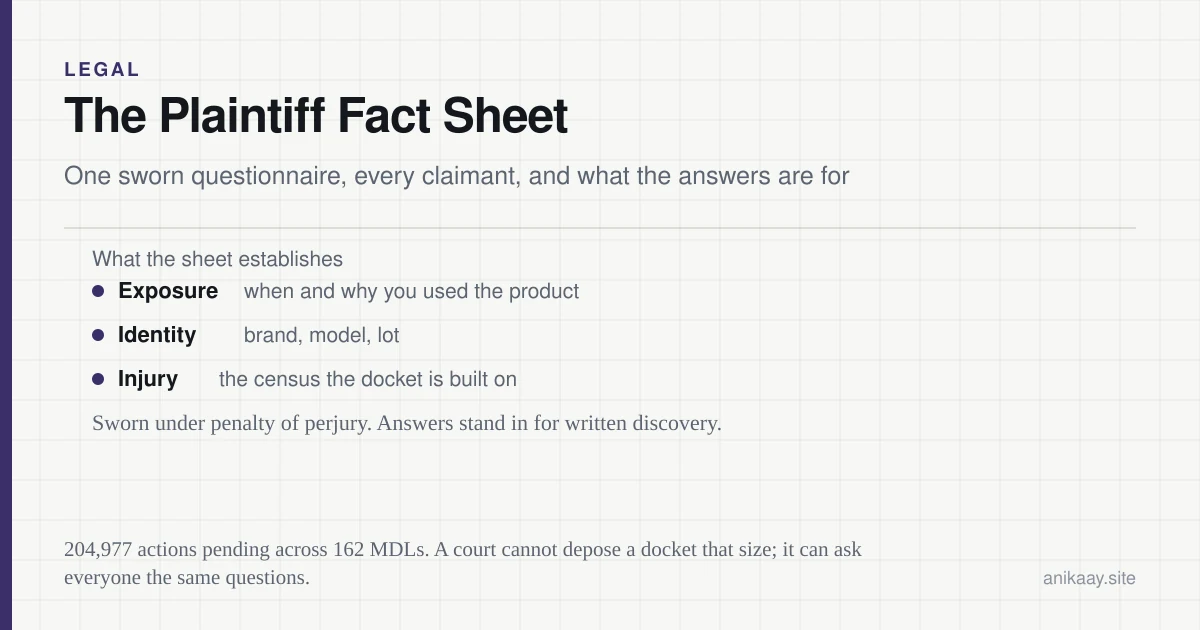
A plaintiff fact sheet in a mass tort is a sworn, standardised questionnaire that every claimant in the docket completes. It asks when and why you used the product, how you identify it, what injury you are claiming, and what records you are releasing — and its answers are generally treated as your responses to written discovery. It exists because the arithmetic of mass tort litigation makes anything else impossible: as of the JPML report dated October 1, 2026, 162 MDLs were active with 204,977 actions pending, five of which hold 131,713 of those actions. A court cannot depose a docket that size. It can, however, ask every claimant the same twenty questions in writing and read the answers.
The Federal Judicial Center — the research arm of the federal judiciary, which published a pocket guide on this subject jointly with the JPML in 2019 — describes fact sheets as party-negotiated and court-approved standardised questionnaires that seek information about parties’ claims and defenses. That guide, and the MDL case management orders it cites, are where everything below comes from.
What does a fact sheet actually ask?
Five things, consistently, across dockets that differ in almost every other respect:
| What it asks | Why the court wants it |
|---|---|
| When and why the plaintiff used the product | Fixes the exposure window against the statute of limitations |
| Product identification — brand, model, lot | Connects the claimant to a specific defendant and a specific record set |
| The plaintiff’s medical history | Establishes baseline conditions before the exposure |
| The injuries claimed | Produces the census of injury types the docket is built around |
| Document requests and a witness list | Supplies the plaintiff-specific discovery that a census cannot |
Proceedings add more where they need to. Some fact sheets ask about education, employment, criminal history, social media use and prior litigation. Nearly all require the plaintiff to sign authorizations releasing medical, insurance and financial records, and those authorizations are usually collected at the same time as the questionnaire — because a fact sheet asking for a medical history is not much use if the records cannot be obtained.
Some dockets also run a defendant fact sheet, submitted after the plaintiff’s. It gathers a different set: the defendant’s contacts with the plaintiff’s prescribing providers, information about product identification, the chain of custody for the product or device, and the adverse event reports the defendant holds. Courts have ordered defendant fact sheets for cases in bellwether selection pools, including in In re Testosterone Replacement Therapy, MDL No. 2545.
When in the life of the docket is it ordered?
Earlier than most people expect. Federal Judicial Center research on products liability MDLs found the time between centralization and an order requiring fact sheets ranged from forty-five days to several years, with an average of about eight months from centralization. Older proceedings tended to wait until the litigation matured; it is now more common to raise fact sheets at the first case management conference.
The judge then directs the parties to negotiate contents and the necessary releases. In some proceedings the sides negotiate with each other and submit one draft. In others the court orders competing proposals and picks one — as happened in In re Biomet M2a Magnum Hip Implant, MDL No. 2391, where the judge entered an order in October 2012 requiring submissions, then selected one of two proposals in January 2013, then adopted a modified version in March 2013 after another negotiation round.
The order itself then sets: who submits where (leadership counsel, opposing counsel directly, or a third-party vendor platform), deadlines for cases already in the docket and for cases filed later, confidentiality handling for medical data, and the enforcement procedure. Courts generally check vendor arrangements — who pays, who can access the data, what security applies — when a vendor platform is used.
How is it different from interrogatories, and from a Lone Pine order?
This is where most confusion happens. Three different mechanisms, often in the same docket.
Interrogatories are written questions served under Rule 33. A fact sheet is a court-ordered questionnaire negotiated by the parties and adopted by case management order. The practical difference is that a completed fact sheet is generally treated as the plaintiff’s answer to a standard set of written discovery requests — which is exactly where the savings come from across thousands of similar claims. It does not replace ordinary discovery: case- specific discovery still runs in cases selected for the initial disposition or the bellwether pool, in the ordinary way. The Mass tort discovery explainer covers how that phase is structured.
A Lone Pine order is a different tool with a different threshold. A Lone Pine order asks a plaintiff for evidence — exposure, injury, and a connection between them, sometimes supported by an expert affidavit. A fact sheet asks for information, and is sworn rather than expert- supported. The Federal Judicial Center states the point directly: plaintiff fact sheets do not require affidavits from expert witnesses of the kind typically required in Lone Pine orders. What a Lone Pine order is sets out that doctrine in full, including where it sits against the Rule 12 and Rule 56 stages.
A profile form is a third term, and it is not a synonym. It is a shortened questionnaire carrying the same core information — identity, product, use, harm — used either at the outset to categorise cases and pick a discovery pool, or later, once the litigation has matured, to collect updated information. Some dockets use only fact sheets, some use both. In In re Abilify, MDL No. 2734, the court ordered a Supplemental Plaintiff Profile Form in 2018 because it needed better data on the case inventory to evaluate the settlement.
What happens if you do not complete one
Notice first, cure second, enforcement third. The Federal Judicial Center reports that most proceedings require the opposing party to notify the non-compliant parties — rather than reporting to the judge directly — with the list of deficient cases either curing the problem or triggering enforcement. Notice periods of 45 days after a fact sheet goes overdue have been used. Cure deadlines then run from two to six weeks; 14 days has been granted in one docket, 42 days in another.
If the deficiency survives, courts have used three main mechanisms:
- Motions to dismiss. In In re Lipitor (No. II), MDL No. 2502, the principal defendant moved to dismiss claims with prejudice for non-compliance with the fact-sheet case management order, relying on Rule 41(b) (failure to comply with a court order) and Rule 37 (failure to comply with a discovery order). Some plaintiffs were dismissed with prejudice. The same mechanism was used in In re Mirena, MDL No. 2434, and In re NuvaRing, MDL No. 1964.
- Show-cause orders. In In re Benicar (Olmesartan), MDL No. 2846, deficiency notice was due within 21 days of the deadline, parties got two weeks to cure, and cases landing on the court’s agenda twice produced an order requiring the delinquent party to show cause why its complaint or answer should not be dismissed or stricken with prejudice.
- Call-docket approach. In In re Taxotere, MDL No. 2740, the court replaced the show-cause process with a monthly call docket listing plaintiffs with deficient fact sheets, with the list published 14 days in advance.
The severity is worth stating plainly. Most discovery disputes end in something proportionate to the discovery. A fact-sheet order is different because the order itself contemplates dismissal, and the Federal Judicial Center says disputes over fact sheets can therefore produce more severe consequences for plaintiffs than other discovery matters.
What the court actually uses the answers for
A census is the point. Once completed, the fact sheets let the court group cases into litigation tracks, identify cases for targeted discovery, select bellwether cases, and — the number that matters most in a docket heading toward resolution — value the claims on the docket. Whether a settlement can be negotiated depends on knowing, claim by claim, who used the product, what they are claiming and how long ago. Without that, a defendant is guessing, and a plaintiff is guessing too.
The Federal Judicial Center is candid about the limit of this. Fact sheets do not replace discovery, and a court that has a census still needs plaintiff-specific discovery for anything headed toward trial. Why mass torts are not class actions covers the structural reason a docket of this size cannot be resolved as one case.
Frequently asked questions
What is a plaintiff fact sheet in a mass tort? A plaintiff fact sheet is a court-approved, standardised questionnaire that every plaintiff in a mass tort or multidistrict litigation docket completes to state when and how they used the product at issue, how they identify it, what injury they claim, and what records they are releasing. Completed under penalty of perjury, its responses are generally treated as answers to interrogatories and requests for production, so they do much of the work of ordinary written discovery at a fraction of the cost. The Federal Judicial Center describes them as party-negotiated and court-approved tools that create a census of the claims and defenses in the proceeding.
What questions does a plaintiff fact sheet ask? Typically five things: when and why the plaintiff used the product, device or service; product identification records such as the brand and model; the plaintiff’s medical history; the injuries sustained; and a request for related documents with a witness list. Some proceedings add background questions about education, employment, litigation history or social media use, and usually require authorizations releasing medical, insurance and financial records. Defendant fact sheets, where used, gather a different set of facts — contact with the plaintiff’s prescribers, chain of custody for the product, and adverse event reports.
How is a fact sheet different from interrogatories? An interrogatory is a written question served under the Federal Rules of Civil Procedure; a fact sheet is a court-ordered questionnaire drafted and negotiated by the parties in an MDL and adopted by case management order. The distinction is functional: a completed fact sheet is generally treated as the plaintiff’s answer to a standard set of written discovery requests, which is why it saves so much cost across thousands of near-identical claims. A fact sheet also does not replace ordinary discovery — plaintiff-specific discovery still happens in cases selected for the initial disposition or bellwether pool.
What happens if I do not complete a plaintiff fact sheet? The usual sequence is notice, then an opportunity to cure, then enforcement. Most proceedings require the opposing party to notify non-compliant plaintiffs within a set period after the deadline — 45 days is one figure courts have used — after which plaintiffs typically get between two and six weeks to cure. If the deficiency stands, courts have dismissed claims with prejudice, entered show-cause orders, or placed non-compliant plaintiffs on a monthly call docket. The Federal Judicial Center treats these as among the discovery matters where the consequences for a plaintiff are more severe than usual, because the order expressly contemplates dismissal.
Do I need to fill out a profile form as well as a fact sheet? Sometimes. A profile form is a shortened questionnaire carrying the same core information — identity, product, use, harm — and is sometimes used at the outset to categorise cases and pick a discovery pool, or later during a settlement process to gather updated information. Some MDLs use only fact sheets, some use both. In In re Abilify, MDL No. 2734, the court ordered a Supplemental Plaintiff Profile Form because it needed better data on the case inventory once the litigation had matured.
Does completing a fact sheet tell the court whether my claim has merit? No. A fact sheet is a data-collection instrument, not a merits test. It records what you say you used and what injury you claim; whether the exposure caused that injury is usually a separate question, litigated through expert discovery, Daubert motions and dispositive motions. Nothing on this page, and nothing in a fact sheet, can tell you whether your claim is worth pursuing — that requires a lawyer who can read your medical records and the law of the state where you filed.
Where the primary sources are
- Federal Judicial Center and Judicial Panel on Multidistrict Litigation, Plaintiff Fact Sheets in
Multidistrict Litigation Proceedings: A Guide for Transferee Judges (first edition, 2019),
fjc.gov— the source for every characterisation of fact-sheet practice above - Margaret S. Williams, Emery G. Lee III & Jason A. Cantone, Plaintiff Fact Sheets in Multidistrict Litigation: Products Liability Proceedings 2008–2018 (Federal Judicial Center, 2019) — the study behind the timing data
- Federal Rule of Civil Procedure 16(c)(2)(L) — the authority courts cite for adopting special
procedures in protracted, complex actions, at
law.cornell.edu/rules/frcp/rule_16 - Federal Rules of Civil Procedure 33 and 34, and Rule 26’s duty to supplement — the discovery rules a fact sheet response stands in for
- Federal Rules of Civil Procedure 41(b) and 37 — the enforcement authorities cited in In re Lipitor (No. II), MDL No. 2502, for dismissing claims that never complied
- 28 U.S.C. § 1407 — the authority for MDL centralization and the transferee judge’s pretrial case management latitude
- Judicial Panel on Multidistrict Litigation, Pending MDLs report dated October 1, 2026,
jpml.uscourts.gov— the source for every docket count above
Orders and practice vary by docket, and this practice has changed substantially over time. Check the specific case management order in your own file and the current JPML report before relying on any particular requirement or figure.
This is not legal advice
This describes how a case management tool works. It cannot tell you whether you have a claim, whether your case is progressing, or what deadline applies to your own file. Only a lawyer reviewing your records can do that.
Topics
Frequently asked questions
What is a plaintiff fact sheet in a mass tort?
A plaintiff fact sheet is a court-approved, standardised questionnaire that every plaintiff in a mass tort or multidistrict litigation docket completes to state when and how they used the product at issue, how they identify it, what injury they claim, and what records they are releasing. Completed under penalty of perjury, its responses are generally treated as answers to interrogatories and requests for production, so they do much of the work of ordinary written discovery at a fraction of the cost. The Federal Judicial Center describes them as party-negotiated and court-approved tools that create a census of the claims and defenses in the proceeding.
What questions does a plaintiff fact sheet ask?
Typically five things: when and why the plaintiff used the product, device or service; product identification records such as the brand and model; the plaintiff's medical history; the injuries sustained; and a request for related documents with a witness list. Some proceedings add background questions about education, employment, litigation history or social media use, and usually require authorizations releasing medical, insurance and financial records. Defendant fact sheets, where used, gather a different set of facts — contact with the plaintiff's prescribers, chain of custody for the product, and adverse event reports.
How is a fact sheet different from interrogatories?
An interrogatory is a written question served under the Federal Rules of Civil Procedure; a fact sheet is a court-ordered questionnaire drafted and negotiated by the parties in an MDL and adopted by case management order. The distinction is functional: a completed fact sheet is generally treated as the plaintiff's answer to a standard set of written discovery requests, which is why it saves so much cost across thousands of near-identical claims. A fact sheet also does not replace ordinary discovery — plaintiff-specific discovery still happens in cases selected for the initial disposition or bellwether pool.
What happens if I do not complete a plaintiff fact sheet?
The usual sequence is notice, then an opportunity to cure, then enforcement. Most proceedings require the opposing party to notify non-compliant plaintiffs within a set period after the deadline — 45 days is one figure courts have used — after which plaintiffs typically get between two and six weeks to cure. If the deficiency stands, courts have dismissed claims with prejudice, entered show-cause orders, or placed non-compliant plaintiffs on a monthly call docket. The Federal Judicial Center treats these as among the discovery matters where the consequences for a plaintiff are more severe than usual, because the order expressly contemplates dismissal.
Do I need to fill out a profile form as well as a fact sheet?
Sometimes. A profile form is a shortened questionnaire carrying the same core information — identity, product, use, harm — and is sometimes used at the outset to categorise cases and pick a discovery pool, or later during a settlement process to gather updated information. Some MDLs use only fact sheets, some use both. In In re Abilify, MDL No. 2734, the court ordered a Supplemental Plaintiff Profile Form because it needed better data on the case inventory once the litigation had matured.
Does completing a fact sheet tell the court whether my claim has merit?
No. A fact sheet is a data-collection instrument, not a merits test. It records what you say you used and what injury you claim; whether the exposure caused that injury is usually a separate question, litigated through expert discovery, Daubert motions and dispositive motions. Nothing on this page, and nothing in a fact sheet, can tell you whether your claim is worth pursuing — that requires a lawyer who can read your medical records and the law of the state where you filed.
Case enquiry
Ask about What Is a Plaintiff Fact Sheet in a Mass Tort?
Send your details and we will reply within one working day. Three short steps — you can go back at any point.
No obligation. We do not share your details.