What Is a Daubert Motion in Mass Tort Litigation?
A Daubert motion asks the judge to exclude expert testimony that does not meet Federal Rule of Evidence 702. In a mass tort it is usually the fight over causation, and it can end a claim before a deposition is ever taken.
A Daubert motion asks the court to exclude, or to limit, expert testimony that does not meet Federal Rule of Evidence 702. In a mass tort it is usually the fight over causation, because the plaintiff’s claim rests on an expert saying the product caused the injury. It can end a claim before a single deposition is taken, which is why defendants file it early and why it deserves its own explanation.
It is not a separate rule. “Daubert” is shorthand for a Rule 702 challenge, named for Daubert v. Merrell Dow Pharmaceuticals, Inc., 509 U.S. 579 (1993). That decision assigned trial judges the job of screening expert evidence for reliability, and the 2000 amendment to Rule 702 wrote the standards of that screening into the rule text. The 2023 amendment then tightened the standard that governs the screen.
What the judge is actually screening
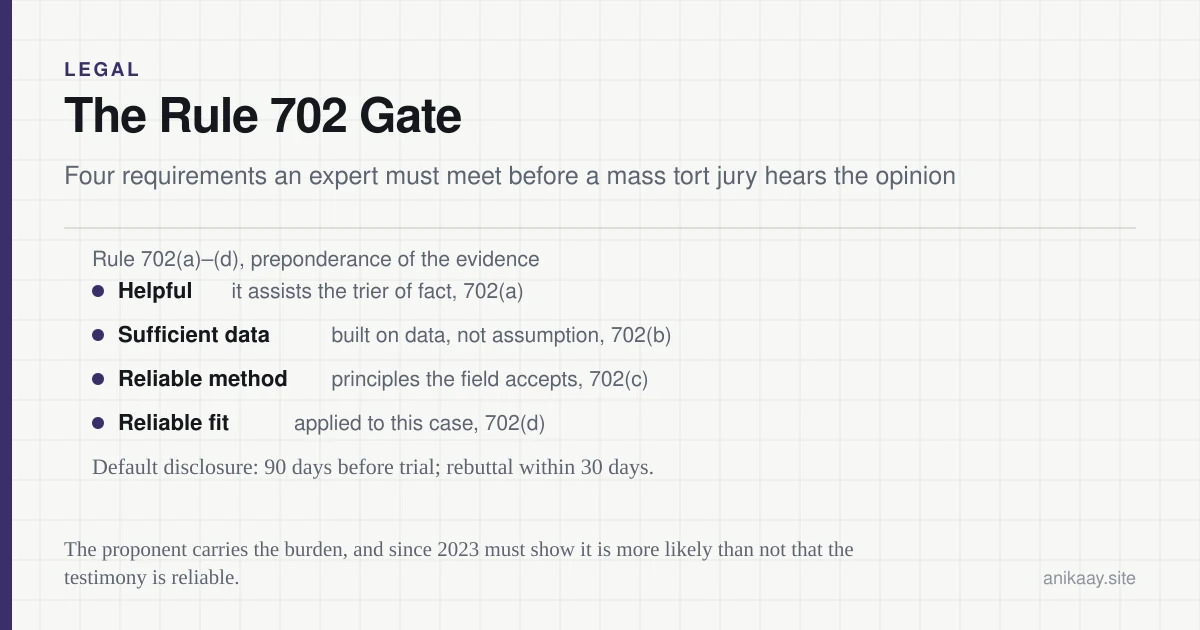
Since the 2023 amendment, Rule 702 reads as one threshold and four requirements. A witness qualified as an expert may testify in the form of an opinion or otherwise if the proponent demonstrates to the court that it is more likely than not that:
| Requirement | Rule 702 subdivision | The question the judge asks |
|---|---|---|
| Helpfulness | (a) | Will this knowledge help the trier of fact understand the evidence or determine a fact in issue? |
| Sufficient facts or data | (b) | Is the opinion built on data, or on assumption? |
| Reliable principles and methods | (c) | Are the underlying principles and methods reliable? |
| Reliable application | (d) | Were those principles and methods applied reliably to this case? |
Subdivision (d) is the one most often overlooked, and the 2023 Advisory Committee note singles out forensic experts in civil cases: an expert “should avoid assertions of absolute or one hundred percent certainty—or to a reasonable degree of scientific certainty—if the methodology is subjective and thus potentially subject to error.” A method with a meaningful error rate does not become an infallible one because an expert testifies about it.
Why the burden matters
The proponent carries it, and the standard is preponderance of the evidence under Rule 104(a). The 2023 amendment added those words to the rule text because, as the Advisory Committee note records, many courts had held that the sufficiency of an expert’s basis and the application of the methodology were questions of weight for the jury rather than questions of admissibility for the judge. The Committee called those rulings an incorrect application of Rules 702 and 104(a).
The same note draws a line the motion turns on. If the court finds it more likely than not that an expert has a sufficient basis for the opinion, then an attack on that basis becomes a question of weight — but only after the threshold is met. The proponent does not have to prove the opinion is correct, only that it is reliable. Two qualified experts who disagree on a contested fact can both testify; the jury decides whom to credit.
The reliability factors courts apply
Daubert listed a non-exclusive checklist, and the 2000 Committee note reproduced it. The rule deliberately does not codify them, and no single factor is dispositive.
- Testability — whether the theory can be challenged in an objective sense.
- Peer review and publication — whether the technique appears in the literature.
- Known or potential error rate — what the method gets wrong, and how often.
- Standards and controls — whether the field maintains them.
- General acceptance — whether the relevant community accepts the theory.
The Advisory Committee note also records five further considerations that courts have used: whether the expert’s work grew out of research independent of the litigation; whether the expert has unjustifiably extrapolated, citing General Electric Co. v. Joiner, 522 U.S. 136, 146 (1997), on “too great an analytical gap between the data and the opinion proffered”; whether the expert accounted for obvious alternative causes; whether the expert is working at the same level of rigor as in regular professional work outside paid litigation consulting; and whether the claimed field even reaches reliable results for the kind of opinion offered. Kumho Tire Co. v. Carmichael, 119 S.Ct. 1167 (1999), established that the gatekeeping function applies to non-scientific experts too, subject to the “particular circumstances of the particular case.”
What has to be disclosed, and when
A Daubert challenge is fought on the expert report, so the disclosure rules decide the battleground. Rule 26(a)(2)(D) provides two default deadlines where the court has not ordered otherwise: 90 days before the date set for trial or for the case to be ready for trial, and 30 days after the other party’s disclosure for rebuttal testimony directed at the same subject matter.
The written report required of a retained or specially employed expert must contain:
- a complete statement of all opinions the witness will express, and the basis and reasons for them;
- the facts or data considered in forming them;
- any exhibits used to summarize or support them;
- the witness’s qualifications, including a list of all publications authored in the previous 10 years;
- a list of all other cases in which the expert testified in the previous 4 years;
- a statement of the compensation paid for the study and testimony.
That list of prior testimony is itself a Daubert exhibit. A methodology defended in one docket and attacked in the next is a normal feature of a mass tort docket, where the same causal question is litigated across thousands of claims. Discovery in these cases is governed by the protocols described in how discovery works in a mass tort, and the phase a claim sits in is set out in how a mass tort claim moves.
What the court can do
The usual outcomes are exclusion, limitation, or admission. A court can bar a specific opinion while admitting the rest of the report, which is common where the causation opinion fails but the damages or standard-of-care opinion stands on its own. The court cannot let a party bypass the screen, and where the expert was never disclosed, Rule 37(c)(1) supplies a separate route: a party that fails to identify a witness as Rule 26(a) or (e) requires “is not allowed to use that information or witness to supply evidence on a motion, at a hearing, or at a trial, unless the failure was substantially justified or is harmless.”
Where it sits among the pretrial steps
A mass tort has several screens, and they are easy to confuse because each asks a different question.
A Rule 12(b)(6) motion to dismiss attacks the complaint as written, with no outside evidence. It is covered in the motion to dismiss explainer.
A Lone Pine order asks each plaintiff to attach evidence of exposure, injury and a preliminary causal link before discovery opens. It is a case management tool of the judge managing the docket, not a party motion, and it is described in what a Lone Pine order is.
A Daubert motion goes at the expert. It does not attack the claim’s existence; it attacks the admissibility of the opinion that would prove it.
A Rule 56 summary judgment motion asks whether there is no genuine dispute of any material fact and the law entitles judgment, tested against the discovery record. It is covered in the Rule 56 explainer, and it frequently follows a successful Daubert motion, because a claim left without a causation expert is a claim with no admissible proof of causation.
Because MDL centralization means thousands of claims moving through one docket, a successful exclusion can have an effect far beyond the single case in front of the judge. That is one reason the surrounding machinery matters: an MDL coordinates cases without consolidating them, which why mass torts are not class actions sets out.
Frequently asked questions
What is a Daubert motion? A Daubert motion is a motion asking the court to exclude, or to limit, expert testimony that does not meet Federal Rule of Evidence 702. It is not a separate rule of its own: it is the name courts use for a Rule 702 challenge, after Daubert v. Merrell Dow Pharmaceuticals, Inc., 509 U.S. 579 (1993), the Supreme Court decision that made the trial judge a gatekeeper of expert reliability. The motion is aimed at the evidence, not at the complaint, so it cannot be filed on the pleadings alone.
What must an expert prove under Rule 702? Four things, and since the 2023 amendment to the rule the proponent must show it is more likely than not that the testimony meets them. The expert must be qualified by knowledge, skill, experience, training or education; the testimony must help the trier of fact understand the evidence or determine a fact in issue; it must be based on sufficient facts or data; it must be the product of reliable principles and methods; and the opinion must reflect a reliable application of those principles and methods to the facts of the case. Those are subdivisions (a) through (d) of Rule 702.
Who carries the burden on a Daubert motion? The party offering the expert carries it. Rule 702 puts the duty on the proponent to demonstrate admissibility, and the 2023 amendment added the express words “more likely than not,” applying the preponderance standard of Rule 104(a) to the reliability requirements in (b), (c) and (d). That matters because many courts had been treating sufficiency of an expert’s basis as a question of weight for the jury. The Advisory Committee note is explicit that those rulings were an incorrect application of Rules 702 and 104(a).
What happens if the court grants a Daubert motion? The court can exclude the testimony entirely, limit it to a narrower question, or exclude specified opinions within it. A court can also strike the designation of the expert under Federal Rule of Civil Procedure 37(c)(1), which bars a party from using an information or witness that Rule 26(a) or (e) required it to disclose, unless the failure was substantially justified or is harmless. In a mass tort, excluding the causation expert usually leaves the plaintiff with a records-only case, which is why these motions are filed early.
When does a party have to disclose its expert? Rule 26(a)(2)(D) sets two default deadlines if the court has not ordered otherwise: at least 90 days before the date set for trial or for the case to be ready for trial, and, for testimony intended solely to contradict or rebut the other side’s expert, within 30 days after that party’s disclosure. The written report required of a retained expert must contain a complete statement of the opinions to be expressed, the facts and data considered, the exhibits, the expert’s qualifications including publications from the previous 10 years, a list of cases in which the expert testified in the previous 4 years, and a statement of compensation.
Does a Daubert motion decide whether my claim has merit? No, and no site or rule can decide that for you. A Daubert motion is about the admissibility of one witness’s opinion, not about the value of an injury, the strength of an exposure history or the prospects of a case. Whether a claim is worth pursuing is a question for a lawyer who can review your medical records, your exposure history and the discovery schedule in the docket your claim is in.
Where the primary sources are
- Federal Rule of Evidence 702 — the rule text as amended in 2023, with the Committee
Notes on the 2000, 2011 and 2023 amendments, at
law.cornell.edu/rules/fre/rule_702 - Federal Rule of Civil Procedure 26(a)(2) — disclosure of expert testimony, the contents
of the written report, and the 90-day and 30-day default deadlines, at
law.cornell.edu/rules/frcp/rule_26 - Federal Rule of Civil Procedure 37(c)(1) — preclusion of information and witnesses not
disclosed as required, at
law.cornell.edu/rules/frcp/rule_37 - Federal Rule of Evidence 104(a) — the preponderance standard governing preliminary admissibility determinations, cross-referenced by the 2023 note to Rule 702
- Daubert v. Merrell Dow Pharmaceuticals, Inc., 509 U.S. 579 (1993) — the gatekeeping decision and the reliability factors, as reproduced in the 2000 Committee Note
- Kumho Tire Co. v. Carmichael, 119 S.Ct. 1167 (1999) — gatekeeping applies to non-scientific expert testimony
- General Electric Co. v. Joiner, 522 U.S. 136 (1997) — the “analytical gap” between data and opinion, cited in the 2000 Committee Note
Rule text changes. Check the current version of Rule 702 and your own docket’s scheduling orders before relying on a particular standard or deadline.
This is not legal advice
This describes how expert evidence is screened. It cannot tell you whether you have a claim, whether your case is progressing, or what deadline applies to your own file. Only a lawyer reviewing your records and your docket can do that.
Topics
Legal
primary sources behind this article
01What this matter is made of
- Question
- daubert motion mass tort
- what this article answers
- Sources
- 0
- primary sources cited
- Market
- United States
- the edition this was written for
- Questions answered
- 6
- in the FAQ below
02Pending actions across the largest multidistrict dockets
Bar chart of pending actions. MDL 2738 leads with 69,340 pending actions. The axis is logarithmic.
Logarithmic scale. A linear bar would hide every docket below 8,424 actions entirely. The 8.2× spread is real; the axis is stretched so you can see it.
Source: JPML multidistrict litigation report, 2026-10-01.
03How a mass tort case reaches this point
- Claims filedindividual actions in the district courts
- MDL formedconsolidated for pretrial
- Discovery and motionsthe record this article reports
- Resolutionsettlement or ruling
Frequently asked questions
What is a Daubert motion?
A Daubert motion is a motion asking the court to exclude, or to limit, expert testimony that does not meet Federal Rule of Evidence 702. It is not a separate rule of its own: it is the name courts use for a Rule 702 challenge, after Daubert v. Merrell Dow Pharmaceuticals, Inc., 509 U.S. 579 (1993), the Supreme Court decision that made the trial judge a gatekeeper of expert reliability. The motion is aimed at the evidence, not at the complaint, so it cannot be filed on the pleadings alone.
What must an expert prove under Rule 702?
Four things, and since the 2023 amendment to the rule the proponent must show it is more likely than not that the testimony meets them. The expert must be qualified by knowledge, skill, experience, training or education; the testimony must help the trier of fact understand the evidence or determine a fact in issue; it must be based on sufficient facts or data; it must be the product of reliable principles and methods; and the opinion must reflect a reliable application of those principles and methods to the facts of the case. Those are subdivisions (a) through (d) of Rule 702.
Who carries the burden on a Daubert motion?
The party offering the expert carries it. Rule 702 puts the duty on the proponent to demonstrate admissibility, and the 2023 amendment added the express words "more likely than not," applying the preponderance standard of Rule 104(a) to the reliability requirements in (b), (c) and (d). That matters because many courts had been treating sufficiency of an expert's basis as a question of weight for the jury. The Advisory Committee note is explicit that those rulings were an incorrect application of Rules 702 and 104(a).
What happens if the court grants a Daubert motion?
The court can exclude the testimony entirely, limit it to a narrower question, or exclude specified opinions within it. A court can also strike the designation of the expert under Federal Rule of Civil Procedure 37(c)(1), which bars a party from using an information or witness that Rule 26(a) or (e) required it to disclose, unless the failure was substantially justified or is harmless. In a mass tort, excluding the causation expert usually leaves the plaintiff with a records-only case, which is why these motions are filed early.
When does a party have to disclose its expert?
Rule 26(a)(2)(D) sets two default deadlines if the court has not ordered otherwise: at least 90 days before the date set for trial or for the case to be ready for trial, and, for testimony intended solely to contradict or rebut the other side's expert, within 30 days after that party's disclosure. The written report required of a retained expert must contain a complete statement of the opinions to be expressed, the facts and data considered, the exhibits, the expert's qualifications including publications from the previous 10 years, a list of cases in which the expert testified in the previous 4 years, and a statement of compensation.
Does a Daubert motion decide whether my claim has merit?
No, and no site or rule can decide that for you. A Daubert motion is about the admissibility of one witness's opinion, not about the value of an injury, the strength of an exposure history or the prospects of a case. Whether a claim is worth pursuing is a question for a lawyer who can review your medical records, your exposure history and the discovery schedule in the docket your claim is in.
Ask about this case
What Is a Daubert Motion in Mass Tort Litigation?