What Is a Lone Pine Order in Mass Tort Litigation?
A Lone Pine order is a case management order that makes a mass tort plaintiff show basic proof of exposure and causation before discovery opens. It is the cheapest, earliest filter an MDL court has.
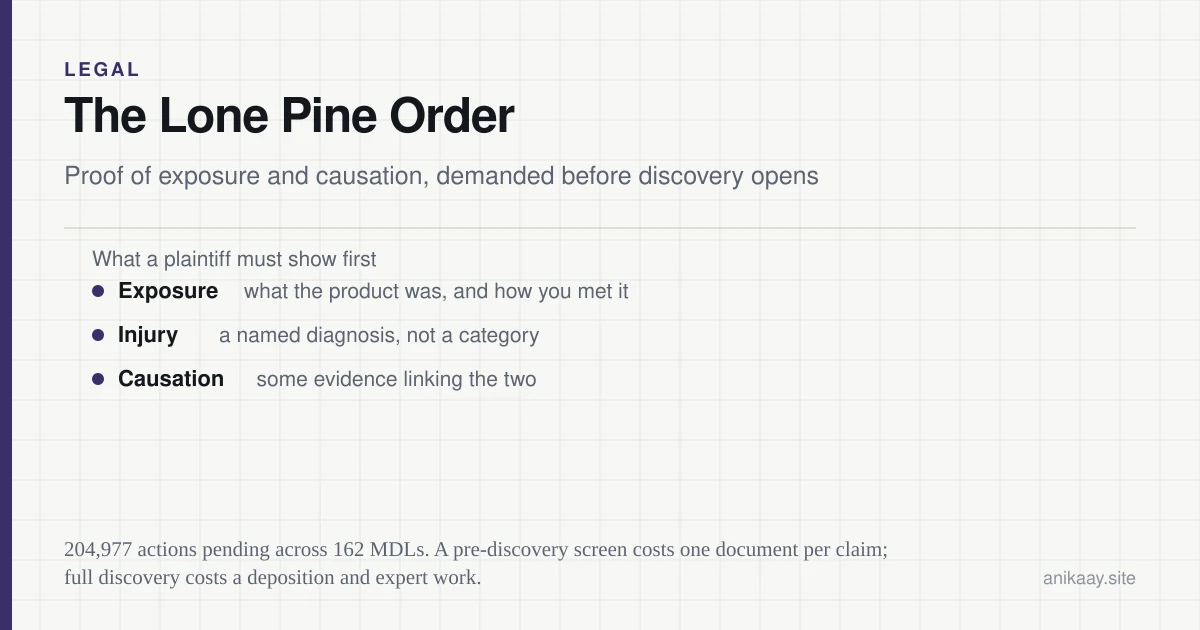
A Lone Pine order is a case management order, most often used in mass tort litigation, that requires each plaintiff to produce some preliminary evidence before full discovery opens. It typically asks the plaintiff to identify the product and exposure, name the injury, and show a prima facie link between the two. Claims that cannot meet that threshold are dismissed or held in abeyance without the cost of full discovery.
The name comes from Lore v. Lone Pine Corp., 1986 WL 637507 (N.J. Super. Ct. Law Div. Nov. 18, 1986). The Fifth Circuit later gave the category its standard description in Steering Committee of the Continental Gulf Lines v. Exxon Mobil Corp., 461 F.3d 598, 604 n.2 (5th Cir. 2006), calling them “pre-discovery orders designed to handle the complex issues and potential burdens on defendants and the court in mass tort litigation.”
What a Lone Pine order actually requires
The elements are consistent across the dockets that use the order, though wording varies.
Exposure. The plaintiff must identify what the defendant made or sold, and say how they came into contact with it. For a drug, that usually means a name, a manufacturer, and the dates of the prescriptions. For a chemical or a workplace exposure, it usually means the substance, the employer or site, and the period of exposure.
Injury. The plaintiff must specify the injury claimed, not a category of injury. “I was sick” is not an injury. A named diagnosis with the date of diagnosis is what the order expects.
Causation. Some showing connects the exposure to the injury. This is the element that carries the weight, because it is the one that requires evidence rather than narrative. Courts generally accept a range of proof here at this stage — a treating physician’s records, an occupational medicine record, a diagnosis listing the exposure as a risk factor — and leave the contest for expert testimony later.
The threshold is deliberately set between two stages readers already know. A complaint must merely state a plausible claim to survive a motion to dismiss; a party moving for summary judgment must prove its case. A Lone Pine order sits between the two.
Why an MDL court issues one
The reason is arithmetic. As of the JPML report dated October 1, 2026:
| Measure (JPML report, October 1, 2026) | Figure |
|---|---|
| Active MDLs | 162 |
| Actions pending across all MDLs | 204,977 |
| Actions historically filed across all MDLs | 717,525 |
| MDLs with 1,000 or more pending actions | 21 |
| MDLs with between 1 and 999 pending actions | 136 |
| MDLs with no pending actions | 5 |
Discovery is priced per claimant. If a docket has tens of thousands of plaintiffs and each one generates document requests, depositions and expert work, the discovery budget consumes everything else. A pre-discovery screen moves the cost from the discovery phase, where it is multiplied, to the pleadings phase, where one document per claimant settles the question.
Courts also use the showings for a second purpose. What a plaintiff produced to clear the Lone Pine threshold is exactly what a Daubert challenge or a Rule 56 motion will later attack. Building the record once and reusing it is efficient case management, and it is why the Fifth Circuit’s formula calls them a foundation for dispositive motions rather than merely a cost-saving screen.
The four rationales usually stated
Courts that enter these orders give reasons that recur.
Weeding out meritless claims. Some filed claims are filed without a plausible product link at all, through mass marketing, duplicate docket entries, or a misunderstanding of what a claim requires. Removing them before discovery protects the court’s docket time.
Narrowing and focusing discovery. Once the claims that survive are known, discovery can be aimed at the real causal questions instead of every claimant’s full history.
Laying a foundation for dispositive motions. The causation evidence assembled at this stage supports later expert and summary judgment practice.
Giving both sides a better settlement position. A docket where every claim has a documented product link is a docket where value can be reasoned about rather than guessed at.
These rationales are why the order survives the objection that a plaintiff has not yet had its day in court. The answer is that the court is not deciding the case; it is deciding what is worth trying to develop, and it is saying so in advance, on the record, before anyone spends money.
Can a claim be dismissed for failing one?
Yes. A court that has stated what it requires and given a deadline, and received nothing, can dismiss. The two features that keep the order fair in practice are the notice and the opportunity to cure. The order tells a plaintiff in advance exactly what will be measured, which is what distinguishes it from a dismissal that surprises the plaintiff after the fact. And courts commonly distinguish a claim that produced nothing from one that produced a deficient showing; the second frequently gets a second chance, sometimes after a meet and confer, and often with a reduced but adequate showing.
Two consequences are worth being precise about. First, a dismissal under a Lone Pine order can be with prejudice, meaning the claim cannot be refiled, or without prejudice. Second, the order does not apply uniformly — courts issue modified orders, and in some dockets the burden is staged, with a lighter showing early and a fuller one before trial.
Where it sits against the other pretrial steps
There are three pre-discovery screens in a federal mass tort, and they are easy to confuse.
A motion to dismiss under Rule 12(b)(6) attacks the complaint as written. No outside evidence is considered. It tests whether the claim is legally stated, not whether it is true. The motion to dismiss explainer covers that stage, including the four grounds a defendant can raise.
A Lone Pine order applies after the pleadings and asks for evidence. It is issued by the judge managing the docket rather than motioned by a party, and its threshold is a showing rather than a pleading.
A motion for summary judgment under Rule 56 comes much later, usually after discovery has narrowed the issues, and requires the moving party to prove its case with admissible evidence and to show that no genuine dispute of material fact exists. The Rule 56 explainer covers that stage.
The order is also distinct from the alternative structures an MDL court might use instead — inactive docket lists, census orders, plaintiff fact sheets and short-form complaints. Why mass torts are not class actions explains what the litigation is not, and where these case management tools fit in a structure that is not a class.
Discovery, once a claim clears the order, runs under a master protocol with common fact depositions. That phase is covered in how discovery works in a mass tort.
Frequently asked questions
What is a Lone Pine order? A Lone Pine order is a case management order, most often used in mass tort litigation, that requires each plaintiff to produce some preliminary evidence before full discovery opens. It typically asks the plaintiff to identify the product and exposure, name the injury, and show a prima facie link between the two. Claims that cannot meet the threshold are dismissed or held in abeyance without the cost of full discovery. The name comes from Lore v. Lone Pine Corp., 1986 WL 637507 (N.J. Super. Ct. Law Div. Nov. 18, 1986), and the Fifth Circuit has described such orders as “pre-discovery orders designed to handle the complex issues and potential burdens on defendants and the court in mass tort litigation.”
What must a plaintiff show to satisfy a Lone Pine order? Ordinarily three things: that the plaintiff was exposed to the defendant’s product or its predecessor, that the plaintiff suffered a specific identified injury, and that there is at least some evidence connecting that exposure to that injury. The standard sits above the pleading stage, where a complaint only has to state a plausible claim, and below the summary judgment stage, where a party has to prove the case. Precise elements vary by court, so the order itself is the governing document.
Can a mass tort claim be dismissed for failing a Lone Pine order? Yes, that is one of the main purposes of the order. A court that has put a plaintiff on notice of what it must produce, and given a deadline to produce it, can dismiss the claim with prejudice or without prejudice when nothing is produced. Because the notice is explicit, courts usually allow an opportunity to amend or to cure, and a plaintiff who supplied a deficient showing rather than none at all is often given a second chance. Pre-discovery orders are also a common basis for later Daubert or summary judgment motions, which is why the showing is built to be usable later.
How is a Lone Pine order different from a motion to dismiss? A motion to dismiss under Rule 12(b)(6) attacks the complaint as written, and no outside evidence is allowed. A Lone Pine order applies after the pleadings and asks the plaintiff to attach evidence to the claim. It also differs from a motion for summary judgment under Rule 56, which comes much later and requires the party to prove its case with admissible evidence. The Lone Pine order sits in the gap: it is cheaper than both, and it is issued by the judge managing the docket rather than by a party motioning.
Does every mass tort have Lone Pine orders? No. They are discretionary case management tools, and a court with a smaller docket, or one with a well-established settlement structure, may not use them at all. The orders are most common where the number of pending claims makes full discovery impractical. As of the JPML report dated October 1, 2026, 162 MDLs were active with 204,977 actions pending, five of which accounted for 131,713 of those actions, and orders of this kind are one of the tools used to make dockets of that size manageable.
Does a Lone Pine order decide whether my claim has merit? No, and no site or order can do that for you. A Lone Pine order is a low threshold aimed at filtering out claims that cannot support a product link, not an assessment of the value of an injury or the strength of a case. Whether a particular claim is worth pursuing is a question for a lawyer who can look at your medical records, your exposure history and the law of the state where you filed.
Where the primary sources are
- Lore v. Lone Pine Corp., No. L-33606-85, 1986 WL 637507 (N.J. Super. Ct. Law Div. Nov. 18, 1986) — the case the order is named for
- Steering Committee of the Continental Gulf Lines v. Exxon Mobil Corp., 461 F.3d 598, 604 n.2 (5th Cir. 2006) — the Fifth Circuit’s definition of the order and its stated rationales
- Federal Rule of Civil Procedure 16 — pretrial conferences and case management orders, the
authority courts most often cite alongside their inherent docket management power, at
law.cornell.edu/rules/frcp/rule_16 - Federal Rule of Civil Procedure 26(b)(1) — the proportionality limits on discovery, which
the order is a case management answer to, at
law.cornell.edu/rules/frcp/rule_26 - 28 U.S.C. § 1407(a) — the authority for MDL centralization and for the broad case management latitude that makes such orders possible
- Judicial Panel on Multidistrict Litigation, Pending MDLs report dated October 1, 2026,
jpml.uscourts.gov— the source for every count in the table above
Orders and docket counts change. Check the specific order in your own file and the current JPML report before relying on a particular requirement or figure.
This is not legal advice
This describes how a case management order works. It cannot tell you whether you have a claim, whether your case is progressing, or what deadline applies to your own file. Only a lawyer reviewing your records can do that.
Topics
Legal
primary sources behind this article
01What this matter is made of
- Question
- lone pine order
- what this article answers
- Sources
- 0
- primary sources cited
- Market
- United States
- the edition this was written for
- Questions answered
- 6
- in the FAQ below
02Pending actions across the largest multidistrict dockets
Bar chart of pending actions. MDL 2738 leads with 69,340 pending actions. The axis is logarithmic.
Logarithmic scale. A linear bar would hide every docket below 8,424 actions entirely. The 8.2× spread is real; the axis is stretched so you can see it.
Source: JPML multidistrict litigation report, 2026-10-01.
03How a mass tort case reaches this point
- Claims filedindividual actions in the district courts
- MDL formedconsolidated for pretrial
- Discovery and motionsthe record this article reports
- Resolutionsettlement or ruling
Frequently asked questions
What is a Lone Pine order?
A Lone Pine order is a case management order, most often used in mass tort litigation, that requires each plaintiff to produce some preliminary evidence before full discovery opens. It typically asks the plaintiff to identify the product and exposure, name the injury, and show a prima facie link between the two. Claims that cannot meet the threshold are dismissed or held in abeyance without the cost of full discovery. The name comes from Lore v. Lone Pine Corp., 1986 WL 637507 (N.J. Super. Ct. Law Div. Nov. 18, 1986), and the Fifth Circuit has described such orders as "pre-discovery orders designed to handle the complex issues and potential burdens on defendants and the court in mass tort litigation."
What must a plaintiff show to satisfy a Lone Pine order?
Ordinarily three things: that the plaintiff was exposed to the defendant''s product or its predecessor, that the plaintiff suffered a specific identified injury, and that there is at least some evidence connecting that exposure to that injury. The standard sits above the pleading stage, where a complaint only has to state a plausible claim, and below the summary judgment stage, where a party has to prove the case. Precise elements vary by court, so the order itself is the governing document.
Can a mass tort claim be dismissed for failing a Lone Pine order?
Yes, that is one of the main purposes of the order. A court that has put a plaintiff on notice of what it must produce, and given a deadline to produce it, can dismiss the claim with prejudice or without prejudice when nothing is produced. Because the notice is explicit, courts usually allow an opportunity to amend or to cure, and a plaintiff who supplied a deficient showing rather than none at all is often given a second chance. Pre-discovery orders are also a common basis for later Daubert or summary judgment motions, which is why the showing is built to be usable later.
How is a Lone Pine order different from a motion to dismiss?
A motion to dismiss under Rule 12(b)(6) attacks the complaint as written, and no outside evidence is allowed. A Lone Pine order applies after the pleadings and asks the plaintiff to attach evidence to the claim. It also differs from a motion for summary judgment under Rule 56, which comes much later and requires the party to prove its case with admissible evidence. The Lone Pine order sits in the gap: it is cheaper than both, and it is issued by the judge managing the docket rather than by a party motioning.
Does every mass tort have Lone Pine orders?
No. They are discretionary case management tools, and a court with a smaller docket, or one with a well-established settlement structure, may not use them at all. The orders are most common where the number of pending claims makes full discovery impractical. As of the JPML report dated October 1, 2026, 162 MDLs were active with 204,977 actions pending, five of which accounted for 131,713 of those actions, and orders of this kind are one of the tools used to make dockets of that size manageable.
Does a Lone Pine order decide whether my claim has merit?
No, and no site or order can do that for you. A Lone Pine order is a low threshold aimed at filtering out claims that cannot support a product link, not an assessment of the value of an injury or the strength of a case. Whether a particular claim is worth pursuing is a question for a lawyer who can look at your medical records, your exposure history and the law of the state where you filed.
Ask about this case
What Is a Lone Pine Order in Mass Tort Litigation?